


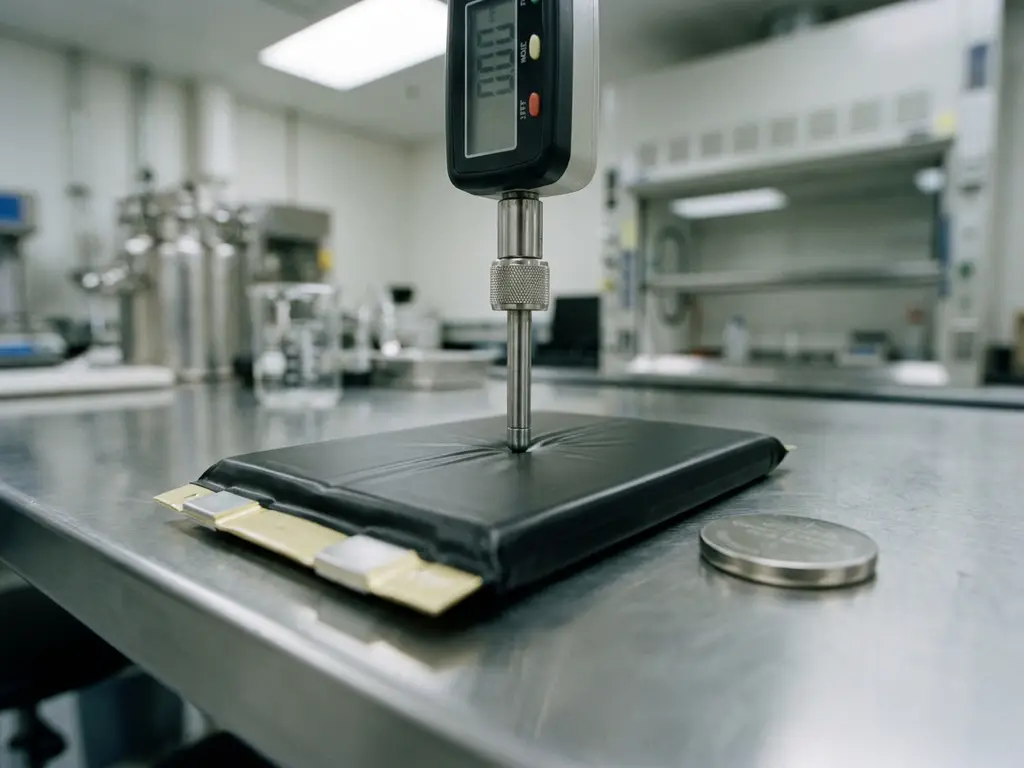
Pouch cells and coin cells serve different purposes in battery research, and the force conditions applied to each format have a direct and measurable effect on electrochemical performance. Understanding what force requirements each format demands is not a minor procedural detail — it is a fundamental variable in experimental design. This article builds from the basic distinctions between the two formats through to practical guidance on constructing a force-aware test strategy that produces reproducible, publication-quality data.
What are pouch cells and coin cells in battery research?
Pouch cells and coin cells are two of the most widely used formats in laboratory-scale battery research, each suited to different experimental objectives and operating conditions.
A coin cell is a small, rigid, stainless-steel enclosure — typically 20 mm in diameter — in which electrode discs, a separator, and electrolyte are stacked and crimped under a defined pressure. The crimping process itself applies a fixed mechanical constraint to the cell stack. Coin cells are widely used for half-cell testing of electrode materials, where the primary goal is measuring specific capacity (mAh/g or mAh/cm²), coulombic efficiency, and rate capability under controlled electrochemical conditions.
A pouch cell uses a flexible laminated aluminium foil casing that is heat-sealed around the electrode stack. Because the casing offers no inherent mechanical rigidity, the stack is free to expand and contract during cycling — unless external force is applied deliberately. Pouch cells are commonly used with larger electrode areas and are closer in geometry to commercial cell designs, making them relevant for research that bridges laboratory findings and scalable manufacturing.
Both formats are used extensively in research on lithium-ion and next-generation battery chemistries, including solid-state battery testing, where mechanical constraints take on even greater significance.
How force affects electrochemical performance in each format
Mechanical force influences electrochemical performance through its effect on interfacial contact, electrolyte distribution, and electrode morphology — all of which change during cycling as electrodes expand and contract with lithiation and delithiation.
Force effects in coin cells
In coin cells, the crimping force sets the initial stack pressure. If this pressure is too low, poor contact between the electrode and separator leads to uneven current distribution and higher contact resistance. If it is too high, the separator can be damaged or the electrode compressed in ways that alter its porous structure and accessible surface area. The crimping force is therefore a fixed parameter that must be controlled consistently across experiments to ensure reproducibility.
For example, two coin cells assembled from the same electrode material but crimped at different forces can produce measurably different capacity values and coulombic efficiency figures — not because the material differs, but because the interfacial conditions differ.
Force effects in pouch cells
In pouch cells, the absence of a rigid casing means that electrode breathing — the volumetric change associated with charge and discharge — directly affects stack thickness. Without external constraint, this breathing can cause delamination between layers, loss of electrolyte contact, and progressive degradation of the solid electrolyte interphase (SEI) layer on the anode. Applying a defined, controlled external pressure stabilises the stack geometry and maintains consistent interfacial contact throughout the cycle life.
In solid-state battery testing, where liquid electrolyte is replaced by a solid ionic conductor, intimate contact between electrode and electrolyte is even more critical. Force requirements in this context are substantially higher and must be maintained actively across the full operating range.
Force requirements: pouch cell vs coin cell compared
The force requirements for pouch cells and coin cells differ in magnitude, application method, and experimental control needs.
- Coin cells: Force is applied once, during assembly, via a crimping tool. Typical stack pressures are in the range of a few hundred kPa, determined by the crimping die geometry and applied load. Once sealed, the internal pressure is fixed and cannot be adjusted during cycling.
- Pouch cells: Force must be applied externally throughout cycling, using a dedicated cell holder or press. The required pressure depends on the electrode chemistry, the electrolyte type, and the degree of volume change expected. For liquid electrolyte systems, moderate pressures in the range of tens to low hundreds of kPa are typical. For solid-state systems, pressures can reach several MPa to ensure adequate solid-solid contact.
- Dynamic vs static force: In pouch cell testing, force can be applied as a fixed (static) load or tracked dynamically to monitor how stack thickness evolves with state of charge. This distinction matters for research into electrode swelling, electrolyte wetting, and mechanical degradation mechanisms.
The key difference is control: coin cell force is a one-time assembly variable, while pouch cell force is an ongoing experimental parameter that requires dedicated hardware to manage and, in many cases, to measure.
Matching cell format and force control to your research goals
Choosing between a pouch cell and a coin cell format is not simply a question of convenience — it should follow directly from the research question being asked.
If the goal is rapid screening of electrode materials for capacity, rate performance, or first-cycle coulombic efficiency, coin cells offer a practical and well-established platform. The force variable is managed at assembly and does not require active monitoring during the experiment. Consistency in crimping procedure is the primary control requirement.
If the goal involves studying volume change, interfacial mechanics, long-term cycle stability, or the behaviour of solid electrolytes under realistic mechanical conditions, pouch cells with defined and controllable external force are the more appropriate choice. Force test cells designed specifically for this purpose — such as the PAT-Cell-Force — allow researchers to set, maintain, and in some configurations measure the pressure applied to the cell stack throughout the experiment.
For solid-state battery testing specifically, the format and force question is inseparable from the experimental design. Solid electrolytes require sustained, uniform pressure to maintain ionic contact across the electrode-electrolyte interface. A test cell that cannot apply and hold the required pressure will produce data that does not reflect the true electrochemical behaviour of the material. The PAT-Cell-Solid is designed specifically for this application.
Common force-related mistakes that compromise test results
Several recurring errors in force management lead to data that is difficult to interpret or impossible to reproduce.
- Inconsistent coin cell crimping: Using a manual crimper without a defined force setting introduces variability between cells assembled by different operators or on different days. This is a common but underappreciated source of scatter in coin cell datasets.
- No external pressure on pouch cells: Testing pouch cells without any external constraint allows the stack to breathe freely. This may seem like a more “natural” condition, but it typically accelerates delamination and produces cycle life data that is not reproducible across different labs or cell holders.
- Applying excessive force to liquid electrolyte cells: Over-constraining a cell with liquid electrolyte can squeeze electrolyte out of the electrode pores, increasing internal resistance and distorting capacity measurements. Force must be matched to the system.
- Ignoring force in solid-state experiments: Treating solid-state cells as if they behave like liquid electrolyte cells — and applying the same low pressures — leads to poor interfacial contact, high overpotential, and apparent capacity values that reflect contact resistance rather than material properties.
- Not recording the applied force: Even when force is applied, failing to document the exact value makes it impossible for others to reproduce the experiment or compare results across studies.
Building a force-aware test strategy for reproducible results
A force-aware test strategy integrates mechanical control as a defined experimental variable from the outset, rather than treating it as an assembly detail.
For coin cell work, this means standardising the crimping process: using a calibrated crimping tool with a fixed force setting, documenting the applied load, and maintaining consistent electrode disc geometry and stack composition. Small changes in stack height — caused by varying electrode thickness or electrolyte volume — alter the effective pressure at a given crimp force, so these parameters should be controlled as tightly as the electrochemical ones.
For pouch cell work, the strategy requires selecting a cell holder or press that can apply a defined, uniform pressure across the electrode area. Where volume change is relevant to the research question, a setup that can measure stack thickness continuously — such as the ECD-4-nano electrochemical dilatometer — provides additional mechanistic insight alongside the electrochemical data.
For solid-state battery testing, the force strategy must account for the higher pressures required and the sensitivity of solid electrolyte contacts to pressure variation. Test cells designed for solid-state work should be capable of applying and sustaining pressures in the MPa range, with geometry that ensures uniform distribution across the electrode face.
Across all formats, the principle is the same: define the force condition before the experiment begins, apply it consistently, and report it alongside the electrochemical data. This transforms force from a background variable into a controlled parameter that supports meaningful comparison between experiments and between laboratories.
How EL-Cell GmbH supports force-controlled battery testing
EL-Cell GmbH designs and manufactures test cells specifically for researchers who need precise mechanical control alongside electrochemical measurement. Our product range addresses the force requirements of both pouch cell and coin cell formats, as well as the more demanding conditions of solid-state battery testing.
Conventional test cells present a significant practical challenge: studies cite an assembly failure rate of around 43% for standard designs. Even experienced builders typically achieve only 4 out of 5 working cells, while less experienced assemblers fall below a 50% success rate. The PAT-Cell-Force and PAT-Cell-Solid from EL-CELL address this directly: their standardised preparation process simplifies assembly to the point where nearly every cell runs without failure.
Several additional limitations of conventional test cells are also worth noting when selecting hardware for force-controlled experiments:
- No integrated force sensing: Conventional cells record only the initial stack pressure. Mechanical settling during cycling can reduce that pressure over time without any indication — a silent source of experimental drift. EL-CELL cells include an integrated force sensor that monitors pressure continuously throughout the experiment. An optional gas pressure sensor can also be added, allowing force changes caused by gas evolution to be separated from purely mechanical ones.
- Inhomogeneous electrode compression: Standard cell designs compress electrode material unevenly. The PAT-Solid-Core insert, used in both the PAT-Cell-Force and PAT-Cell-Solid, uses guided plane-parallel tungsten carbide plungers and a dedicated pressing tool to ensure homogeneous compression across the electrode face.
- Moisture absorption from housing materials: Conventional cells are typically sealed with O-rings and use PEEK housings, which absorb significant moisture and require drying at 120°C under vacuum before use. EL-CELL cells use aluminium seals and glass-metal feedthroughs in place of O-rings, and PPS plastic instead of PEEK. PPS absorbs considerably less moisture, reducing both contamination risk and preparation time.
- Plunger degradation over time: In conventional designs, plungers embed electrode particles during use and must be ground or polished between measurements — a process that gradually alters cell geometry. EL-CELL uses tungsten carbide plungers that withstand high mechanical loads without this type of surface degradation, preserving cell geometry across experiments.
- The PAT-Cell-Force applies a defined, calibrated force to the electrode stack and measures that force continuously throughout cycling, providing a direct record of how stack pressure evolves with state of charge and cycle number.
- The PAT-Cell-Solid is designed for solid-state battery testing and supports the high, sustained pressures required to maintain solid-solid interfacial contact in all-solid-state cell configurations.
- The PAT-Cell-Press enables pouch cell testing under controlled uniaxial pressure, with a defined and reproducible mechanical boundary condition across the full electrode area.
- The ECD-4-nano electrochemical dilatometer quantifies electrode thickness changes with a resolution of better than 5 nm, providing direct measurement of the volume changes that drive force requirements during cycling.
All of these instruments are part of the PAT Series ecosystem and are compatible with our potentiostats, galvanostats, and EL-Software, allowing force and electrochemical data to be recorded in a single, integrated workflow. If you are designing a test strategy around force-controlled cell formats, contact our Application Laboratory to discuss which configuration is appropriate for your experimental requirements.
Comments are closed.