


Prussian white (PW) is considered one of the most promising cathode materials for sodium-ion batteries (SIB), due to its large ion-diffusion channels, facile preparation, and low cost.[1, 2] However, a successful translation of a battery material into a technical cell faces additional challenges. Among these, characterising electrode dilation is essential, as reversible and irreversible expansion of an electrode can influence various safety- and performance-related parameters of the cell.
For PW-based electrodes, in-situ crystallographic studies point towards significant lattice changes during cycling.[3] However, to the best of our knowledge, no study on the direct measurement of the electrochemical dilation of PW-based electrodes in a battery environment is known to literature. In this work, we amend this gap and performed direct measurements of the swelling of a series of PW-based electrodes. We show that these electrodes exhibit a massive reversible swelling upon de-sodiation, which is in accordance with the in-situ X-Ray data.
This study was carried out in collaboration with Litona GmbH, Germany.
Experimental Setup
In this study, we characterised the swelling of a set of four Mn-containing Prussian white electrodes, only differing in areal capacity and therefore in thickness (Table 1). The electrodes were provided by Litona and were used as received. The measurements were carried out using the ECD-4-Nano electrochemical dilatometer[4] (Figure 1), which allows for the direct measurement of the reversible and irreversible swelling of a single electrode during cycling. The cells were cycled with a PAT-Tester-x-8 potentiostat[5] running EL-Software Version 3.1.
For each material, an electrode with an 8 mm diameter was prepared using EL-Cut precision cutting pliers[6]. The electrodes were assembled into an ECD-4 Electrochemical Dilatometer in a half-cell setup. Metallic sodium was used as both counter and reference electrode. After a rest time of 36 hours, the cells were cycled in a climate chamber (25°C) for four cycles with a constant current of C/20 to keep the electrodes close to equilibrium, followed by a CV phase of one hour. The lower and upper cut-off voltages were V₁R, min = 2.5 V and V₁R, max = 3.8 V, respectively.
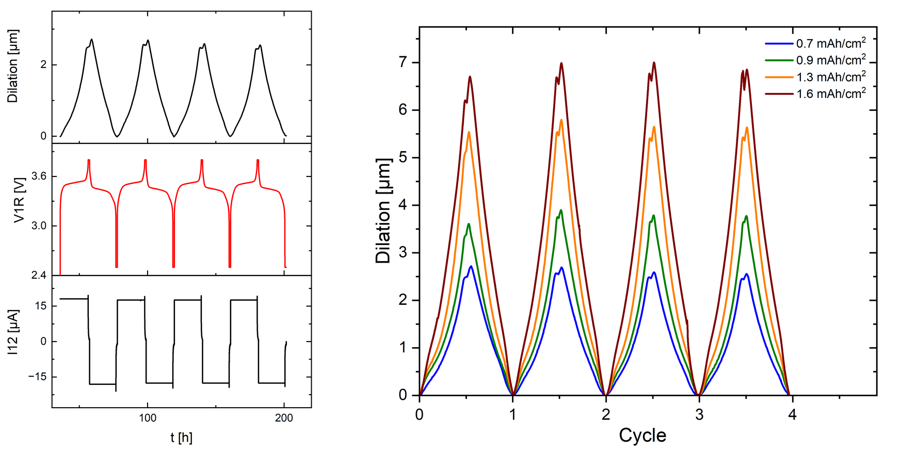
Figure 1, left: Electrochemical data and dilation for the 0.7 mAh/cm2-Sample. Right: Dilation signals of all samples, corrected for baseline and sensor drift, plotted vs SOC.
In Figure 1, left, electrochemical data and the dilation curve are shown for the 0.7 mAh/cm2-sample. This is exemplary, as the data for the other four samples look similar. It can clearly be seen that the dilation curve is periodic and synchronous with both current and potential. It is also noticeable that the dilation is positive on increasing half-cell potential, indicating swelling of the sample upon de-sodiation. In Figure 1, right, the dilation curves of all four samples for the first four circles are plotted against the SOC of the respective cycle. All four dilation curves show the same line shape: monotonous steep flanks with a double dip, resembling the shape of a volcano. Also, the peak heights of the dilation curves increase with increasing capacities of the electrodes. In Table 2, areal capacities, electrode thickness and 2nd cycle dilations are denoted. To evaluate dilation, the height of the second peak (See Figure 2, left) was used since irreversible effects from formation that can usually be seen in the first peak are ignored by this method.
| Table 1: Electrode capacities, thickness, dilation and thickness change | ||||
| Electrode # | Areal Capacity [mAh/cm²] | Thickness w/o foil [µm] | Dilation [µm] | Thickness change [%] |
| A | 0.7 | 52 | 2.7 | 5.2 |
| B | 0.9 | 63 | 3.9 | 6.2 |
| C | 1.3 | 91 | 5.8 | 6.4 |
| D | 1.6 | 125 | 7.0 | 5.6 |
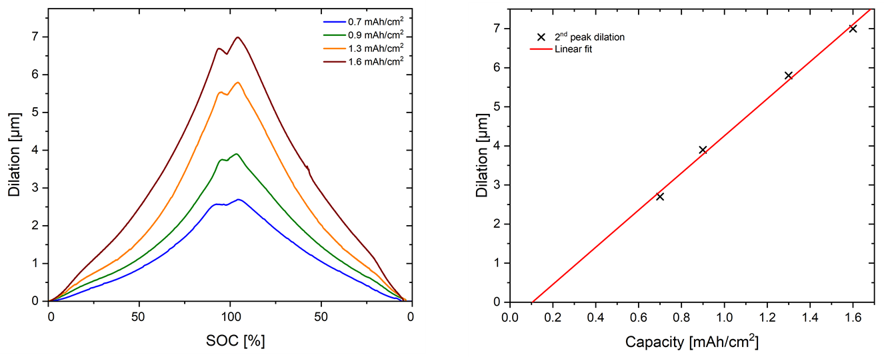
Figure 2, left: Dilation of the second cycle vs. SOC. Right: 2nd-Cycle-Dilation vs. Capacity with linear fit. R2=0.99.
In Figure 2, left, the dilation of the 2nd cycle is plotted. The double-dip feature (volcano crater) is prominent. In Figure 2, right, for each electrode, the magnitudes of the 2nd cycle dilation are plotted against the respective capacities. Additionally, a linear fit was performed on the data with R² = 0.99. A linear correlation between capacity and dilation can be observed, and a slope of 4.7 µm/(mAh/cm²) was determined.
Due to the linear correlation between dilation and capacity/loading, it can be safely assumed that the swelling of the electrodes is due to chemomechanical changes in the active material. The observed dilation curves indicate that desodiation leads to swelling of the material and sodiation to contraction, which is in accordance with findings based on crystallographic studies [3]. It is argued that the loss of sodium from the pores of this material leads to a relaxation of the pores and thus a swelling of the material. In addition, the oxidation of manganese from Mn(II) to Mn(III) leads to a Jahn-Teller distortion, which in turn results in the lengthening of metal-ligand bonds, further adding to the observed swelling of the material.
Conclusion
To the best of our knowledge, this is the first study demonstrating a direct measurement of the electrochemical dilation of a Prussian white material and correlating an observed macroscopic effect to an existing crystallographic study. Also, the magnitude of the observed dilation has an impact on cell design and must be taken into account when the observed material is to be translated into a commercial battery cell.
Literature:
[1]: Sun, Y. et al. (2023). ACS Applied Materials & Interfaces. [DOI:10.1021/acsami.3c08521] (https://doi.org/10.1021/acsami.3c08521)
[2]: Peng, B. et al. (2021). Advanced Materials. [DOI:10.1002/adma.202108384] (https://doi.org/10.1002/adma.202108384)
[3]. Calvelin, T. et al. (2026). ACS Materials Letters. [DOI:10.1021/acsmaterialslett.6c00125] (https://doi.org/10.1021/acsmaterialslett.6c00125)
[4]: EL-Cell, ECD-4-nano
[5]: EL-Cell, PAT-Tester-x-8
[6]: EL-Cell. (n.d.). EL-Cut
–
by Dr Bernhard Bugenhagen (EL-CELL), Dr Michael Sieffert (Litona), Laura Kalder (Litona)
This study was carried out in collaboration with Litona GmbH, Germany.

About the author


Comments are closed.