


For those studying sodium ion batteries, the characterisation of hard carbon materials (HC) in HC/Na half cells is challenging. This is due to a high overpotential typically observed in such cells. This makes it difficult to investigate the plateau region of the HC potential curve, and only the so called “sloping” region of the voltage curve can be accessed. Thus, the measured capacities of the HC are often far below the theoretical capacity of the material. (C. Müller, 2023) (Yuheng Zheng, 2017) In order to obtain accurate data over the full capacity range , it is often necessary to take experimental detours like building half cells with niche electrolyte formulations. As these cell formulations are model systems and not designed with the cathode in mind, the systems are only rarely representative for a technical cell. One potential solution to this problem is the usage of a three-electrode setup.
Using a three-electrode setup can help to avoid the aforementioned pitfalls inherent to half-cell measurements. More specifically, in a three-electrode setup the half-cell potentials are measured current-less and thus without any contributions of overpotentials. This enables to cycle the cell and setting a precise cutoff potential for the HC anode (usually a few millivolts above the plating potential) which allows access to the whole plateau region.
One potential problem with using a three-electrode set up in order to test different HC materials is that full cells traditionally feature an N:P ratio larger than 1, meaning that an amount of anode active material with a higher corresponding capacity than the cathode active material is present in the cell. Consequently, the hard carbon voltage curve is not entirely visualised, as the sodium inventory in the cell is not sufficient to fully sodiate the HC material (Fig 1a). As such, the capacity of the material is not accurately determined, causing incorrect pairing of an anode and a cathode for a sodium-ion battery full cell. In this study, we present a method to reproducibly characterise different HC materials by using an oversized Prussian White (PW) Electrode in a three-electrode setup. We demonstrate that by this method, different HC materials can adequately compared.
This study was carried out in collaboration with Litona GmbH, Germany.
Experimental Setup
In this study, two different hard carbon anode materials are electrochemically characterised in order to determine of the material. A three-electrode PAT-Cell is built with a well characterised Litona GmbH Prussian White cathode, a hard carbon anode of interest, and a separator sleeve with a built in Na reference. It is important that the capacity of the Prussian White electrode is greater than that of the hard carbon electrode, giving an N:P ratio of less than 1. In order to illustrate the problems with a full cell featuring an N:P ratio greater than 1, hard carbon voltage curves with such a set up are shown in Fig. 1a. This does beg the obvious question of what hard carbon capacity to use. It is best to overestimate the capacity value of the anode; in our case we recommend 400 mAh/g. This ensures that the capacity of the hard carbon will stay well below the Prussian White’s, even for high-capacity hard carbons.
Once assembled, the cell is run according to a protocol with two charge/discharge cycles at a rate of C/20. The first charge and discharge cycle allows for the determination of the initial coulombic efficiency, a key characteristic of the hard carbon materials. The second C/20 cycle allows for an accurate determination of the material’s charge and discharge capacities. With these capacity values, accurate electrode pairings can be determined for full cells.
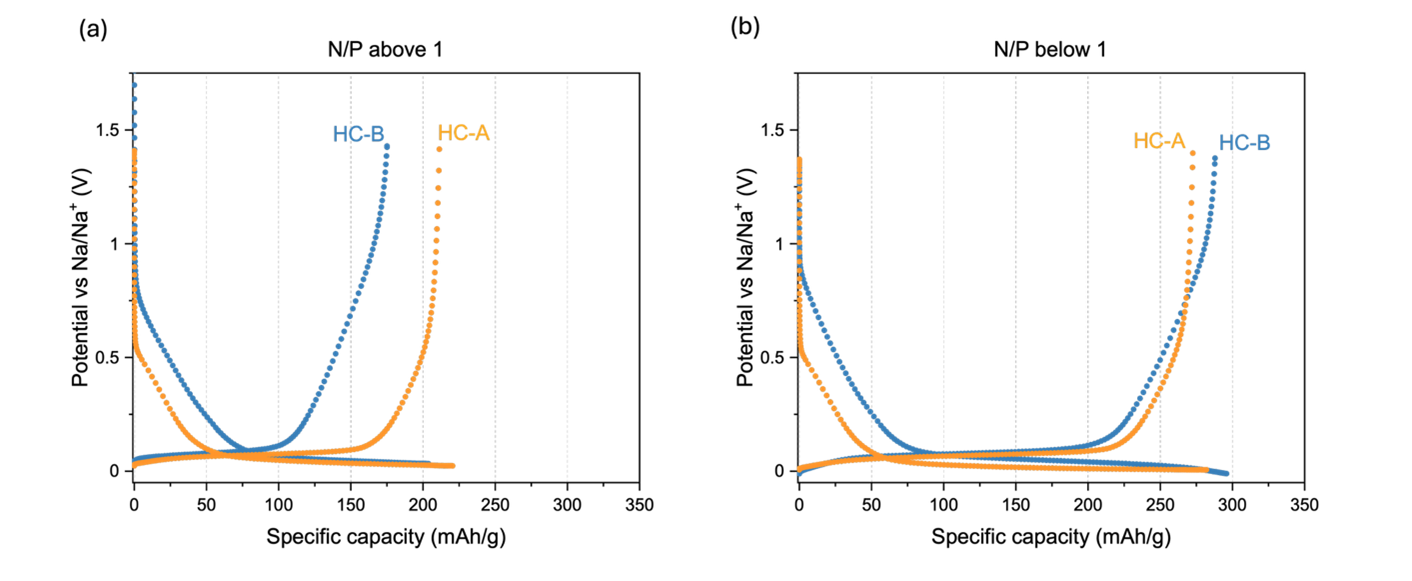
Fig. 1. (a) Second-cycle capacity curves of commercial hard carbon anodes at C/20 with an N:P ratio above 1, in which the cathode capacity is limiting and the hard carbon will not be fully charged with sodium ions. (b) Second-cycle specific capacity curves of commercial hard carbon anodes at C/20 with an N:P ratio below 1, allowing the structure of the hard carbon to be fully filled with sodium ions.
Results and Discussion
For this study, the method described above was used to qualify two different hard carbons in the Litona laboratory (Fig 1b). A large difference in the shape of the anode materials can be seen, with the sloping regions much more prominent in certain samples. Importantly, when comparing Fig. 1a and 1b, it is clearly visible that only by using an N:P ratio below 1, are the voltage curves truly comparable. The line shapes of the different voltage curves indicate different sodium storage mechanisms. For example, the sloping region of the charge-discharge potential profile implies that sodium ions are stored on graphene layer edges and defect sites, while plateau regions typically reflect the filling of micropores. (Xinwei Dou, 2019)
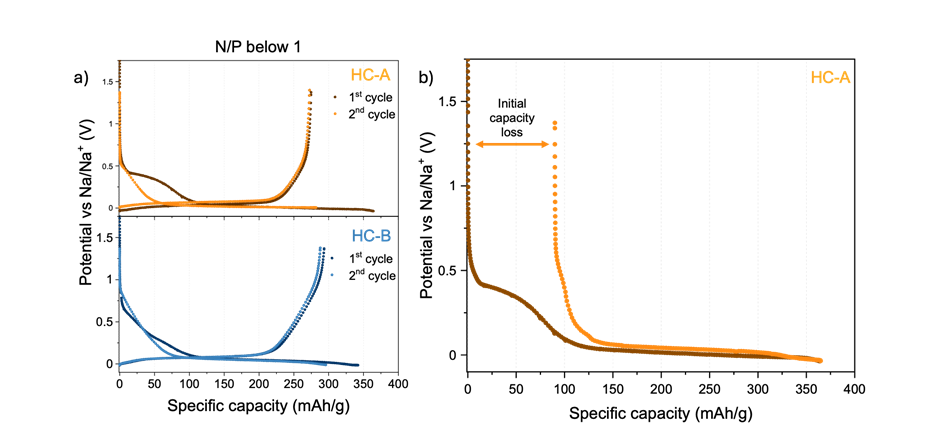
Fig. 2. Coulombic efficiency. (a) First- and second-cycle specific capacity curves of hard carbons A and B. The capacity loss of hard carbon A is greater than that of hard carbon B, resulting in a lower Coulombic efficiency. (b) First-cycle charge-discharge curves of hard carbon A show a capacity loss of almost 100 mAh/g.
The second full cycle allows for the determination of a stable discharge capacity as seen in Fig. 1b, 2a. Thus, it was determined that hard carbon A features a capacity of 282 mAh/g, which is 14 mAh/g less than hard carbon B at 296 mAh/g. Using the parameters derived from these PAT Cells, researchers have ample data for deciding on a hard carbon material for a project.
The first cycle also reveals an accurate value for the initial coulombic efficiencies (ICE) for the two materials. These values are derived from the capacity lost between the first charge cycle and the first discharge cycle (Fig. 2a). These initial efficiencies are highly important to cell manufacturers, as they play a large role in determining the usable capacity of a cell after formation. As seen in Fig. 2b, hard carbon B possesses a higher initial coulombic efficiency, meaning in correctly paired cells, hard carbon B will allow for a larger usable capacity than cells using hard carbon A.
Conclusion
Here we present a method for quick and accurate electrochemical characterisation of different hard carbon materials, using a PAT-Tester-i-16 and PAT-Cells. Using a three-electrode set up allows researchers to bypass the technical difficulties that come with building sodium half cells with hard carbon electrodes. The method allows for the determination of the initial coulombic efficiency as well as the charge and discharge capacities of the hard carbon of interest. This method will be highly useful for researchers of sodium-ion batteries.
Literature:
C. Müller, Z. W.-T. (2023). Influences on Reliable Capacity Measurements of Hard Carbon in Highly Loaded Electrodes. Batteries & Supercaps.
Xinwei Dou, I. H. (2019). Hard carbons for sodium-ion batteries: Structure, analysis, sustainability, and electrochemistry,. Materials Today, .
Yuheng Zheng, Y. W.-S. (2017). A high-performance sodium-ion battery enhanced by macadamia shell derived hard carbon anode. Nano Energy.
–
by Laura Kalder (Litona), Dr Bernhard Bugenhagen (EL-CELL), Dr Michael Sieffert (Litona),
This study was carried out in collaboration with Litona GmbH, Germany.

About the author


Comments are closed.