


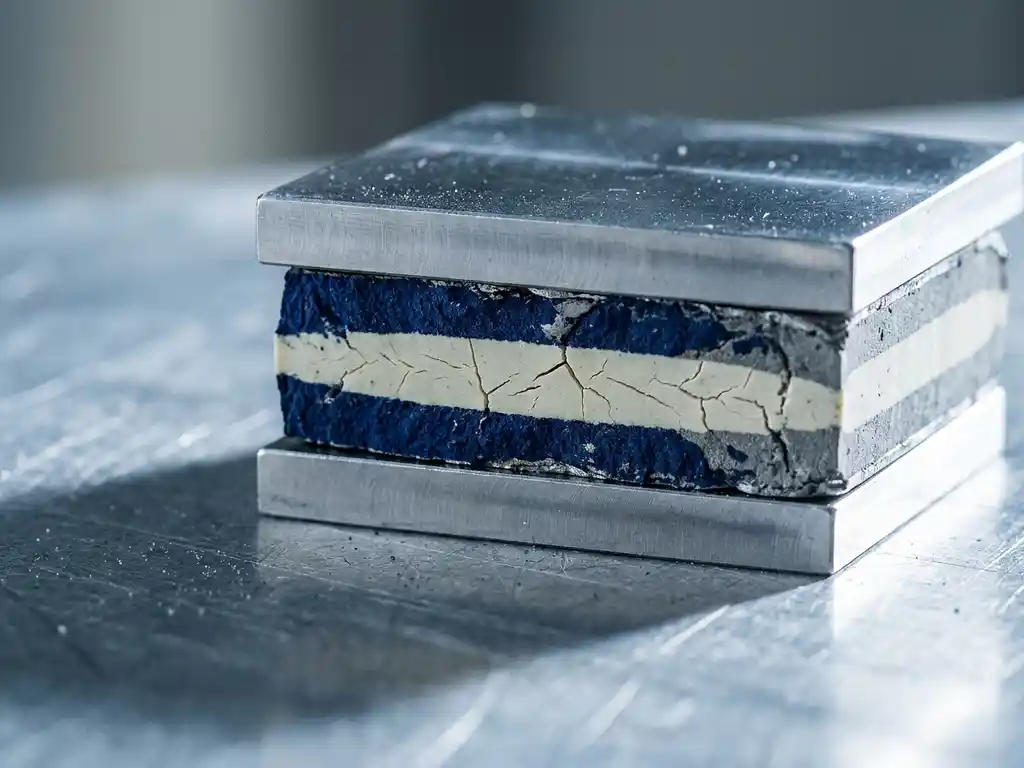
Mechanical stress at solid-state battery (SSB) interfaces is no longer a secondary concern in battery research. As solid electrolytes replace liquid counterparts, the mechanical behaviour of interfaces becomes a primary determinant of cell performance, safety, and longevity. This article builds from the foundations of interfacial stress to the practical methods researchers use to map, interpret, and act on that data — progressing from concept to application in a structured sequence.
What is mechanical stress in solid-state battery interfaces?
Mechanical stress in SSB interfaces refers to the internal forces per unit area that develop at the contact zones between solid electrodes and solid electrolytes during cell operation. Unlike liquid electrolytes, which conform passively to electrode surfaces, solid electrolytes are rigid and cannot accommodate dimensional changes through flow.
These stresses arise from several sources. Volume changes in electrode active materials during lithiation and delithiation generate local expansion and contraction. Differences in thermal expansion coefficients between adjacent layers introduce thermally driven stress during cycling or temperature excursions. Fabrication processes — pressing, sintering, or calendering — can also imprint residual stress into the interface before the cell ever operates.
A useful analogy is a tiled floor laid over a substrate that expands seasonally. The grout lines represent the interface: if the substrate moves and the tiles cannot, stress concentrates at the joints until cracking occurs. In SSBs, the equivalent failure modes include delamination, void formation, and microcrack propagation — all of which degrade ionic contact and accelerate capacity fade.
How stress distribution shapes interface behavior
Stress at SSB interfaces is rarely uniform. It distributes heterogeneously across the contact area, forming regions of high compressive stress alongside zones of tensile stress or even complete contact loss. This spatial variation has direct consequences for local electrochemistry.
Regions under high compressive stress maintain intimate solid-solid contact, supporting efficient lithium-ion transport across the interface. Regions under tensile stress or experiencing void formation present increased interfacial resistance, leading to localised overpotential and uneven current distribution. Over repeated cycles, this non-uniformity accelerates degradation preferentially at the weakest contact zones.
The relationship between stress distribution and electrochemical behaviour creates a feedback loop. Uneven current distribution causes uneven lithium plating or stripping, which in turn generates further mechanical stress. For researchers studying lithium metal anodes in particular, understanding this cycle is essential — lithium dendrite nucleation is strongly correlated with local stress concentrations and current hotspots at the electrolyte interface.
Core techniques for mapping stress at SSB interfaces
Stress mapping at SSB interfaces draws on a combination of mechanical measurement, imaging, and spectroscopic methods, each suited to different length scales and experimental conditions.
Force and pressure measurement during cycling
The most direct approach is to monitor the macroscopic force exerted by the cell stack during electrochemical cycling. Instrumented test cells equipped with load cells record how stack pressure evolves as a function of state of charge. This provides a time-resolved signal that correlates mechanical events — such as sudden pressure drops indicating delamination — with electrochemical data. Force test cells designed for this purpose allow researchers to apply and measure controlled uniaxial pressure throughout the experiment, which is particularly relevant for solid-state battery testing under realistic stack conditions.
Imaging-based stress analysis
Techniques such as X-ray computed tomography (CT) and scanning electron microscopy (SEM) provide spatial maps of interface morphology, revealing crack networks, void distributions, and delamination zones. When combined with digital image correlation (DIC), surface displacement fields can be converted into strain maps. Synchrotron-based X-ray diffraction extends this further by resolving lattice strain in crystalline phases directly, offering sub-micrometre spatial resolution under operando conditions.
Spectroscopic and optical methods
Raman spectroscopy is sensitive to stress-induced shifts in vibrational modes of electrode and electrolyte materials, enabling stress mapping at the microscale. Photoluminescence mapping serves a similar function for certain oxide electrolytes. These methods are particularly valuable for identifying stress gradients near grain boundaries within polycrystalline solid electrolytes.
Applying stress mapping data to interface diagnostics
Building on the measurement techniques described above, stress mapping data becomes most powerful when it is integrated with electrochemical diagnostics rather than treated as a standalone measurement.
A common diagnostic workflow proceeds as follows:
- Establish a baseline stress map of the pristine cell before cycling begins.
- Record force or pressure evolution continuously during galvanostatic cycling, correlating mechanical events with voltage profiles.
- Perform post-mortem or operando imaging at defined states of charge to localise stress concentrations spatially.
- Cross-reference stress maps with electrochemical impedance spectroscopy (EIS) data to assign resistance contributions to specific interfacial regions.
- Iterate cell design or stack pressure parameters based on the combined dataset.
For example, a sudden increase in interfacial resistance observed in EIS, combined with a simultaneous drop in stack force, is strong evidence of delamination rather than a purely chemical degradation mechanism. This distinction directly informs whether the solution lies in mechanical engineering — adjusting stack pressure or electrolyte thickness — or in surface chemistry modification.
Why stress mapping reveals what electrochemistry alone cannot
A common misconception in SSB research is that electrochemical measurements — capacity, coulombic efficiency, EIS — are sufficient to diagnose interface degradation. In practice, electrochemical signals are aggregate responses that cannot distinguish between competing failure mechanisms without additional physical characterisation.
Consider two cells showing identical capacity fade curves. In one, fade arises from chemical decomposition of the electrolyte at the interface. In the other, it arises from progressive delamination that reduces the active contact area. Both produce similar electrochemical signatures, but the corrective actions are entirely different. Stress mapping resolves this ambiguity by providing a physical account of interface integrity that electrochemistry cannot supply independently.
Stress mapping also captures transient mechanical events that leave no permanent electrochemical trace. A brief delamination event that self-heals under compressive stack pressure may not appear in capacity data but will appear in a time-resolved force signal. Identifying these transient events early is valuable for understanding the mechanical durability limits of a given electrolyte-electrode combination before catastrophic failure occurs.
Integrating stress mapping into a complete SSB research workflow
Stress mapping is most effective when it is embedded in a research workflow from the outset rather than applied retrospectively as a troubleshooting tool. This means selecting test hardware that supports simultaneous mechanical and electrochemical measurement, and planning experiments so that mechanical and electrochemical data share a common time axis.
Practically, this requires test cells that allow controlled stack pressure application, load cell integration, and compatibility with in-situ imaging or dilatometry. It also requires that the electrochemical instrument driving the cell — potentiostat or galvanostat — can synchronise its data acquisition with the mechanical measurement system. Solid-state battery test cells that combine these capabilities reduce the need for separate experimental runs and improve the interpretability of combined datasets.
Researchers should also consider the role of controlled external pressure as an experimental variable rather than a fixed condition. Systematically varying stack pressure across a series of experiments reveals the pressure dependence of interface stability and helps establish the optimal operating window for a given cell chemistry. This approach is especially relevant for ceramic electrolytes, which are brittle and highly sensitive to non-uniform stress distributions.
How EL-Cell GmbH supports mechanical stress analysis in SSB research
EL-Cell GmbH designs and manufactures test equipment that directly addresses the experimental requirements described throughout this article. Our product range supports the integration of mechanical and electrochemical measurements within a single, coherent research workflow.
- PAT-Cell-Force: A test cell with an integrated load cell that records stack force continuously during electrochemical cycling, enabling direct correlation of mechanical and electrochemical events in real time.
- PAT-Cell-Solid: A test cell designed specifically for solid-state battery research, supporting controlled uniaxial pressure application and compatibility with solid electrolyte assemblies.
- ECD-4-nano: A high-resolution electrochemical dilatometer capable of resolving electrode thickness changes with better than 5 nm resolution, providing a complementary mechanical signal at the electrode level.
- PAT-Tester-i-16: A multichannel battery tester with integrated EIS capability and a temperature-controlled cell chamber, allowing synchronised electrochemical and mechanical data acquisition across up to 16 channels.
All instruments are designed as part of an interoperable ecosystem, so mechanical and electrochemical data streams share a common experimental framework. If you are building or expanding an SSB research programme and want to discuss which PAT Series test cells best fit your experimental requirements, contact our team directly.
Comments are closed.