


The advancement of all-solid-state batteries (ASSBs) is significantly hindered by a lack of reproducibility and comparability in performance data across research institutions. This issue arises from the absence of standardised cell designs and assembly procedures, leading to inconsistent results even when identical materials are used. A 2024 interlaboratory study involving 21 research groups demonstrated this challenge by providing participants with the same set of materials but allowing them to use their own cell assembly methods. This study revealed substantial variations in electrochemical outcomes, including initial discharge capacities and coulombic efficiencies. Furthermore, a high cell failure rate of 43% was observed, which masks the practical challenges of ASSB fabrication [1]. The new PAT-Cell-Solid provides a standardised cell design and testing framework that directly addresses interlaboratory variability, enables reliable comparison of emerging materials, and accelerates the development and commercialisation of ASSB technology.
Experiment: Building the PAT-Cell-Solid
PAT-Cell-Solid main features:
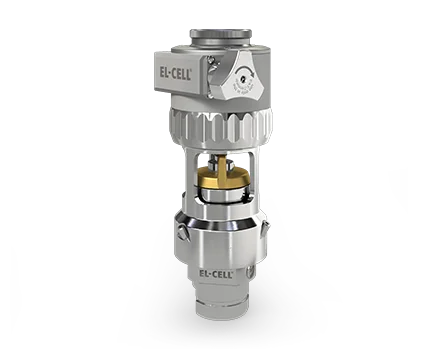
- Pressure of up to 300 MPa at 6 mm / 115 MPa at 10 mm electrode diameter
- Force adjustment and online measurement, up to 9000 N
- Temperature sensor, temperature range -20° C to 80° C
- Optional gas pressure sensor and gas in- and outlet for OEMS setup
> Read more about the features here
The PAT-Cell-Solid and PAT-Cell-Force utilise the modular PAT-Solid-Core to press and assemble the cell stack.
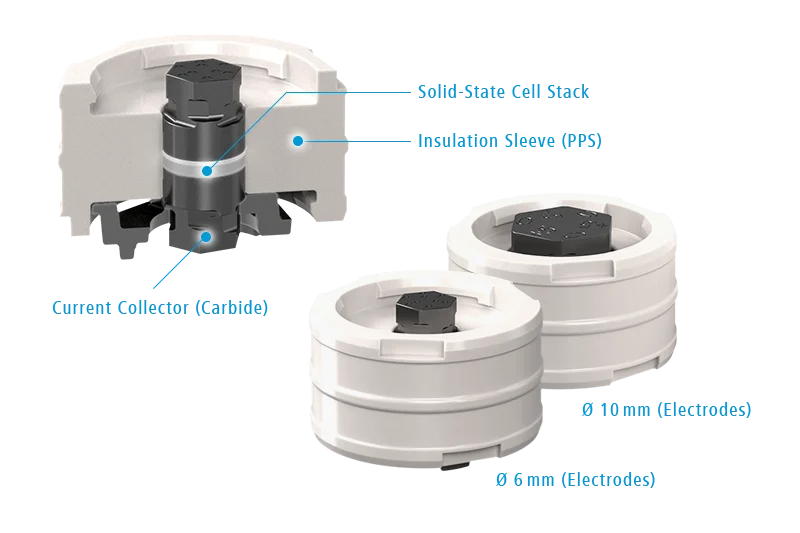
Overview of the PAT-Solid-Core
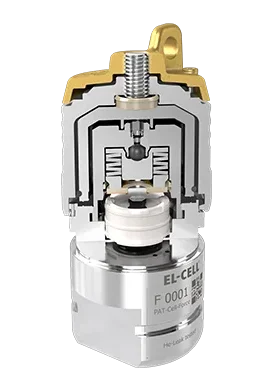
PAT-Cell-Force with inserted PAT-Solid-Core
In our case, the PAT-Solid-Core was built using LPSCl as the solid electrolyte, a silicon–carbon composite as the working electrode, and an indium/lithium/indium stack as the counter electrode. The PAT-Cell-Solid and PAT-Cell-Force were then assembled.
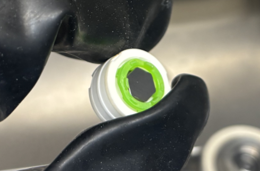
Position lower
plunger in insulation sleeve of PAT-Solid-Core
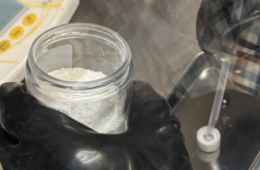
Add electrolyte in 10 mm PAT-Solid-Core
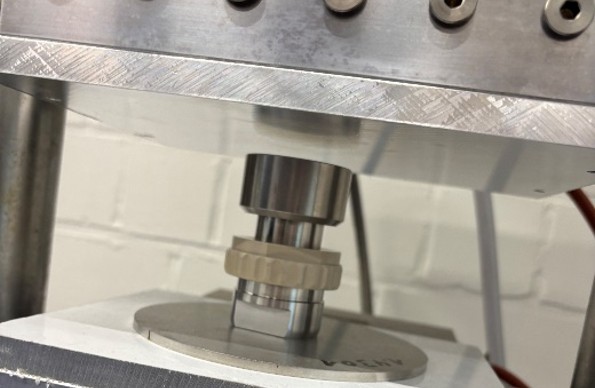
Solid-State-Pressing-Device is used for 3 minutes with an external press (450MPa)
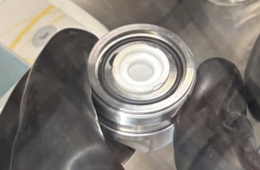
Compressed LPSCl electrolyte tablet after press
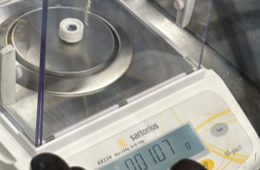
Add active material (10 mg CSi) in PAT-Solid-Core
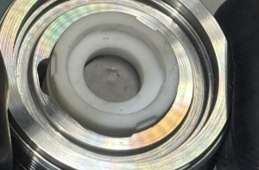
Active material tablet after pressing with 450 MPa
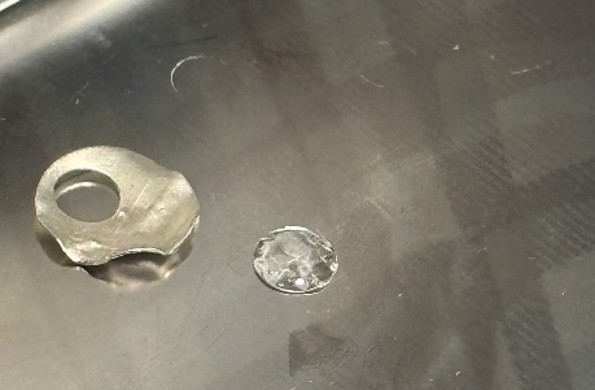
Prepare In/Li/In stack with 9 mm indium, 7 mm lithium, 9 mm indium discs
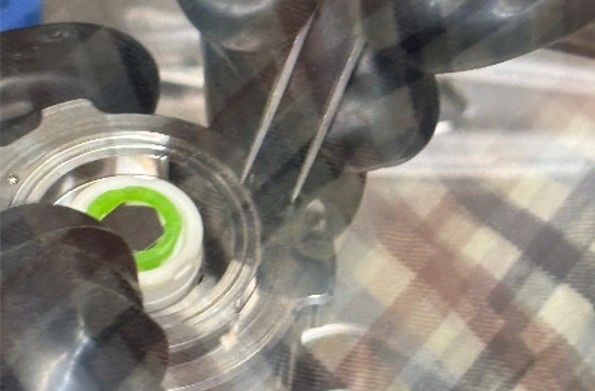
Flip PAT-Solid-Core and place the stack on top of the electrolyte tablet
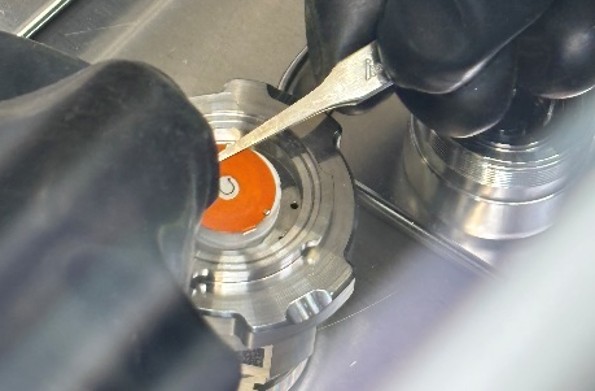
Attach contact disc on top of the upper electrode for electrical contact
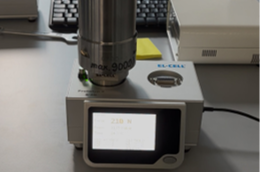
Insert the assembled test cell into to PAT-Terminal-1 and apply up to 9000 N of force on the cell stack
Results: PAT-Cell-Solid
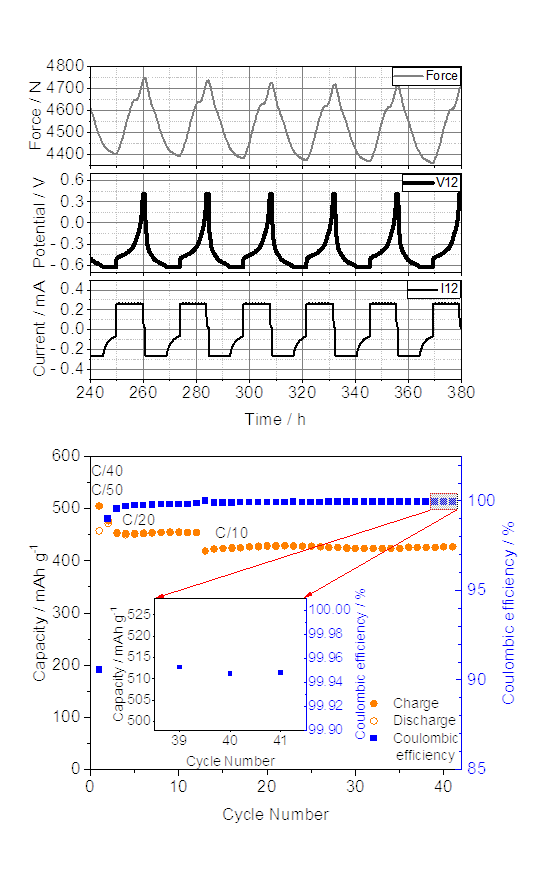
- In this setup, the 10 mm PAT-Solid-Core was used with a force of around 4500 N, corresponding to approx. 57 MPa.
- Reproducible force amplitudes were caused by electrode swelling, with low background drift due to radial force application.
- Different CV phase durations due to lithium stripping and dendritic lithium deposition
- An excellent coulombic efficiency of up to 99.95% was achieved due to the use of aluminium sealings.
- Very good cycling stability was observed, with slow capacity fading.
Results: PAT-Cell-Force
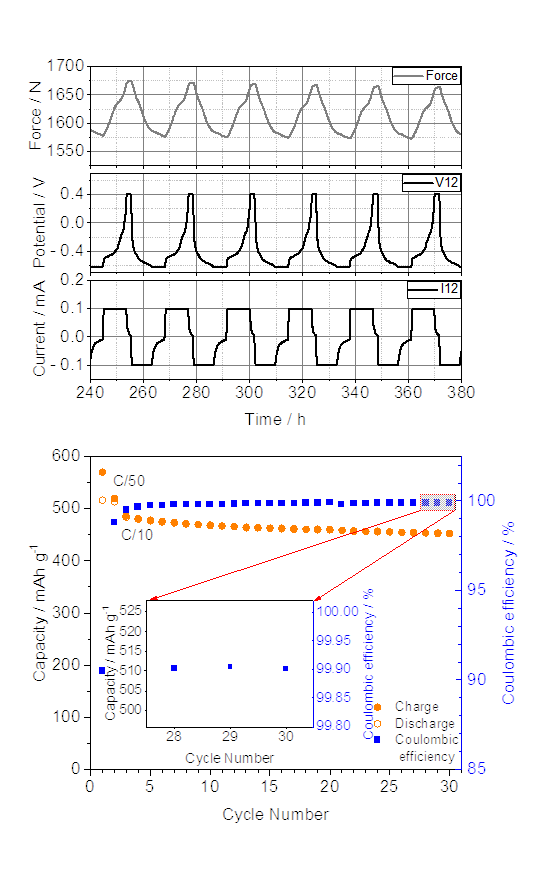
- In this setup, a 6 mm PAT-Solid-Core was used with an applied force of about 1600 N, corresponding to approx. 57 MPa.
- The yoke system provides highly reproducible force amplitudes with minimal background drift.
- Comparable results obtained with the PAT-Cell-Solid confirm the consistency between both systems.
- A high coulombic efficiency of 99.90% was achieved, together with slow capacity fading attributed to aluminium sealing.
Conclusion & Outlook
This work presents the first measurement data using the Solid Core in the PAT-Cell-Solid & -Force. The force measurement data show excellent radial force application with minimal background drift. Furthermore, due to the aluminium sealing, long-term measurements are possible. With the PAT-Solid-Core, a defined workflow is established to reduce the cell failure rate during assembly.
In future work, additional electrochemical tests are planned to further demonstrate the high reproducibility between different cells using the same chemistries. A broader range of materials will be investigated, including full-cell setups such as NCM811 | CSi. The PAT-Solid-Core will also be optimised for use with a reference electrode, enabling three-electrode measurements for all-solid-state batteries (ASSBs).
Literature:
[1] Puls, Sebastian et al. (2024): Benchmarking the reproducibility of all-solid-state battery cell performance. In: Nature Energy, 9(10), S. 1310–1320. DOI: 10.1038/s41560-024-01634-3.
_
by Jan Römer et al.
Related products:
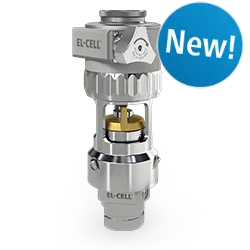
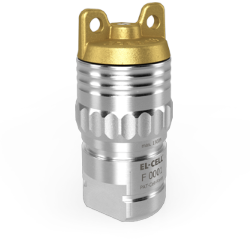
Battery test cell for solid-state and liquid cell chemistries. Up to 60 MPa applied pressure!
About the author


Comments are closed.