


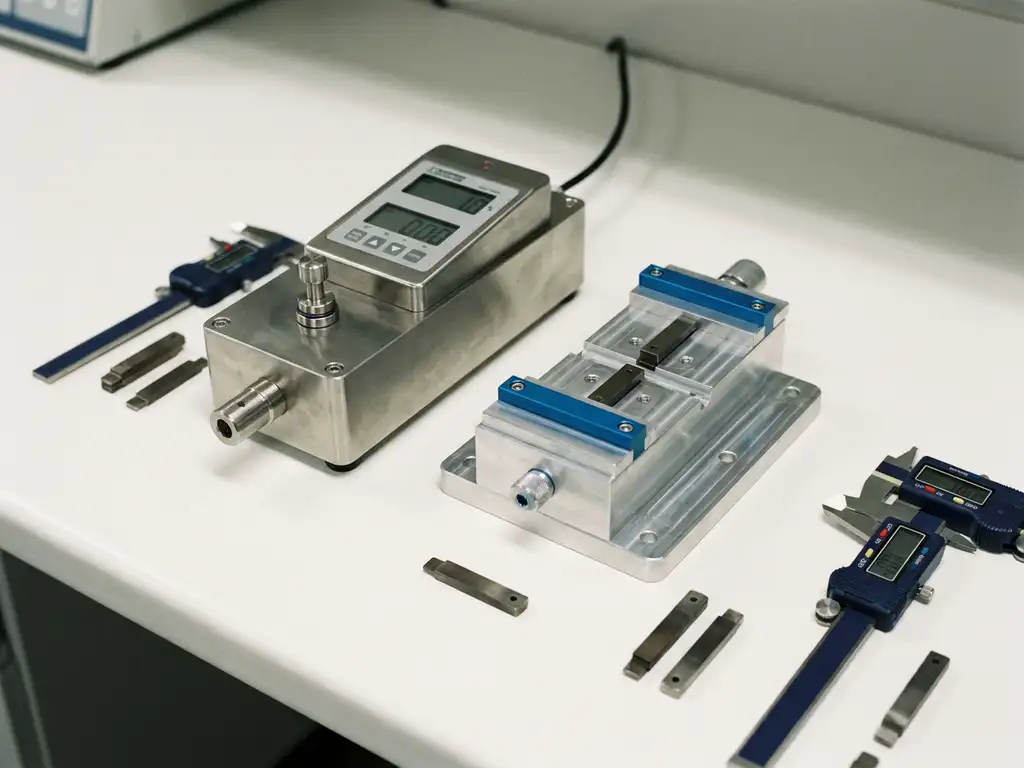
For solid-state battery (SSB) research, the choice between a commercial force test cell and a custom fixture depends primarily on the stage and scope of your work. Commercial force test cells offer validated, reproducible stack pressure control out of the box, making them a practical starting point for most labs. Custom fixtures become relevant when experimental constraints fall outside what commercial designs can accommodate.
What makes stack pressure control so critical in SSB research?
Stack pressure control is critical in solid-state battery research because solid electrolytes do not flow to compensate for volume changes during cycling. Unlike liquid electrolytes, which redistribute freely to maintain interfacial contact, ceramic or polymer solid electrolytes require sustained mechanical pressure to preserve electrode-electrolyte contact throughout charge and discharge. Loss of contact directly increases interfacial resistance and accelerates cell failure.
During cycling, electrode materials expand and contract with lithium insertion and extraction. In a liquid-electrolyte cell, the electrolyte accommodates these dimensional changes passively. In a solid-state cell, the same volume changes can open micro-gaps at the electrode-electrolyte interface, dramatically increasing cell impedance. Applying and maintaining a defined stack pressure suppresses this delamination mechanism and keeps interfacial resistance stable across cycles.
Stack pressure also affects the densification of solid electrolyte pellets and composite electrodes. Insufficient pressure during assembly or testing can leave residual porosity that increases ionic resistance. Excessive pressure risks fracturing brittle ceramic electrolytes. Controlling pressure within a defined window is therefore not a secondary consideration but a primary experimental variable in SSB research.
What is a commercial force test cell and what does it measure?
A commercial force test cell is a standardised electrochemical test cell equipped with an integrated or attachable load-measurement system that monitors and, in some designs, controls the compressive force applied to the cell stack during electrochemical cycling. It measures both electrochemical performance and the mechanical response of the cell simultaneously.
In practice, a force test cell records stack pressure as a function of time, state of charge, and cycle number alongside conventional electrochemical data such as voltage, capacity, and coulombic efficiency. Some designs integrate a load cell directly into the current collector assembly, while others use an external frame with a calibrated spring or pneumatic actuator to apply a defined pre-load.
The key measurements a force test cell provides include:
- Compressive force or pressure on the cell stack in real time
- Electrode stack thickness change correlated with electrochemical state
- Electrochemical impedance spectroscopy (EIS) data under controlled mechanical load
- Capacity, coulombic efficiency, and voltage profiles under defined stack pressure
This combination of mechanical and electrochemical data is particularly valuable for SSB research, where the two domains are tightly coupled. The PAT-Cell-Force is an example of a commercial force test cell designed specifically for this type of coupled measurement in a laboratory format.
What are the limitations of conventional test cells for SSB work?
Conventional test cells present several well-documented challenges for solid-state battery research that go beyond simple specification constraints. Assembly failure rates are a significant practical problem: studies cite a failure rate of around 43% for conventional test cells, and even experienced builders typically achieve only 4 out of 5 working cells. Inexperienced researchers fall below a 50% success rate. This level of attrition wastes materials, time, and effort — particularly when working with scarce solid electrolyte samples.
Conventional cells also lack an integrated force sensor. Only the initial applied pressure is recorded, and mechanical settling over the course of an experiment can reduce that pressure without any means of detection. This makes it impossible to distinguish genuine electrochemical effects from artefacts caused by undetected pressure loss.
Pressure distribution is a further concern. Conventional cell designs compress electrode material inhomogeneously, introducing variability across the active area that complicates data interpretation. Similarly, conventional plungers embed particles during use and must be ground or polished between measurements, gradually altering cell geometry and introducing additional sources of irreproducibility.
Material choices in conventional cells also add preparation burden. Many designs use PEEK housings, which absorb significant moisture and require drying at 120°C under vacuum before use. O-ring seals are a further source of contamination risk. These factors extend preparation time and increase the likelihood of moisture-related degradation in moisture-sensitive solid electrolyte systems.
When SSB experiments require electrode dimensions, pressure regimes, or environmental conditions outside standard design parameters, conventional commercial cells may not be suitable without modification. Common specification-level limitations include:
- Fixed electrode area: Most commercial cells are designed around a standard electrode diameter. Researchers working with non-standard pellet sizes or large-format electrodes may find the active area incompatible.
- Pressure range constraints: Commercial designs typically cover a defined pressure window. Some SSB electrolyte systems require pressures at the high end or beyond what a standard spring-loaded cell can deliver consistently.
- Limited in-situ access: Adding optical, X-ray, or neutron diffraction access to a commercial cell format is rarely straightforward. Cells designed for operando synchrotron experiments often require geometries that commercial products do not support.
- Temperature range: Commercial cells rated for standard laboratory temperatures may not be suitable for elevated-temperature SSB testing without additional hardware.
- Integration with external actuators: Some research programmes require active pressure control via servo-actuators or pneumatic systems rather than passive spring loads. Adapting a commercial cell to an external actuator can be mechanically complex.
These limitations do not make commercial force test cells unsuitable for SSB research in general. For the majority of laboratory studies involving pellet-format cells at standard electrode dimensions, they remain the most practical option. The limitations become relevant only when experimental design demands fall outside the standard specification.
When does building a custom fixture make sense for SSB experiments?
Building a custom fixture makes sense when the experimental requirements are well-defined, the limitations of commercial cells have been confirmed through direct evaluation, and the research programme is sufficiently long-term to justify the engineering investment. Custom fixtures are not a starting point for most labs.
Specific scenarios where custom fixtures are justified include:
- Non-standard electrode geometries: Research on large-format or irregularly shaped solid electrolyte membranes may require a bespoke cell body that no commercial product accommodates.
- Active pressure control: Experiments designed to hold stack pressure constant as the cell expands and contracts require closed-loop actuator systems that go beyond passive spring loading.
- Multi-modal operando experiments: Combining electrochemical cycling with synchrotron X-ray diffraction, neutron imaging, or acoustic emission monitoring typically requires custom cell geometries with specific window materials and beam access ports.
- Extreme temperature or pressure regimes: Testing solid-state cells at temperatures above several hundred degrees Celsius or under very high stack pressures requires materials and tolerances that standard commercial cells are not designed for.
- Integration into automated test rigs: Large-scale screening programmes that require mechanical integration with robotic handling or custom clamping mechanisms may benefit from purpose-built fixtures aligned with the broader system architecture.
Before committing to a custom build, it is worth confirming whether the requirement can be met by an existing commercial product or by a manufacturer-supplied customisation of a standard design. Custom development carries significant time and cost, and the resulting fixture must still be validated for mechanical and electrochemical performance before it can generate reliable data.
How do reproducibility and data quality compare between the two approaches?
Commercial force test cells generally offer higher reproducibility than custom fixtures, particularly early in a research programme, because they are manufactured to consistent tolerances, tested against defined specifications, and used across multiple laboratories. Custom fixtures can match or exceed commercial reproducibility, but only after a thorough validation process that takes time and resources to complete.
Reproducibility in force test measurements depends on several factors:
- Dimensional consistency: Cell body tolerances directly affect how uniformly pressure is distributed across the electrode stack. Commercial cells are machined to validated tolerances; custom fixtures require equivalent quality control to achieve the same consistency.
- Load cell calibration: Both approaches require calibrated force measurement. Commercial cells typically ship with calibration data. Custom fixtures must be calibrated independently and recalibrated periodically.
- Assembly protocol: Reproducible assembly is critical for solid-state battery testing, where small variations in pellet thickness or alignment affect contact pressure. Commercial cells often include assembly guides and tooling that help standardise this process.
- Seal integrity: Consistent sealing prevents electrolyte degradation from atmospheric moisture or oxygen. Commercial cells are tested for leak performance; custom fixtures require equivalent seal validation.
For publication-quality data, the standard of the fixture matters less than the rigour of the validation process. A well-validated custom fixture can produce data of equal quality to a commercial cell. However, data from a commercial cell is more directly comparable with results from other laboratories using the same platform, which carries practical value for benchmarking and peer review.
Which option is right for your SSB research setup?
For most SSB research programmes, a commercial force test cell is the right starting point. It provides validated stack pressure control, established assembly protocols, and data that is directly comparable with other laboratories using the same format. A custom fixture is appropriate only when specific experimental requirements cannot be met by any available commercial design.
A practical decision framework:
- Define the experimental requirements precisely before evaluating hardware. Identify the required electrode area, pressure range, temperature window, and any in-situ measurement access needed.
- Evaluate commercial options against those requirements. Many apparent limitations of commercial cells can be addressed through manufacturer customisation rather than a full custom build.
- Assess the research timeline. If results are needed within months, a commercial cell is almost always the faster path. Custom fixture development, validation, and troubleshooting typically take considerably longer.
- Consider the data comparability requirement. If the work will be benchmarked against published results from other groups, using the same commercial platform simplifies that comparison.
- Evaluate cost and technical capacity. Custom fixture development requires machining expertise, materials knowledge, and an in-house validation programme. These resources are not available in every lab.
For researchers working with standard pellet geometries and pressure ranges consistent with common solid electrolyte systems, a commercial solid-state battery test cell will meet the requirement in the large majority of cases. Custom fixtures remain a specialist tool for well-defined edge cases, not a general alternative to commercial solutions.
How EL-Cell GmbH supports force testing in solid-state battery research
EL-Cell GmbH designs and manufactures test cells and instrumentation specifically for battery materials research, including solid-state battery testing under controlled stack pressure. The PAT-Cell-Force and PAT-Cell-Solid address many of the shortcomings associated with conventional test cells. Both use the PAT-Solid-Core insert, which features guided plane-parallel tungsten carbide plungers and a dedicated pressing tool to ensure homogeneous compression across the electrode area — eliminating the inhomogeneous pressure distribution common in conventional designs. The tungsten carbide plungers withstand high mechanical loads without embedding particles, so no grinding or polishing between measurements is required and cell geometry remains stable over time.
Both cells also use aluminum seals and glass-metal feedthroughs in place of O-rings, and PPS plastic instead of PEEK. PPS absorbs significantly less moisture than PEEK, reducing contamination risk and cutting preparation time by removing the need for extended vacuum drying cycles. Standardised assembly procedures mean that nearly every cell runs without failure — a marked improvement over the roughly 43% failure rate reported for conventional test cell designs.
Our product range addresses the core requirements discussed in this article:
- The PAT-Cell-Force provides integrated force measurement alongside electrochemical cycling, enabling simultaneous recording of stack pressure and electrochemical performance data in a validated, reproducible format. An optional gas pressure sensor can be added to measure force changes caused by gas evolution separately from mechanical ones, allowing the two contributions to be distinguished.
- The PAT-Cell-Solid is designed for solid electrolyte systems, with geometry and materials suited to the assembly and pressure requirements of ceramic and polymer electrolyte cells.
- The PAT-Cell-Press applies defined uniaxial pressure during electrochemical testing, supporting research programmes that require precise mechanical loading beyond passive spring designs.
- The ECD-4-nano electrochemical dilatometer measures electrode thickness changes with sub-5-nanometre resolution, providing the dimensional data needed to understand stack pressure evolution during cycling.
- For labs with requirements outside standard product specifications, we offer customisation of existing designs to accommodate specific electrode dimensions, pressure ranges, or integration requirements.
If you are evaluating whether a commercial force test cell or a customised solution is appropriate for your solid-state battery research, contact EL-Cell GmbH directly to discuss your experimental requirements. Our team can help you identify the most appropriate configuration from our PAT Series or advise on customisation options where standard designs do not fully meet your needs.
Comments are closed.