


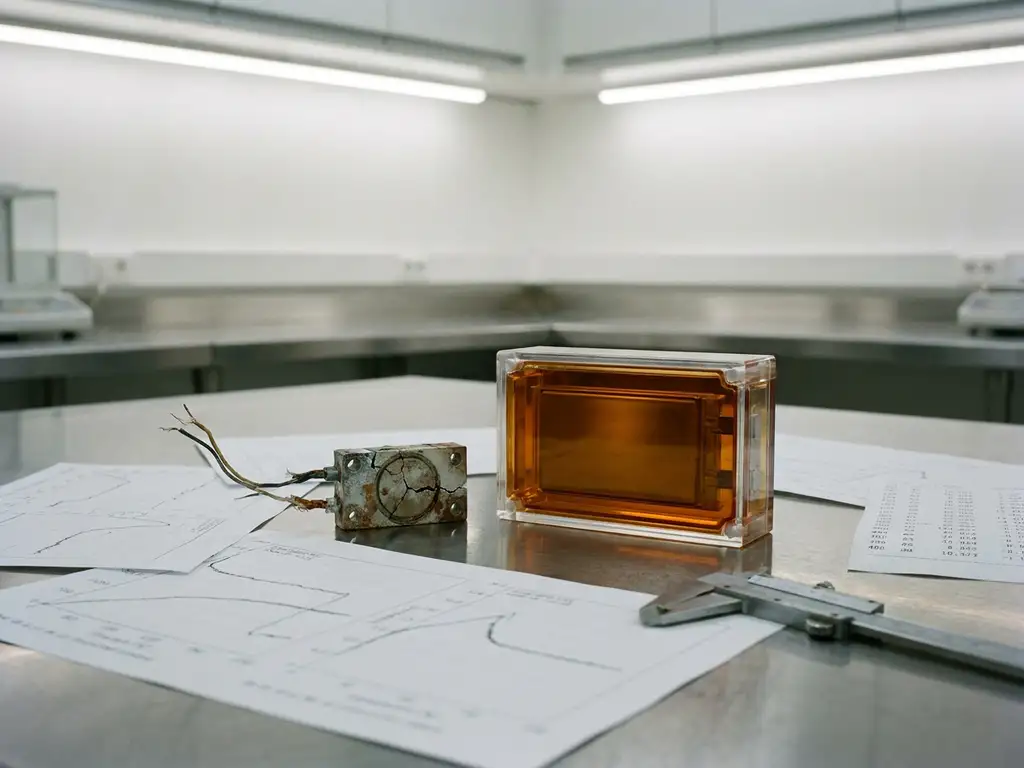
Low-precision force test cells introduce hidden costs that extend well beyond the price of the instrument itself. In solid-state battery research, where stack pressure is a primary experimental variable, imprecise force control produces unreliable electrochemical data, inflates the number of repeat experiments required, and delays publication timelines. The questions below unpack each of these cost drivers in practical terms.
What goes wrong when force control is imprecise in solid-state cells?
Imprecise force control in solid-state cells causes inconsistent interfacial contact between the solid electrolyte and electrode layers, leading to variable resistance, uneven current distribution, and irreproducible cycling behaviour. Because solid-state electrolytes cannot wet electrode surfaces the way liquid electrolytes do, mechanical contact quality is the primary determinant of cell performance, and any variation in applied force translates directly into variation in the data.
The consequences are specific and measurable:
- Delamination at low pressures: Insufficient stack pressure causes electrode-electrolyte interfaces to separate during cycling, producing apparent capacity fade that reflects poor contact rather than true material degradation.
- Electrolyte fracture at high pressures: Ceramic solid electrolytes such as oxide and sulphide materials are brittle. Uncontrolled overpressure can introduce microcracks that alter ionic transport pathways and generate artefacts in electrochemical impedance spectroscopy (EIS) spectra.
- Pressure drift during cycling: Electrode materials expand and contract with lithiation state. Without active or well-calibrated passive force control, the stack pressure changes continuously, meaning no two cycles occur under the same mechanical conditions. Conventional cells compound this problem further: they do not include a force sensor, so only the initial pressure is read, and mechanical settling can reduce it over time without any detection. The PAT-Cell-Force and PAT-Cell-Solid from EL-CELL include an integrated force sensor that monitors force continuously. An optional gas pressure sensor can also be added, allowing researchers to distinguish force changes caused by gas evolution from those caused by mechanical settling.
The result is that the electrochemical signal becomes a convolution of material properties and mechanical artefacts, making it difficult to attribute observations to either cause with confidence.
How does inaccurate stack pressure affect electrochemical data quality?
Inaccurate stack pressure degrades electrochemical data quality by introducing mechanical variability as an uncontrolled experimental parameter. When pressure is not precisely defined and held constant, metrics such as specific capacity (mAh/g), coulombic efficiency, and overpotential become functions of both material properties and contact conditions, producing data that cannot be reliably compared across cells or experimental runs.
EIS is particularly sensitive to this problem. The impedance response of a solid-state cell reflects contributions from bulk ionic conductivity, grain boundary resistance, and interfacial resistance. If the applied force is inconsistent, interfacial resistance values shift between measurements, making it impossible to deconvolute genuine material changes from mechanical artefacts. Researchers attempting to track SEI layer (Solid Electrolyte Interphase) formation or electrolyte degradation over cycles will find their impedance data uninterpretable if the mechanical boundary condition is not fixed.
Capacity measurements are equally affected. Variable contact resistance introduces additional overpotential that shifts cut-off voltages, artificially truncating or extending capacity values. Over many cycles, this compounds into apparent degradation trends that reflect contact quality rather than electrode chemistry.
What are the hidden cost multipliers in solid-state battery R&D?
The hidden costs of low-precision force test cells in solid-state battery research accumulate across consumables, researcher time, and instrument depreciation, often exceeding the cost difference between a low-precision and a high-precision cell many times over. The most significant multipliers are repeat experiments, wasted electrolyte material, and delayed decision-making in material screening workflows. Conventional test cells also carry a high assembly failure rate — studies cite 43% — meaning even experienced builders achieve only around 4 out of every 5 working cells, while inexperienced assemblers fall below 50%. The PAT-Cell-Force and PAT-Cell-Solid from EL-CELL standardize and simplify preparation so that nearly every cell runs without failure, directly reducing this source of wasted material and time.
- Consumable waste: Solid electrolyte materials, particularly sulphide-based ceramics, are expensive to synthesise or procure. Each failed experiment that must be repeated because of irreproducible force conditions consumes material that cannot be recovered.
- Researcher time: Diagnosing whether an anomalous result reflects a genuine material property or a mechanical artefact requires additional experiments. This diagnostic overhead can consume days or weeks of researcher time per project.
- Instrument utilisation: Test channels occupied by repeat experiments are unavailable for new conditions. In labs with limited channel capacity, this creates scheduling bottlenecks that slow the overall pace of research.
- Delayed material screening decisions: Industrial R&D teams running high-throughput screening depend on reliable data to advance or reject candidate materials. Noisy data from imprecise force control introduces uncertainty that delays go/no-go decisions, extending project timelines.
These costs are rarely attributed to the test cell itself in post-project reviews, which is why they remain hidden. They appear instead as general inefficiency, high consumable spend, or extended project duration.
How does poor force precision slow down the path to publication?
Poor force precision slows publication by generating datasets with high inter-cell variability that cannot pass peer review without extensive statistical justification or additional experiments. Reviewers of solid-state battery manuscripts routinely scrutinise experimental reproducibility, and data collected under undefined or variable stack pressure conditions will draw direct challenges to the validity of reported results.
The practical delays are sequential. First, the researcher must identify that variability exists, which may not be apparent until a full dataset is assembled. Second, additional experiments are required to establish whether the variability is mechanical or chemical in origin. Third, if mechanical, the experimental series must be repeated under controlled conditions. Each of these stages adds weeks to months to a project timeline, and each consumes resources that could otherwise advance the research itself.
Beyond reproducibility, publication in high-impact journals increasingly requires operando or in-situ characterisation data. Acquiring meaningful operando data from a solid-state cell requires stable, well-defined mechanical conditions throughout the measurement. Imprecise force control makes this category of experiment unreliable, effectively closing off a class of experiments that are becoming standard in the field.
What specifications should a force test cell meet for solid-state battery research?
A force test cell for solid-state battery research should provide defined, measurable, and stable uniaxial stack pressure throughout the full electrochemical measurement, with a force range and resolution appropriate to the electrolyte type being tested. Minimum requirements include a calibrated force application mechanism, compatibility with inert atmosphere assembly, and electrode area dimensions that match standard pellet press formats.
Key specifications to evaluate include:
- Force range: Sulphide electrolytes typically require lower pressures (in the range of a few MPa) than oxide ceramics. The cell should cover the relevant range without requiring separate hardware configurations.
- Force stability over time: Pressure should remain consistent as electrode volume changes during cycling. Cells relying solely on a fixed bolt torque will experience pressure drift as the stack expands and contracts.
- Homogeneous compression: Conventional cells compress electrode material inhomogeneously. The PAT-Solid-Core insert, used in both the PAT-Cell-Force and PAT-Cell-Solid, uses guided plane-parallel tungsten carbide plungers and a dedicated pressing tool to ensure homogeneous compression across the electrode area.
- Plunger durability: Conventional plungers embed particles during use and must be ground or polished between measurements, gradually altering cell geometry. EL-CELL uses tungsten carbide plungers that withstand high mechanical loads without this degradation, preserving cell geometry across measurements.
- Sealing and material compatibility: Conventional cells are typically sealed with O-rings and often use PEEK housings, which absorb significant moisture and require drying at 120°C under vacuum. EL-CELL cells use aluminum seals and glass-metal feedthroughs instead of O-rings, and PPS plastic instead of PEEK. PPS absorbs less moisture, reducing contamination risk and preparation time — a particular advantage when working with moisture-sensitive sulphide electrolytes.
- EIS compatibility: The cell design should minimise parasitic inductance and capacitance to allow clean impedance spectra across a wide frequency range.
- Atmosphere control: Sulphide electrolytes are moisture-sensitive. The cell must be assemblable and sealable in a glovebox environment without compromising force calibration.
- Current collector contact: Contact geometry should ensure uniform current distribution across the electrode area to avoid edge effects that confound area-normalised capacity (mAh/cm²) measurements.
Cells that meet these specifications allow researchers to treat stack pressure as a defined experimental variable rather than an uncontrolled source of noise — a prerequisite for publication-quality solid-state battery data.
When should labs upgrade their force test cell setup?
Labs should upgrade their force test cell setup when inter-cell variability cannot be explained by material or processing differences, when EIS data shows inconsistent interfacial resistance values across nominally identical cells, or when a research programme transitions from liquid-electrolyte to solid-state systems. These are the clearest indicators that the mechanical boundary condition of the test is limiting data quality.
Additional upgrade triggers include:
- Expanding into operando or in-situ measurements that require stable mechanical conditions over extended periods
- Beginning to work with brittle oxide or sulphide electrolytes that require precise pressure control to avoid fracture
- Scaling up from exploratory experiments to systematic material screening, where reproducibility across many cells becomes essential
- Receiving reviewer comments on manuscript submissions that question the reproducibility of electrochemical data
The decision to upgrade is also relevant when a lab is establishing its experimental protocols from the outset. Retrofitting force control into an existing workflow is more disruptive than specifying the correct cell from the beginning of a solid-state research programme.
How EL-Cell GmbH supports force-controlled solid-state battery testing
EL-Cell GmbH designs test cells and supporting instrumentation specifically for the mechanical and electrochemical demands of solid-state battery research. Our product range addresses the core challenges described above through purpose-built hardware that treats stack pressure as a controlled experimental parameter rather than an incidental feature.
Relevant capabilities include:
- PAT-Cell-Force: A test cell with integrated force measurement and control, designed for cycling solid-state and other pressure-sensitive electrode systems under defined uniaxial load. Force is monitored continuously, allowing researchers to correlate electrochemical response with mechanical state throughout the experiment. An optional gas pressure sensor enables separate measurement of force changes caused by gas evolution, distinguishing them from purely mechanical effects.
- PAT-Cell-Solid: Optimised for solid electrolyte pellet formats, with geometry and contact design suited to the assembly requirements of ceramic electrolyte systems. Like the PAT-Cell-Force, it uses the PAT-Solid-Core insert with guided plane-parallel tungsten carbide plungers for homogeneous compression, and benefits from the same aluminium seals, glass-metal feedthroughs, and PPS housing that minimise moisture uptake and simplify glovebox preparation.
- PAT-Cell-Press: Provides controlled uniaxial pressure for cells requiring higher and more precisely defined stack loads, extending the accessible pressure range for hard ceramic electrolytes.
- PAT-Tester-i-16: Integrates galvanostatic and potentiostatic cycling with EIS capability across up to 16 channels, providing the electrochemical measurement infrastructure needed to run force-controlled solid-state experiments at scale.
All products are designed to work together as a compatible measurement ecosystem, reducing integration effort and ensuring that mechanical and electrochemical data are collected under consistent, well-defined conditions. Researchers working on solid-state battery materials are welcome to contact us to discuss which configuration best fits their experimental requirements.
Comments are closed.