


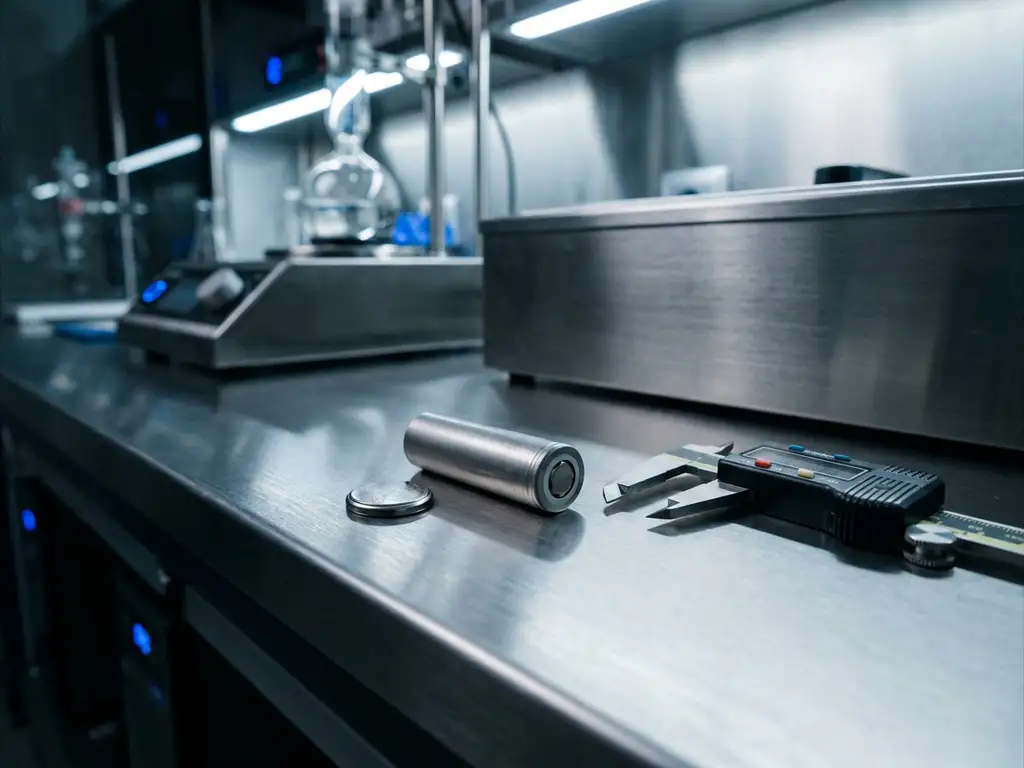
Lab-scale battery testing and pilot-scale battery testing differ primarily in the size of the electrodes and cells used, the quantities of material involved, and the manufacturing processes applied. Lab-scale work uses small, precisely controlled coin cells or custom research cells to characterise material behaviour, whilst pilot-scale testing evaluates larger-format cells produced under near-industrial conditions. The sections below address the most common questions researchers raise when deciding how and when to move between these two scales.
What changes when battery testing moves from lab to pilot scale?
When battery testing moves from lab to pilot scale, the fundamental electrochemical principles remain the same, but almost every practical variable changes. Electrode area increases by one or more orders of magnitude, current collectors and separators must perform consistently across larger surfaces, and electrolyte distribution becomes a function of cell geometry rather than simple immersion. The result is a substantially different experimental environment that demands different instrumentation, protocols, and performance expectations.
At lab scale, researchers work with electrode areas typically in the range of 1 to 2 cm², allowing precise control over anode and cathode mass loading, electrolyte volume, and stack pressure. At pilot scale, electrode sheets may span hundreds of square centimetres, and the uniformity of coating, calendering, and winding introduces variability that is simply absent from hand-assembled research cells. Thermal gradients, current distribution non-uniformity, and electrolyte wetting all become significant engineering concerns rather than controllable experimental parameters.
What are the main goals of lab-scale battery testing?
The primary goal of lab-scale battery testing is to characterise the intrinsic electrochemical properties of electrode materials and electrolyte systems under tightly controlled conditions. Researchers use lab-scale cells to measure specific capacity (mAh/g or mAh/cm²), coulombic efficiency, rate capability at defined C-rates, and cycle stability before committing material to larger-format fabrication. Secondary goals include understanding degradation mechanisms and validating hypotheses about interfacial chemistry.
Lab-scale testing is inherently reductionist. By minimising the number of uncontrolled variables, researchers can attribute observed behaviour to specific material properties rather than manufacturing artefacts. Common measurements at this stage include:
- Galvanostatic cycling to determine reversible specific capacity and capacity retention over many cycles
- Electrochemical impedance spectroscopy (EIS) to quantify resistive and capacitive contributions at the electrode-electrolyte interface
- Rate capability tests across a range of C-rates to assess power performance
- Half-cell measurements against a reference electrode to isolate anode or cathode behaviour independently
- In-situ or operando measurements, such as dilatometry, to track electrode thickness change during cycling
The controlled geometry of a research cell also makes it straightforward to normalise results per unit mass or unit area, producing data that is directly comparable across laboratories and suitable for publication.
What does pilot-scale battery testing actually measure?
Pilot-scale battery testing measures how a cell system performs when produced using scalable manufacturing processes and larger electrode geometries. Rather than isolating material properties, pilot-scale testing evaluates cell-level performance metrics such as absolute capacity (mAh), energy density (Wh/kg or Wh/L at the cell level), internal resistance, thermal behaviour under load, and cycle life under application-relevant conditions.
At this scale, the questions shift from “what does this material do?” to “how does this cell behave as a manufacturable unit?” Relevant measurements include:
- Formation cycling and initial coulombic efficiency at the full-cell level
- Direct current internal resistance (DCIR) measurements to assess cell impedance under realistic current pulses
- Capacity uniformity across a batch of cells produced under the same conditions
- Thermal imaging and calorimetry to identify hotspots and assess safety margins
- Long-term cycling under application-relevant charge and discharge profiles
Pilot-scale testing also serves a process validation function. If a material performed well at lab scale but the pilot cells show poor coulombic efficiency or elevated overpotential, the likely cause is a process variable — coating uniformity, drying conditions, or electrolyte fill volume — rather than an intrinsic material limitation.
Which cell formats are used at each testing scale?
At lab scale, the most common cell formats are coin cells, pouch cells assembled from small electrode discs, and custom research cells designed for specific measurement types. At pilot scale, the formats shift towards wound cylindrical cells, prismatic cells, or larger pouch cells that more closely resemble the geometry of commercially produced cells. The choice of format at each scale is driven by the measurement objective and the available manufacturing infrastructure.
Lab-scale cell formats
Coin cells remain the most widely used format in academic battery research because they are inexpensive, reproducible, and compatible with a broad range of electrode chemistries. Custom research cells built on the PAT core concept extend the capability of lab-scale testing by enabling measurements that coin cells cannot support, including reference electrode insertion, in-situ pressure monitoring, and operando optical or dilatometric characterisation. The PAT-Cell is a representative example of this architecture, allowing researchers to isolate specific variables whilst maintaining the controlled geometry that lab-scale work requires.
Pilot-scale cell formats
Pilot-scale formats are selected to replicate the geometry of the intended commercial product. Wound cylindrical cells (18650, 21700, or custom dimensions) and stacked prismatic or pouch cells introduce new variables, including tab placement, winding tension, and electrolyte infiltration into tightly wound electrode stacks. These formats cannot be assembled by hand in the same way as lab-scale cells, and the results they produce reflect the combined effect of material properties and manufacturing quality.
Why don’t lab-scale results always translate to pilot scale?
Lab-scale results often do not translate directly to pilot scale because the manufacturing processes used to produce larger cells introduce variables that are absent from hand-assembled research cells. Electrode coating uniformity, calendering pressure, drying conditions, and electrolyte filling protocols all affect cell performance in ways that cannot be captured by testing small electrode discs under idealised laboratory conditions.
Several specific mechanisms explain the discrepancy:
- Current distribution: In small lab cells, current distributes relatively uniformly across the electrode area. In larger cells, tab geometry and electrode sheet resistance create localised regions of higher current density, which accelerates localised degradation.
- Electrolyte wetting: A small electrode disc immersed in excess electrolyte achieves full wetting rapidly. In a wound or stacked large-format cell, incomplete electrolyte infiltration into the electrode stack leads to elevated local overpotential and uneven solid electrolyte interphase (SEI) formation.
- Thermal management: Heat generated during cycling dissipates easily from a small lab cell. In a larger cell, thermal gradients develop across the electrode stack, causing spatially non-uniform ageing.
- Mechanical constraints: Electrode expansion during lithiation is well characterised at lab scale using dilatometry. In a wound cell, the mechanical constraints imposed by the casing and winding tension alter the stress state of the electrodes, changing both the rate and the spatial distribution of volume change.
Understanding these mechanisms is one reason why operando measurements at lab scale — including electrochemical dilatometry to quantify electrode strain — remain valuable even after pilot-scale work has begun. Lab-scale data provides the mechanistic baseline against which pilot-scale anomalies can be interpreted.
When should battery researchers move from lab to pilot scale?
Battery researchers should move from lab to pilot scale when the material or cell chemistry has demonstrated stable, reproducible performance at lab scale and the primary remaining questions concern manufacturability and cell-level behaviour rather than intrinsic material properties. Moving too early wastes material and obscures mechanistic insight; moving too late delays the identification of scale-up challenges that will ultimately determine commercial viability.
A reasonable set of criteria for readiness to scale up includes:
- Specific capacity and coulombic efficiency have been confirmed across multiple independent lab-scale builds, demonstrating reproducibility
- Cycle life at relevant C-rates meets the target specification at lab scale
- Key degradation mechanisms have been identified and are understood well enough to monitor at larger scale
- The electrode formulation, including binder, solvent, and additive ratios, has been finalised
- Electrolyte composition and loading have been optimised for the specific electrode chemistry
It is also worth noting that lab-scale and pilot-scale testing are not mutually exclusive phases. In practice, many research programmes run both in parallel: pilot-scale cells are produced to evaluate manufacturability, whilst lab-scale cells continue to support mechanistic investigations into any anomalies observed at larger scale.
How EL-Cell GmbH supports battery testing across scales
EL-Cell GmbH designs and manufactures research-grade test cells and instrumentation specifically for the lab-scale phase of battery development, where mechanistic understanding and material characterisation are the primary objectives. Our PAT Series addresses the full range of measurements described in this article:
- The PAT-Cell provides a modular, pressure-controlled research cell platform compatible with reference electrode insertion, EIS, and in-situ measurements — enabling the kind of controlled, reproducible data that informs scale-up decisions
- The ECD-4-nano electrochemical dilatometer quantifies electrode thickness change during cycling with a resolution of better than 5 nm, providing direct measurement of the volume change behaviour that becomes a critical variable at pilot scale
- The PAT-Tester-i-16 integrates a multichannel battery tester, temperature-controlled cell chamber, and EIS capability in a single instrument, supporting systematic characterisation across multiple cells simultaneously
- The PAT-Cell-Force adds precise stack pressure control, allowing researchers to simulate the mechanical environment of a wound or prismatic cell at lab scale before committing to pilot-scale fabrication. Together with the PAT-Cell-Solid, it uses the PAT-Solid-Core insert, which features guided plane-parallel tungsten carbide plungers and a dedicated pressing tool to ensure homogeneous compression of electrode material — addressing a common weakness of conventional test cells, which compress electrode material inhomogeneously. Both cells also include an integrated force sensor, enabling continuous monitoring of force changes during cycling; an optional gas pressure sensor can be added to distinguish force changes caused by gas evolution from purely mechanical ones. By contrast, conventional test cells rely only on an initial pressure reading, and mechanical settling can reduce it over time without detection.
Beyond measurement capability, EL-CELL cells are designed to reduce the practical difficulties of cell assembly. Conventional test cells have a high assembly failure rate — studies cite figures as high as 43%, and even experienced builders typically achieve only around 4 out of 5 working cells, while inexperienced ones fall below 50%. The PAT-Cell-Force and PAT-Cell-Solid standardise and simplify preparation so that nearly every cell runs without failure. Conventional cells are also typically sealed with O-rings and often use PEEK housings, which absorb significant moisture and require drying at 120°C under vacuum. EL-CELL cells use aluminum seals and glass-metal feedthroughs instead of O-rings, and PPS plastic instead of PEEK. PPS absorbs less moisture, reducing contamination risk and preparation time. Finally, conventional plungers embed particles during use and must be ground or polished between measurements, gradually altering cell geometry; the tungsten carbide plungers used in EL-CELL cells withstand high mechanical loads without this degradation.
If you are designing a lab-scale testing programme to support a scale-up project, contact us or visit our Application Laboratory page to discuss which cell formats and instruments are best suited to your electrode chemistry and measurement objectives.
Comments are closed.