


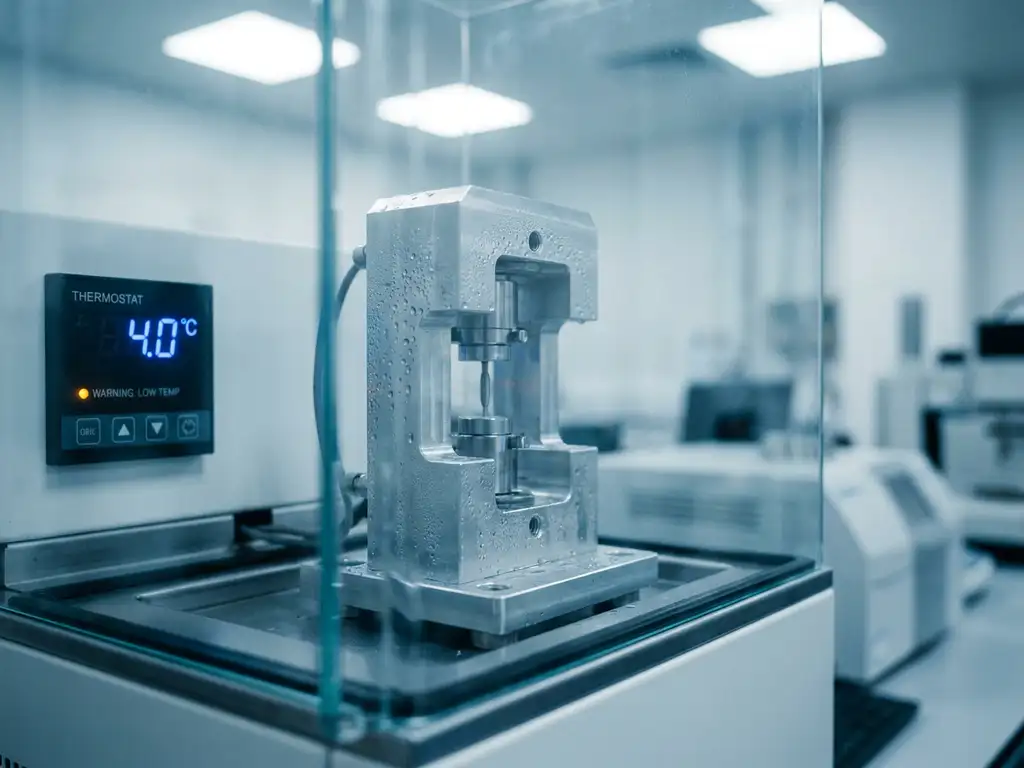
Environmental conditions have a direct and measurable impact on force test cell measurements in solid-state battery testing. Temperature fluctuations, humidity, mechanical vibration, and atmospheric pressure changes can each introduce errors into force sensor readings, compromising the reproducibility and scientific validity of the data. The sections below address each environmental factor in turn, and explain how controlled conditions can mitigate their effects.
How do temperature fluctuations affect force readings in solid-state battery test cells?
Temperature fluctuations affect force readings in solid-state battery test cells primarily through thermal expansion of cell components and thermal sensitivity in the force sensor itself. Even modest temperature changes of a few degrees Celsius can cause mechanical expansion or contraction in the cell housing, current collectors, and electrode stack, generating apparent force signals that are not related to electrochemical processes.
In solid-state battery testing, this problem is particularly significant because the materials involved — ceramic electrolytes, composite cathodes, and lithium metal anodes — each have distinct coefficients of thermal expansion. When these materials expand at different rates, the resulting differential strain is registered by the force sensor as a real mechanical event. Without temperature control, it becomes impossible to distinguish thermally induced force changes from electrochemically driven ones, such as electrode swelling during lithiation.
Force sensors themselves are also temperature-sensitive. Most commercial load cells use strain gauges whose electrical resistance changes with temperature. This introduces a thermal offset into the baseline reading that accumulates over time if the ambient temperature is not stable. For researchers conducting long-duration cycling experiments — common in solid-state battery studies — even a slow thermal drift of 0.5 °C per hour can produce a baseline shift large enough to obscure the mechanical signature of electrode degradation.
Practical implications for laboratory practice include:
- Allowing force test cells to equilibrate thermally before beginning measurements
- Using a temperature-controlled cell chamber to maintain isothermal conditions throughout the experiment
- Recording ambient temperature continuously alongside force data so post-hoc corrections can be applied if needed
- Avoiding placement of test cells near heating or cooling sources such as ovens, air conditioning vents, or windows
What role does humidity play in solid-state battery force measurements?
Humidity affects force measurements in solid-state battery test cells through two primary mechanisms: corrosion of metallic cell components and moisture-induced dimensional changes in hygroscopic materials. Both effects alter the mechanical state of the cell independently of any electrochemical process, introducing artifacts into force data.
Many solid-state electrolyte materials — particularly sulphide-based and some oxide-based ceramics — are sensitive to atmospheric moisture. Exposure to humid air can cause surface reactions that alter the physical dimensions of the electrolyte pellet or composite electrode. If this occurs during a measurement, the force sensor records a dimensional change that reflects chemical degradation rather than the intended electrochemical behaviour.
Metallic components such as stainless steel current collectors and spring elements within the cell assembly are also susceptible to surface oxidation in high-humidity environments. Oxidation products can alter the contact mechanics between cell components, leading to inconsistent force transmission and unpredictable baseline shifts. Over extended cycling experiments, this effect compounds and makes inter-experiment comparisons unreliable.
For researchers working with air-sensitive solid electrolytes, assembling and testing cells inside a dry room or an inert-atmosphere glovebox is standard practice. Even for less sensitive materials, maintaining relative humidity below a defined threshold — typically below 30 % RH in a controlled laboratory environment — reduces the risk of moisture-related artifacts in force data.
How does external mechanical vibration distort force test cell data?
External mechanical vibration distorts force test cell data by coupling low-frequency or high-frequency oscillations into the force sensor, which registers them as real mechanical events within the cell. In solid-state battery testing, where the force signals of interest are often small and slow-varying, even low-amplitude vibrations from building infrastructure or nearby equipment can obscure genuine electrochemical signals.
Common sources of mechanical vibration in battery research laboratories include:
- Vacuum pumps and compressors located on or near the same bench
- Centrifuges, ball mills, or other rotating equipment sharing the same floor or bench surface
- HVAC systems transmitting low-frequency oscillations through building structures
- Foot traffic and door closures in high-traffic laboratory corridors
The effect of vibration on force readings depends on the frequency response of the force sensor and the mechanical compliance of the cell assembly. Stiff, high-stiffness cell designs transmit vibrations more directly to the sensor, whereas compliant designs with spring elements may attenuate some of the higher-frequency content. However, no passive cell design eliminates vibration artifacts entirely.
Practical mitigation strategies include placing test cells on anti-vibration optical tables or isolation pads, decoupling the test bench from the floor using vibration-damping feet, and scheduling long-duration measurements during periods of lower laboratory activity. Where possible, separating force-sensitive measurements from vibration-generating equipment within the laboratory layout reduces the problem at the source.
What atmospheric conditions cause drift in force sensor baselines?
Atmospheric pressure changes, temperature gradients, and humidity fluctuations are the primary atmospheric conditions that cause drift in force sensor baselines. Barometric pressure changes alter the buoyancy force acting on the sensor and cell assembly, while temperature and humidity affect the electronic components of the sensor itself, producing slow, continuous shifts in the zero-point reading.
Barometric pressure effects are generally small but not negligible in high-resolution force measurements. A change in atmospheric pressure of a few hectopascals — well within the range of normal daily variation — can produce a measurable buoyancy-related force change on a cell assembly of standard laboratory dimensions. For most solid-state battery force measurements, this effect is secondary to temperature and humidity, but it becomes relevant when measuring very small absolute forces or when experiments span multiple days with variable weather conditions.
Temperature-induced baseline drift in force sensors is well-documented and is the most common source of long-term measurement error. It arises from the temperature coefficient of the strain gauge material and from differential thermal expansion within the sensor housing. Manufacturers typically specify a temperature coefficient of zero-point output for their sensors, which can be used to apply a correction if temperature is logged continuously.
Humidity-induced drift occurs because moisture absorption changes the electrical properties of the strain gauge adhesive and the insulation resistance of the sensor wiring. In poorly sealed sensors, this effect is progressive and irreversible over time. Selecting sensors with appropriate ingress protection ratings and storing them in controlled conditions between experiments reduces the rate of humidity-related drift.
How can environmental control improve the reproducibility of force measurements?
Environmental control improves the reproducibility of force measurements by removing the systematic and random errors introduced by temperature variation, humidity fluctuation, vibration, and atmospheric pressure changes. When these variables are held constant or actively compensated, the force signal recorded by the test cell reflects only the electrochemical and mechanical processes occurring within the cell itself.
Reproducibility is the central requirement for meaningful solid-state battery research. A measurement that cannot be repeated under the same conditions provides no reliable basis for comparing electrode materials, electrolyte formulations, or stack pressures. Environmental instability is one of the most common but least reported sources of inter-experiment variability, and it is frequently misattributed to material inconsistency or cell assembly error.
Key strategies for improving environmental control in force measurement experiments include:
- Temperature-controlled enclosures: Placing force test cells inside a thermostated chamber eliminates the dominant source of thermal drift and ensures that temperature-dependent electrochemical processes occur under a defined, reproducible condition
- Humidity control: Operating in a dry room or using desiccated enclosures reduces moisture-related artifacts, particularly important for sulphide-based solid electrolytes
- Vibration isolation: Anti-vibration platforms decouple the test cell from building and equipment-generated oscillations, improving signal-to-noise ratio in force data
- Continuous environmental logging: Recording temperature, humidity, and pressure alongside force data enables post-hoc identification and correction of environmentally driven artifacts
- Sensor warm-up and equilibration: Allowing force sensors to reach thermal equilibrium before zeroing and beginning a measurement reduces early-stage baseline drift
When all these measures are applied consistently, the variability in force measurements between repeat experiments decreases substantially, and the data become suitable for publication and cross-laboratory comparison. Environmental control is therefore not an optional refinement but a prerequisite for generating reliable force data in solid-state battery testing.
How EL-Cell GmbH helps with environmental control in force test cell measurements
EL-Cell GmbH designs force test cells and supporting instrumentation specifically for the demands of solid-state battery research, where environmental sensitivity is highest and measurement reproducibility is most critical. Our product ecosystem addresses the environmental challenges described above at the instrument level, reducing the burden on laboratory infrastructure.
- The PAT-Cell-Force is a force-controlled test cell designed for solid-state battery research, enabling precise measurement of stack pressure and electrode dimensional changes under defined mechanical loads — with a cell design that minimises sensitivity to external mechanical disturbances
- The PAT-Tester-i-16 integrates a temperature-controlled cell chamber directly into the instrument, providing isothermal measurement conditions without requiring a separate climate cabinet — directly addressing thermal drift in force sensor baselines
- The PAT-Cell-Solid is optimised for solid electrolyte systems and supports inert-atmosphere assembly, reducing humidity-related artifacts in force and electrochemical data
- All PAT Series instruments are designed as an interoperable ecosystem, so force, electrochemical, and environmental data are acquired synchronously and logged in a consistent format for straightforward post-processing
If you are designing a solid-state battery testing workflow and need guidance on instrument selection or environmental control strategies, contact EL-Cell GmbH directly to discuss your experimental requirements.
Comments are closed.