


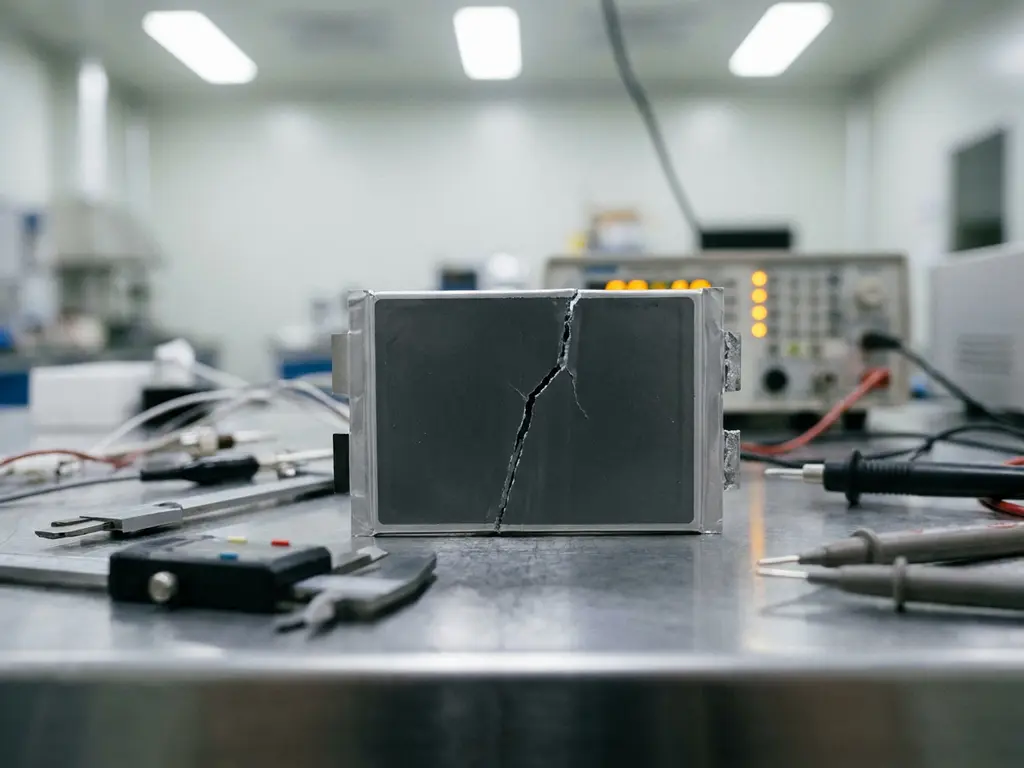
The commercialisation of solid-state batteries is progressing more slowly than many research roadmaps anticipated. One underappreciated reason is the mechanical testing gap: the absence of standardised, well-characterised methods for measuring the mechanical behaviour of solid-state cells under realistic electrochemical conditions. Without these data, researchers cannot reliably predict how cells will perform under the stresses of repeated cycling, and manufacturers cannot translate laboratory results into scalable production processes.
This article builds from first principles. It defines the mechanical testing gap, explains why solid-state architectures generate mechanical demands that liquid-electrolyte cells do not, and describes the instrumentation approaches that are closing the distance between laboratory measurement and commercial readiness.
What is the mechanical testing gap in solid-state batteries?
The mechanical testing gap refers to the lack of standardised, quantitative methods for characterising the mechanical state of a solid-state battery cell during electrochemical operation. In conventional lithium-ion cells with liquid electrolytes, mechanical effects are present but are often managed through cell design tolerances. In solid-state cells, mechanical behaviour is inseparable from electrochemical performance.
The gap has two dimensions. First, there is an instrumentation dimension: many laboratory setups lack the sensors, force measurement systems, or dimensional resolution required to capture the relevant mechanical signals. Second, there is a methodological dimension: even where instruments exist, there is no consensus on how to apply controlled stack pressure, what force ranges are relevant, or how to correlate mechanical data with electrochemical outputs such as impedance or capacity fade.
For example, a researcher cycling a sulphide-based solid electrolyte cell may observe capacity loss over 50 cycles without being able to determine whether the cause is chemical degradation at the electrode-electrolyte interface, delamination driven by volume change, or crack propagation through the electrolyte layer. Without mechanical characterisation, these failure modes are indistinguishable from electrochemical data alone.
Why solid-state cells create unique mechanical demands
Solid-state batteries replace the liquid or gel electrolyte with a solid ionic conductor, which fundamentally changes the mechanical environment inside the cell. A liquid electrolyte is compliant: it flows to fill voids created by electrode volume changes during lithiation and delithiation. A solid electrolyte cannot do this. Every dimensional change in the electrode must be accommodated mechanically, either through elastic deformation, plastic flow, or fracture.
Volume change at the electrode level
During cycling, electrode active materials expand and contract as lithium ions are inserted and extracted. In graphite anodes, this volume change is approximately 10% per cycle. In silicon-containing anodes, it can exceed 300%. In a liquid-electrolyte cell, this movement is partially decoupled from the electrolyte. In a solid-state cell, the electrode and electrolyte are in rigid contact, so volume changes translate directly into internal stress.
- Oxide-based solid electrolytes (such as garnets and NASICON-type materials) are brittle and fracture under tensile stress.
- Sulphide-based electrolytes are more ductile but require controlled stack pressure to maintain ionic contact at interfaces.
- Polymer electrolytes deform viscoelastically, making their mechanical response time-dependent and temperature-sensitive.
Stack pressure as an active variable
In solid-state cells, applied stack pressure is not merely a packaging consideration: it is an electrochemical variable. Insufficient pressure leads to interfacial delamination and loss of ionic contact, which manifests as increased cell impedance and reduced accessible capacity. Excessive pressure can cause electrolyte fracture or induce lithium creep in cells using metallic lithium anodes. The optimal pressure window is material-specific and can shift during cycling as the cell geometry evolves.
This means that force test cells capable of applying and measuring defined stack pressures throughout a full cycling protocol are a prerequisite for generating reproducible solid-state battery testing data, not an optional enhancement.
How uncharacterised mechanics slow the path to commercialisation
Building on the mechanical demands described above, the consequences of leaving these variables uncharacterised are significant for anyone attempting to move a solid-state cell chemistry from research to production.
Reproducibility is the first casualty. If two nominally identical cells are assembled with different stack pressures because the test fixture does not control or record this parameter, their electrochemical data will diverge. This makes it difficult to distinguish genuine material performance from experimental artefacts, and it undermines the statistical validity of any dataset intended for publication or process transfer.
Failure analysis is the second casualty. Post-mortem examination of a cycled solid-state cell can identify physical damage, but without in-situ mechanical data recorded during cycling, it is not possible to determine in which cycle, at which state of charge, and under which conditions the damage initiated. This gap between observation and causation slows the iterative development cycle that is essential for improving cell chemistry and architecture.
- Uncontrolled stack pressure introduces a hidden variable that inflates cell-to-cell variation.
- Without dimensional data, volume change contributions to impedance growth cannot be separated from chemical degradation contributions.
- Scale-up decisions made on the basis of mechanically uncharacterised data carry higher technical risk.
Assembly reliability and material design in conventional versus EL-CELL test cells
Beyond the measurement gap itself, the reliability of the test cell assembly process has a direct impact on data quality. Conventional test cells carry a high assembly failure rate — studies cite 43% of cells failing to work as intended. Even experienced builders achieve only around 4 out of 5 working cells, while inexperienced assemblers fall below a 50% success rate. This level of variability makes it difficult to build statistically meaningful datasets and wastes both materials and time.
The PAT-Cell-Force and PAT-Cell-Solid from EL-CELL address this directly. Both cells use the PAT-Solid-Core insert, which features guided plane-parallel tungsten carbide plungers and a dedicated pressing tool to ensure homogeneous compression of electrode material — something conventional cells, which compress electrode material inhomogeneously, cannot guarantee. The standardised assembly procedure means that nearly every cell runs without failure, removing a significant source of experimental noise before cycling even begins.
The choice of materials also matters. Conventional cells are typically sealed with O-rings and often use PEEK housings, which absorb significant moisture and require drying at 120°C under vacuum before use. EL-CELL cells use aluminum seals and glass-metal feedthroughs instead of O-rings, and PPS plastic instead of PEEK. PPS absorbs considerably less moisture than PEEK, which reduces contamination risk and shortens preparation time — a meaningful advantage when working with moisture-sensitive solid electrolyte materials.
Plunger durability is a further consideration. Conventional plungers embed electrode particles during use and must be ground or polished between measurements, a process that gradually alters the cell geometry and introduces additional variability. EL-CELL tungsten carbide plungers withstand high mechanical loads without this degradation, maintaining consistent geometry across many measurement cycles.
Conventional test cells also lack integrated force sensing. Only the initial applied pressure is known, and mechanical settling can reduce it over time without detection. EL-CELL cells include an integrated force sensor that tracks pressure throughout the experiment. An optional gas pressure sensor can be added to measure force changes caused by gas evolution separately from mechanical ones, enabling more precise attribution of the signals recorded.
Electrochemical dilatometry and in-situ strain monitoring explained
Electrochemical dilatometry is the measurement of dimensional changes in an electrode or cell stack as a function of electrochemical state. It provides a direct, quantitative record of volume change that can be correlated with capacity, voltage, and impedance data acquired simultaneously.
The operating principle is straightforward. A displacement sensor monitors the thickness of the cell stack with sub-micrometre resolution while the cell is being cycled. Expansion during lithiation and contraction during delithiation appear as periodic displacement signals. Irreversible expansion, which accumulates over many cycles, is associated with processes such as electrolyte decomposition, gas evolution, or lithium plating.
What dilatometry reveals that electrochemical data cannot
Consider a cell showing gradual capacity fade over 100 cycles. Electrochemical data alone cannot distinguish between active material loss, growing interfacial resistance, and loss of ionic contact due to delamination. Dilatometry can separate these mechanisms: delamination produces a change in the expansion-contraction profile before it produces a measurable change in capacity, providing earlier diagnostic information.
For solid-state cells specifically, dilatometry under controlled stack pressure provides a coupled mechanical-electrochemical dataset. The ECD-4-nano electrochemical dilatometer achieves a displacement resolution of better than 5 nm, which is sufficient to resolve the sub-micrometre thickness changes that occur in thin-film electrode configurations relevant to solid-state research.
In-situ strain monitoring in force test cells
An alternative approach to dilatometry is the integration of force sensors directly into the test cell body. Rather than measuring displacement at fixed load, these cells measure the force generated by electrode expansion under constrained conditions. This is the configuration relevant to solid-state cells where the electrolyte layer cannot accommodate free expansion.
Force test cells record the evolution of internal stress as a function of cycle number and state of charge. These data are directly relevant to predicting electrolyte fracture risk and to defining the pressure management strategy required in a scaled cell format.
Closing the gap: matching instruments to solid-state test requirements
The practical implication of the preceding sections is that solid-state battery testing requires instruments that can simultaneously control or measure stack pressure, record dimensional change, and acquire electrochemical data. No single measurement modality is sufficient on its own.
When selecting test equipment for solid-state research, the relevant instrument capabilities are:
- Defined and measurable stack pressure: the test cell must apply a known, stable pressure throughout cycling and ideally record how that pressure evolves as the cell expands or contracts.
- Sub-micrometre displacement resolution: relevant for detecting early-stage delamination or electrolyte cracking before these events become visible in capacity data.
- Compatibility with inert atmosphere assembly: most solid-state electrolyte materials are sensitive to moisture and oxygen, requiring glovebox-compatible cell designs.
- Electrochemical impedance spectroscopy (EIS) capability: EIS provides information about interfacial resistance that, when combined with mechanical data, allows more precise attribution of degradation mechanisms.
- Temperature control: many solid electrolytes show strong temperature dependence in ionic conductivity, and mechanical properties also vary with temperature.
Researchers should also consider whether their test cell format supports the electrolyte geometry they are working with. Pellet-pressed sulphide electrolytes, cast oxide films, and polymer membranes each impose different assembly requirements, and a test cell designed for one format may not generate representative data for another.
The path from laboratory measurement to commercialisation runs through reproducible, mechanically characterised data. Closing the mechanical testing gap is not a peripheral concern: it is a prerequisite for the kind of systematic, comparable research that enables scale-up decisions to be made on a sound technical basis.
How EL-Cell GmbH supports solid-state battery testing
EL-Cell GmbH designs and manufactures test cells and instruments that directly address the mechanical and electrochemical requirements described in this article. Our product range includes purpose-built solutions for solid-state battery testing research:
- PAT-Cell-Force: a test cell with an integrated force sensor and defined stack pressure capability, designed for in-situ measurement of internal stress during cycling. It is directly suited to sulphide and oxide solid electrolyte formats where stack pressure is an active electrochemical variable.
- PAT-Cell-Solid: a test cell developed specifically for solid-state battery testing, supporting glovebox assembly and controlled-pressure configurations.
- ECD-4-nano: a high-resolution electrochemical dilatometer with sub-5 nm displacement resolution, enabling quantitative measurement of electrode and cell stack thickness changes correlated with electrochemical data.
- PAT-Tester-i-16: a multichannel battery tester with integrated EIS capability and a temperature-controlled cell chamber, providing the electrochemical measurement infrastructure needed alongside mechanical data acquisition.
All instruments are designed to operate as an interoperable system, so mechanical and electrochemical datasets are acquired under consistent, controlled conditions. If you are establishing a solid-state battery testing workflow or need to add mechanical characterisation to an existing setup, contact EL-Cell GmbH to discuss which instrument configuration is appropriate for your electrolyte chemistry and experimental requirements.
Comments are closed.