


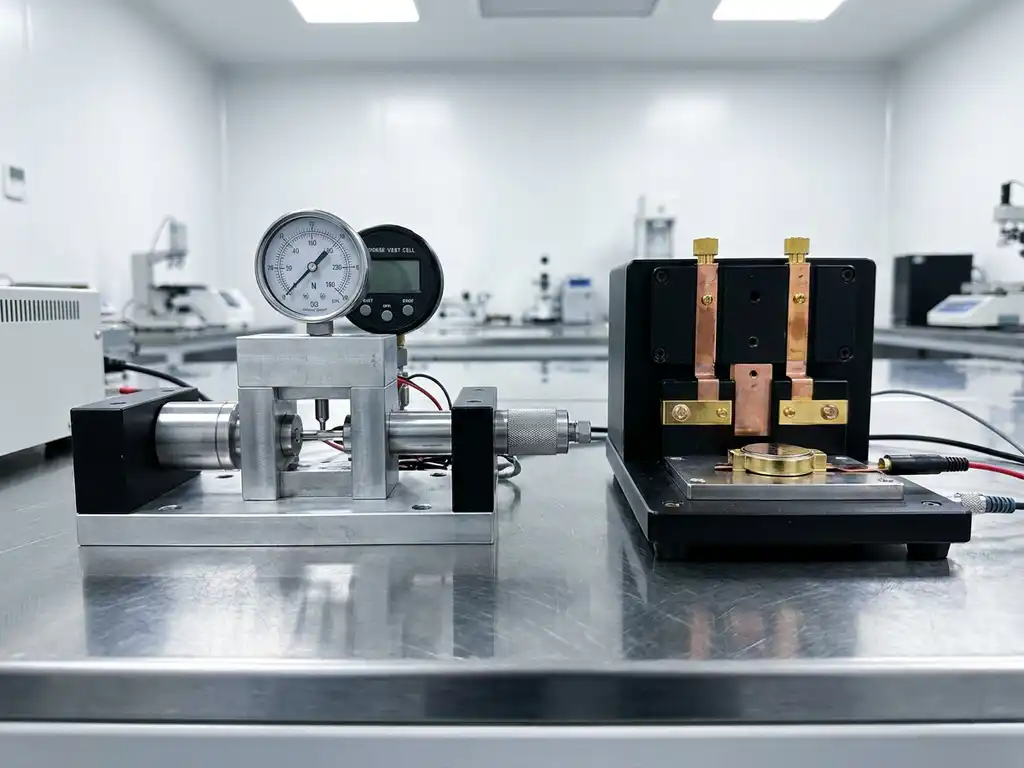
Force test cells and standard battery test fixtures differ in one fundamental way: force test cells apply and monitor a defined mechanical load on the electrode stack, while standard fixtures simply hold the cell together with no control over the pressure exerted on the electrodes. This distinction matters most in solid-state battery testing and any experiment where electrode volume change influences electrochemical behaviour. The sections below address the most common questions researchers ask when deciding between the two approaches.
What mechanical conditions do force test cells actually control?
Force test cells control the compressive load applied perpendicular to the electrode stack. A defined, reproducible pressure is maintained throughout cycling, and in more advanced designs the applied force can be varied systematically or held constant using a spring mechanism or an external press. This gives researchers direct control over a variable that is otherwise left to chance in a standard fixture.
In practice, the mechanical parameters that a force test cell addresses include:
- Stack pressure: the compressive force per unit area acting on the electrodes and separator
- Pressure evolution: changes in force that occur as electrodes expand or contract during lithiation and delithiation
- Constraint conditions: whether the cell is held at constant thickness (constrained) or constant force (compliant)
Controlling these parameters is particularly important in solid-state battery testing, where the solid electrolyte requires intimate interfacial contact that is highly sensitive to applied pressure. Even small deviations in stack pressure can alter ionic conductivity at grain boundaries and affect the reproducibility of capacity and impedance measurements.
What do standard battery test fixtures lack by comparison?
Standard battery test fixtures provide mechanical containment and electrical contact, but they do not control or measure the force acting on the electrode stack. The clamping force is set manually, typically by tightening screws to a torque value, and it changes freely as electrodes swell or shrink during cycling. There is no feedback, no measurement, and no guarantee that two nominally identical assemblies experience the same pressure.
This creates several practical limitations:
- Electrode swelling during lithiation increases contact pressure unpredictably, which can compress the separator and alter transport properties
- Electrode contraction during delithiation reduces contact pressure, potentially increasing interfacial resistance
- Cell-to-cell variability in assembly torque introduces scatter that is difficult to decouple from material-related effects
- Solid electrolytes may crack or delaminate if pressure is not maintained within a controlled range
For many liquid-electrolyte half-cell experiments using well-characterised intercalation materials, these limitations are acceptable. The electrolyte compensates for minor geometric changes, and the primary measurement objective is electrochemical rather than mechanical. However, as soon as the research question involves electrode mechanics, solid electrolytes, or high-strain materials such as silicon or lithium metal, standard fixtures introduce uncontrolled variables that compromise data quality.
When should researchers choose a force test cell over a standard fixture?
Researchers should choose a force test cell when the mechanical state of the electrode stack is either a variable under investigation or a parameter that must be held constant to obtain reproducible data. This applies most directly to solid-state battery testing, silicon anode research, lithium metal anodes, and any study examining the relationship between electrode expansion and electrochemical performance.
More specifically, a force test cell is the appropriate choice when:
- The electrolyte is solid or composite and requires a minimum contact pressure to function
- The active material undergoes large volume changes (greater than approximately 10%) during cycling
- The experiment is designed to measure how applied pressure affects capacity retention, coulombic efficiency, or impedance
- Results need to be directly comparable across different laboratories or instrument generations
- The research output is intended for publication, and mechanical conditions must be fully reported
Standard fixtures remain appropriate for routine liquid-electrolyte experiments with low-strain intercalation materials where the primary objective is electrochemical characterisation rather than mechanical investigation. For a broader overview of how modular test cell platforms address these requirements, see the PAT Series Overview.
How does stack pressure affect battery performance data?
Stack pressure affects battery performance data through several coupled mechanisms. Pressure influences interfacial contact resistance, electrolyte transport through the separator, and the mechanical integrity of electrode coatings. In solid-state systems, pressure directly determines the quality of grain-to-grain contact within the electrolyte layer, which governs ionic conductivity and the onset of void formation at the lithium metal interface.
In liquid-electrolyte cells, the effects are more subtle but still measurable. Elevated stack pressure can compress the separator, reducing porosity and increasing tortuosity for ion transport. This elevates the effective electrolyte resistance and can shift the apparent overpotential at high C-rates. Conversely, insufficient pressure allows electrode delamination, which increases contact resistance and degrades capacity retention over extended cycling.
For silicon-based anodes, where volumetric expansion can exceed 300% at full lithiation, uncontrolled pressure leads to highly variable mechanical constraint conditions from one cycle to the next. A force test cell that records the evolution of stack force throughout cycling provides data that can be correlated directly with differential capacity analysis, electrochemical impedance spectroscopy (EIS), or dilatometry measurements, enabling a more complete mechanistic picture of degradation. The ECD-4-nano electrochemical dilatometer is well suited to this kind of combined mechanical and electrochemical investigation.
Can force test cells be combined with other in-situ measurements?
Yes, force test cells can be combined with other in-situ measurement techniques, and this is one of their principal advantages in a research context. Because the mechanical boundary conditions are defined and stable, the cell geometry is predictable enough to support simultaneous optical, acoustic, or dilatometric measurements without the mechanical state of the cell being an uncontrolled confounding variable.
Common combinations include:
- EIS under controlled pressure: impedance spectra acquired at defined stack pressures allow separation of bulk electrolyte resistance from interfacial contributions that are pressure-dependent
- Dilatometry with force measurement: simultaneous tracking of electrode thickness and the force required to maintain that thickness provides a direct measure of electrode stiffness and its evolution with state of charge
- Optical observation: in cells with transparent windows, controlled pressure prevents geometric distortion that would otherwise compromise image quality during in-situ microscopy
Integrating force measurement with electrochemical cycling also enables researchers to apply defined pressure profiles during formation cycling, which is particularly relevant for solid-state battery testing where the formation protocol strongly influences long-term performance. The ability to apply controlled stack pressure throughout the full experimental sequence, rather than only at the point of assembly, represents a meaningful improvement in experimental control compared to standard fixtures. The PAT-Cell-Force is designed precisely for this purpose, and it operates within the broader PAT Core Concept platform to support multi-modal in-situ characterisation.
How EL-Cell GmbH supports force-controlled battery research
EL-Cell GmbH designs test cells and supporting instrumentation specifically for researchers who need precise mechanical control alongside electrochemical measurement. Our product range addresses the full spectrum of force-controlled experiments, from routine stack-pressure studies to advanced multi-modal in-situ characterisation.
- The PAT-Cell-Force applies a defined, reproducible compressive load to the electrode stack and is compatible with the full PAT Series ecosystem, including the PAT-Tester-i-16 for multi-channel cycling with EIS capability
- The PAT-Cell-Solid is designed specifically for solid-state battery testing, providing the mechanical boundary conditions that solid electrolytes require for reliable interfacial contact
- The PAT-Cell-Press accommodates externally applied press loads for experiments requiring higher or more precisely calibrated pressures than spring-loaded designs provide
- The ECD-4-nano electrochemical dilatometer can be used alongside force test cells to correlate thickness evolution with force data, providing a complete picture of electrode mechanics during cycling
All of these instruments are designed to work together within a single, compatible research platform, reducing integration effort and ensuring that mechanical, electrochemical, and dimensional data are acquired under consistent, well-defined conditions. If you are designing an experiment that requires controlled stack pressure or are transitioning from liquid-electrolyte to solid-state battery testing, contact EL-Cell GmbH to discuss which configuration best suits your experimental requirements. You can also explore our Application Laboratory for measurement services and expert support in configuring the right experimental setup.
Comments are closed.