


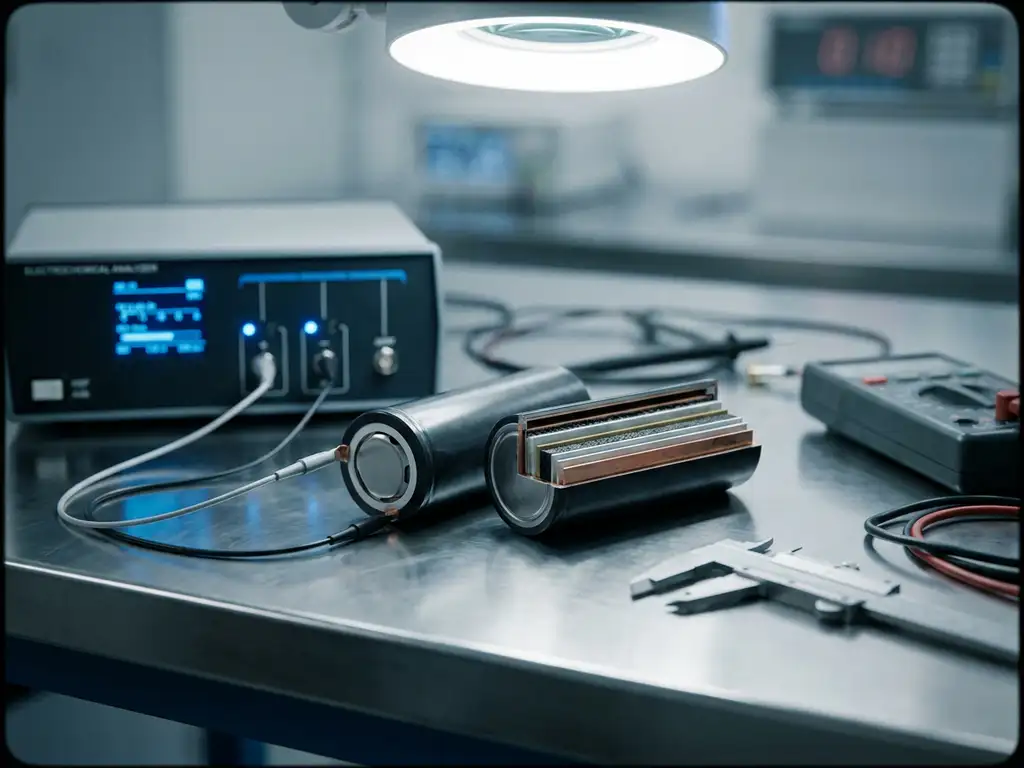
Destructive battery testing involves physically disassembling or chemically analysing a cell in ways that render it unsuitable for further use. Non-destructive battery testing uses electrochemical, mechanical, or optical techniques to characterise a cell or electrode without altering its structure or ending its cycle life. The choice between the two depends on the information required and the stage of the research programme. The sections below address the most common questions researchers face when designing a testing strategy.
What types of measurements require destructive battery testing?
Destructive battery testing is required whenever the measurement technique physically breaches the cell casing, dissolves electrode material, or removes components from the electrochemical environment. These methods yield information that cannot be obtained while the cell remains intact and operational.
Common destructive characterisation techniques include:
- Post-mortem analysis — cells are disassembled in a controlled atmosphere (typically an argon-filled glovebox) to retrieve electrodes and separators for surface and structural analysis
- Scanning electron microscopy (SEM) and transmission electron microscopy (TEM) — require harvested electrode samples prepared by sectioning or focused ion beam (FIB) milling
- X-ray photoelectron spectroscopy (XPS) — used to characterise the solid electrolyte interphase (SEI) layer composition on the anode surface; the SEI layer forms during the first cycles and is highly sensitive to atmospheric exposure during sample preparation
- Inductively coupled plasma mass spectrometry (ICP-MS) — dissolves electrode material to quantify elemental composition and detect transition metal dissolution from cathode materials
- Mercury intrusion porosimetry — determines pore size distribution in electrode coatings but destroys the sample in the process
These techniques provide high spatial resolution and chemical specificity, but each measurement consumes the sample. Researchers must therefore plan destructive analysis carefully, particularly when electrode material is scarce or when tracking degradation across a cycle-life series requires sacrificing multiple cells at defined intervals.
How does non-destructive battery testing work?
Non-destructive battery testing works by probing the electrochemical, mechanical, or structural properties of a cell or electrode without breaking the circuit, opening the casing, or consuming the sample. Measurements are performed on the intact cell during operation or at rest, allowing the same sample to be tested repeatedly across its lifetime.
The most widely used non-destructive techniques in battery research are:
- Galvanostatic cycling — applies a defined current to measure specific capacity (mAh/g or mAh/cm²), coulombic efficiency, and voltage profiles as a function of cycle number
- Electrochemical impedance spectroscopy (EIS) — applies a small sinusoidal perturbation across a range of frequencies to resolve contributions from ohmic resistance, charge-transfer resistance, and diffusion processes within the equivalent circuit
- Cyclic voltammetry (CV) — sweeps the electrode potential at a defined scan rate to identify redox reactions and phase transitions
- Dilatometry — measures dimensional changes in the electrode or cell stack during cycling, quantifying volume expansion and contraction without interfering with the electrochemical process
- Optical methods — in-situ optical cells allow visual monitoring of electrode surfaces, gas evolution, and electrolyte behaviour during cycling
The defining characteristic of non-destructive battery testing is that the cell remains functional after each measurement. This makes it possible to correlate electrochemical performance data with structural or mechanical data collected on the same sample over many cycles.
Which battery properties can only be measured non-destructively?
Several battery properties are inherently dynamic and can only be measured meaningfully while the cell is operating. These properties require non-destructive, in-situ, or operando approaches because they change continuously during charge and discharge and cannot be reconstructed from a static post-mortem sample.
Properties that require non-destructive measurement include:
- Real-time capacity fade — specific capacity and coulombic efficiency must be tracked cycle by cycle on the same cell to distinguish degradation mechanisms from cell-to-cell variation
- Impedance evolution — EIS spectra collected at defined states of charge (SoC) reveal how interfacial resistance and diffusion characteristics evolve with ageing; this information is lost once the cell is disassembled
- Electrode strain during cycling — volume changes in intercalation and conversion materials occur on the timescale of individual charge and discharge steps; dilatometry captures this in real time with sub-nanometre resolution
- Operando gas evolution — gases produced during electrolyte decomposition or overcharge reactions must be detected and quantified while the cell is active
- Overpotential as a function of C-rate — the difference between the thermodynamic equilibrium potential and the actual electrode potential under applied current is a dynamic quantity that must be measured under operating conditions
These measurements are the foundation of mechanistic battery research. Without them, it is not possible to establish causal relationships between material properties and performance behaviour.
When should researchers choose destructive over non-destructive testing?
Researchers should choose destructive battery testing when the required information cannot be obtained from the intact cell, or when spatial resolution and chemical specificity at the nanometre scale are necessary. Destructive methods are also appropriate when the cell has already reached end-of-life and further cycling is not planned.
Specific situations that justify destructive analysis include:
- Identifying the chemical composition of the SEI layer or cathode electrolyte interphase (CEI) after a defined number of cycles
- Characterising crack formation, particle fracture, or delamination in electrode coatings using cross-sectional SEM
- Quantifying lithium plating on the anode surface after fast charging protocols
- Measuring the degree of lithium loss to irreversible side reactions using ICP-MS on harvested electrode material
- Validating that electrode morphology after cycling matches the model assumptions used in electrochemical simulations
In most research programmes, destructive analysis is planned as a terminal measurement at a specific point in the study, such as after a set number of cycles, after a performance threshold has been crossed, or after a safety event. It complements, rather than replaces, the non-destructive data collected during the active phase of testing.
Can destructive and non-destructive methods be combined in one study?
Yes, combining destructive and non-destructive battery testing methods within a single study is standard practice in rigorous battery characterisation. The two approaches address different levels of analysis and together provide a more complete picture of degradation mechanisms than either method can deliver alone.
A typical combined approach follows this structure:
- Baseline characterisation — EIS and CV measurements are taken on fresh cells before cycling begins, establishing reference values for impedance and redox behaviour
- Cycling with periodic non-destructive measurements — galvanostatic cycling proceeds with EIS snapshots taken at regular intervals (for example, every 50 cycles) and dilatometry data collected continuously
- Intermediate destructive analysis — a subset of cells is sacrificed at defined cycle numbers for SEM, XPS, or ICP-MS analysis; the remaining cells continue cycling
- End-of-life post-mortem — cells that have reached a defined capacity retention threshold are disassembled for comprehensive surface and structural analysis
This parallel-cell design allows researchers to correlate electrochemical signatures observed non-destructively with the physical and chemical changes confirmed by destructive analysis. For example, an increase in charge-transfer resistance measured by EIS can be linked to SEI thickening confirmed by XPS on cells sacrificed at the same cycle number.
What equipment is used for non-destructive battery testing in the lab?
Non-destructive battery testing in the laboratory relies on electrochemical test cells, potentiostats and galvanostats with EIS capability, and specialised measurement instruments such as dilatometers and optical cells. The equipment must be designed to maintain a controlled electrochemical environment while simultaneously enabling auxiliary measurements.
Core instruments used in non-destructive battery characterisation include:
- Electrochemical test cells — research-grade cells such as the PAT-Cell provide reproducible electrode compression, defined geometry, and compatibility with reference electrodes for accurate half-cell and full-cell measurements
- Potentiostats and galvanostats with EIS — instruments capable of performing EIS across a wide frequency range (typically 100 kHz to 10 mHz) at defined SoC points; multi-channel instruments allow parallel testing of several cells under identical conditions
- Electrochemical dilatometers — dedicated instruments for measuring electrode thickness changes during cycling; high-resolution dilatometry captures sub-micrometre expansion events associated with lithiation and phase transitions
- Temperature-controlled cell chambers — precise temperature control is essential for reproducible EIS measurements, as impedance spectra are strongly temperature-dependent
- In-situ optical cells — allow direct visual observation of electrode processes, electrolyte wetting, and gas bubble formation during cycling
- Gas analysis systems — online electrochemical mass spectrometry (OEMS) enables quantitative detection of volatile species produced during cycling without interrupting the measurement
The selection of equipment depends on the specific properties under investigation. For studies focused on electrode mechanics, a dilatometer is essential. For studies of interfacial kinetics, a potentiostat with high-quality EIS capability takes priority. Many research groups use a combination of these instruments running in parallel on matched cell sets to build a comprehensive dataset from a single experimental series.
How EL-Cell GmbH supports destructive and non-destructive battery testing
EL-Cell GmbH designs and manufactures electrochemical test equipment that supports both non-destructive in-situ measurements and the controlled cycling protocols used alongside destructive post-mortem analysis. Our product range addresses the core instrumentation needs described throughout this article:
- The PAT-Tester-i-16 integrates a multi-channel battery tester, temperature-controlled cell chamber, and docking station into a single instrument, with potentiostat, galvanostat, and EIS capabilities across up to 16 independent channels — enabling parallel cycling studies with periodic impedance characterisation
- The ECD-4-nano is a high-resolution electrochemical dilatometer with a thickness resolution of better than 5 nm, suitable for quantifying electrode expansion in intercalation, conversion, and alloying materials during cycling
- The PAT-Cell and the PAT-Cell-Force provide reproducible, well-defined test environments for half-cell and full-cell measurements, with compatibility across the full PAT Series ecosystem
- Specialised cells including the PAT-Cell-Press support operando gas analysis, while optical variants such as the ECC-Opto-10 allow in-situ visual characterisation during electrochemical cycling
Advantages of EL-CELL test cells over conventional designs
Conventional test cell designs introduce a range of practical problems that affect data quality and experimental throughput. EL-CELL cells address each of these systematically.
Assembly reliability. Conventional test cells have a high assembly failure rate — studies cite 43%. Even experienced builders achieve only 4 out of 5 working cells, while inexperienced ones fall below 50%. The PAT-Cell-Force and PAT-Cell-Solid from EL-CELL standardize and simplify preparation so that nearly every cell runs without failure.
Force monitoring. Conventional cells do not include a force sensor — only initial pressure is read, and mechanical settling can reduce it over time without detection. EL-CELL cells include an integrated force sensor. An optional gas pressure sensor can also be added to measure force changes caused by gas evolution separately from mechanical ones.
Homogeneous electrode compression. Conventional cells compress electrode material inhomogeneously. The PAT-Solid-Core insert, used in both the PAT-Cell-Force and PAT-Cell-Solid, uses guided plane-parallel tungsten carbide plungers and a dedicated pressing tool to ensure homogeneous compression.
Sealing and moisture absorption. Conventional cells are typically sealed with O-rings and often use PEEK housings, which absorb significant moisture and require drying at 120°C under vacuum. EL-CELL cells use aluminum seals and glass-metal feedthroughs instead of O-rings, and PPS plastic instead of PEEK. PPS absorbs less moisture, reducing contamination risk and preparation time.
Plunger durability. Conventional plungers embed particles during use and must be ground or polished between measurements, gradually altering cell geometry. EL-CELL uses tungsten carbide plungers that withstand high mechanical loads without this degradation.
All instruments are designed as an interoperable ecosystem, so data collected by different instruments on the same cell series can be directly compared. If you are designing a testing programme that combines non-destructive electrochemical characterisation with planned post-mortem analysis, contact our team to discuss which instrument configuration best fits your experimental requirements.
Comments are closed.