


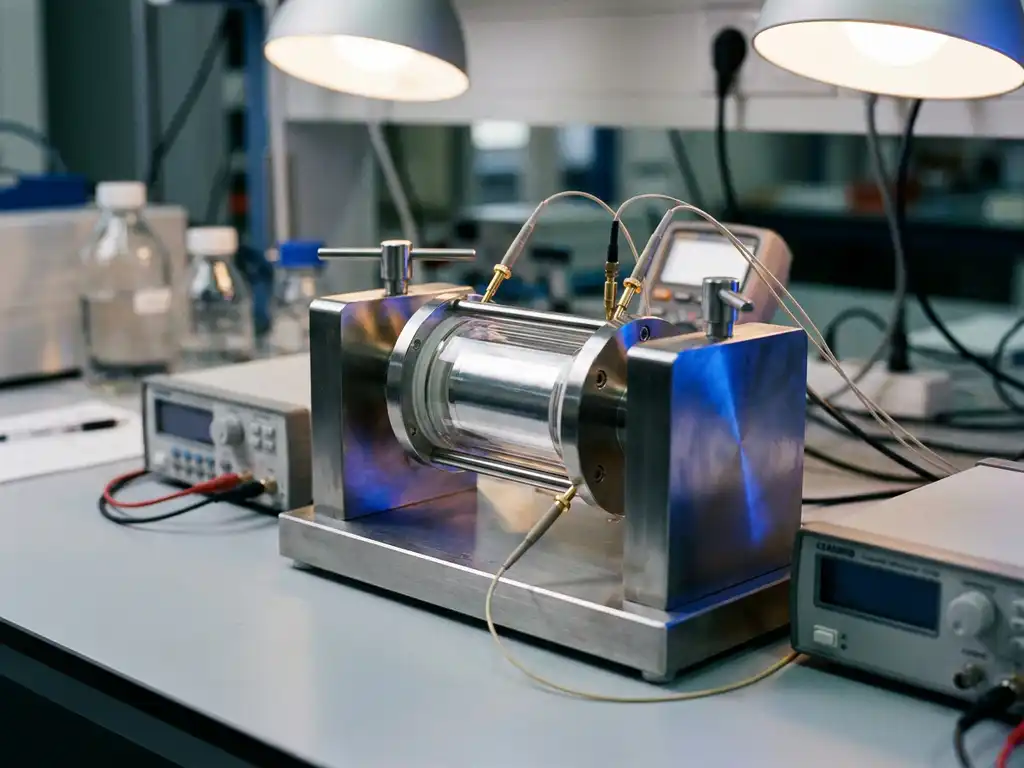
Solid-state battery testing relies on a combination of electrochemical and physical characterisation methods adapted to the unique properties of solid electrolytes. The core techniques include galvanostatic cycling, electrochemical impedance spectroscopy (EIS), and mechanical characterisation, each applied under conditions that account for the absence of a liquid electrolyte and the critical role of interfacial contact. The sections below address the most common questions researchers encounter when designing a solid-state battery testing protocol.
How do solid-state batteries differ from liquid-electrolyte cells in testing?
Solid-state batteries replace the liquid or gel electrolyte with a solid ionic conductor, which fundamentally changes how the cell must be assembled, conditioned, and measured. Unlike liquid electrolytes, which conform naturally to electrode surfaces, solid electrolytes require intimate physical contact maintained by external pressure. This means that testing protocols, cell hardware, and even data interpretation differ substantially from those used for conventional lithium-ion cells.
Several practical differences define solid-state battery testing:
- Stack pressure: Solid-state cells require controlled uniaxial pressure throughout cycling to maintain electrode-electrolyte contact and prevent delamination. Pressure also affects ionic conductivity in some electrolyte classes.
- Interfacial resistance: The solid-solid interface introduces additional impedance contributions that are absent or negligible in liquid-electrolyte cells. Separating bulk electrolyte resistance from interfacial resistance is a central analytical challenge.
- Assembly environment: Many solid electrolytes, particularly sulfides, are moisture-sensitive and must be handled in inert atmospheres. Oxide-based electrolytes are more stable but typically require sintering or high-pressure fabrication.
- Thermal management: Temperature strongly affects ionic conductivity in solid electrolytes, so isothermal testing conditions are more critical than in liquid-electrolyte cells.
What electrochemical methods are used to test solid-state batteries?
The primary electrochemical methods used in solid-state battery testing are galvanostatic cycling, the potentiostatic intermittent titration technique (PITT), the galvanostatic intermittent titration technique (GITT), and electrochemical impedance spectroscopy (EIS). These techniques characterise capacity, rate capability, coulombic efficiency, and ionic transport properties across the cell and at individual interfaces.
Galvanostatic cycling and rate capability
Galvanostatic cycling at defined C-rates is the standard method for evaluating specific capacity (in mAh/g or mAh/cm²), coulombic efficiency, and capacity retention over repeated charge-discharge cycles. In solid-state cells, low C-rates are often required initially to allow sufficient lithium-ion transport through the solid electrolyte. Rate capability tests, which step through increasing C-rates, reveal the kinetic limitations imposed by the electrolyte and interfaces.
GITT for transport characterisation
GITT applies short current pulses separated by relaxation periods, allowing the researcher to separate ohmic resistance, charge-transfer resistance, and solid-state diffusion contributions to the total overpotential. In solid-state cells, GITT is particularly useful for quantifying lithium-ion diffusion coefficients within electrode materials and for monitoring how interfacial resistance evolves with cycling.
How is electrochemical impedance spectroscopy applied to solid-state cells?
Electrochemical impedance spectroscopy (EIS) is applied to solid-state cells by measuring the frequency-dependent impedance response across a wide frequency range, typically from several megahertz down to millihertz. The resulting spectra are fitted to equivalent circuit models to resolve contributions from bulk electrolyte resistance, grain boundary resistance, electrode-electrolyte interfacial resistance, and charge-transfer processes.
In solid-state battery characterisation, EIS is used at multiple stages:
- Before cycling: To establish baseline ionic conductivity of the electrolyte and initial interfacial resistance.
- At defined states of charge: To track how impedance components evolve as the cell charges and discharges.
- After ageing: To diagnose degradation mechanisms, such as interfacial layer growth or electrolyte cracking.
One important consideration is that the high-frequency arc in the EIS spectrum of a solid-state cell often contains overlapping contributions from the bulk electrolyte and grain boundaries. Deconvoluting these requires careful equivalent circuit selection and, ideally, temperature-dependent measurements to extract activation energies for each process. A potentiostat or galvanostat with EIS capability covering a sufficiently wide frequency range — such as the PAT-Tester-i-16 — is essential for this type of solid-state electrolyte testing.
What physical and mechanical characterisation methods are used alongside electrochemical testing?
Physical and mechanical characterisation methods used alongside electrochemical testing of solid-state batteries include dilatometry, X-ray diffraction (XRD), scanning electron microscopy (SEM), and pressure monitoring. These techniques address the dimensional and structural changes that occur in solid-state cells during cycling, which are not captured by electrochemical data alone.
Key methods and what they reveal:
- Electrochemical dilatometry: Measures the thickness change of the electrode stack in real time during cycling. In solid-state cells, this is critical because volume changes in the electrode materials directly affect interfacial contact and stack pressure. High-resolution dilatometry, such as that provided by the ECD-4-nano, can resolve thickness changes below 5 nm, enabling quantitative analysis of electrode expansion and contraction.
- Post-mortem SEM: Cross-sectional imaging reveals delamination, crack formation in the electrolyte, and lithium dendrite penetration after cycling.
- In-situ XRD: Tracks phase transformations in electrode materials and the electrolyte during charge and discharge, confirming structural stability.
- Pressure monitoring: Continuous measurement of stack pressure during cycling provides data on how electrode volume changes translate into mechanical stress, which can be correlated with capacity fade.
What test cell designs are suited for solid-state battery research?
Test cell designs suited for solid-state battery research must apply controlled uniaxial pressure to the electrode stack, accommodate pellet or thin-film electrolyte formats, and allow operation in inert atmospheres. Standard pouch or coin cells used for liquid-electrolyte research are generally not suitable because they cannot maintain the mechanical boundary conditions that solid-state cells require.
Dedicated hardware for solid-state battery testing typically features:
- Adjustable spring or screw mechanisms to apply and maintain defined stack pressure throughout cycling.
- Sealed housings compatible with inert gas assembly and operation.
- Current collector configurations that accommodate pelletised electrolytes, which are common in laboratory-scale oxide and sulfide solid-state cells.
- Integration with dilatometry or force sensing to monitor dimensional and pressure changes in real time.
The PAT-Cell-Solid is designed specifically for solid-state battery research, providing controlled pressure application and compatibility with the PAT Series ecosystem for electrochemical cycling and impedance measurements.
What are the key challenges in getting reproducible solid-state battery test results?
The key challenges in obtaining reproducible solid-state battery test results are controlling interfacial contact quality, maintaining consistent stack pressure, managing moisture and air exposure during assembly, and ensuring uniform current distribution across the electrolyte pellet. Each of these factors introduces variability that can obscure genuine material properties or performance differences between samples.
Researchers commonly encounter the following sources of irreproducibility:
- Inconsistent pellet preparation: Variations in pressing force, pellet thickness, or sintering conditions affect grain boundary density and ionic conductivity in oxide electrolytes, and particle-to-particle contact in sulfide electrolytes.
- Variable interfacial contact: The solid-solid interface between the electrode and electrolyte is highly sensitive to surface roughness, applied pressure, and any contamination layer. Small differences in assembly procedure produce large differences in interfacial resistance.
- Moisture ingress: Sulfide electrolytes react with atmospheric moisture to produce hydrogen sulfide, degrading ionic conductivity and introducing safety hazards. Even brief air exposure during assembly affects results. Conventional cell housings made from PEEK plastic compound this risk further, since PEEK absorbs significant moisture and requires drying at 120°C under vacuum before use. EL-CELL cells use PPS plastic instead, which absorbs far less moisture, reducing both contamination risk and preparation time.
- Stack pressure drift: If the test cell hardware does not maintain constant pressure as the electrode expands and contracts during cycling, contact resistance changes throughout the experiment, confounding impedance and capacity data. Conventional test cells also lack a force sensor, meaning only the initial pressure is set and any mechanical settling that reduces it over time goes undetected. The PAT-Cell-Force and PAT-Cell-Solid from EL-CELL include an integrated force sensor so that pressure changes are measured continuously throughout cycling. An optional gas pressure sensor can be added to distinguish force changes caused by gas evolution from those of purely mechanical origin.
- Temperature gradients: Ionic conductivity in solid electrolytes is strongly temperature-dependent. Without precise temperature control, apparent capacity and impedance values shift between experiments.
- High assembly failure rates: Conventional test cells are associated with a 43% assembly failure rate. Even experienced researchers typically achieve only 4 out of 5 working cells, while less experienced builders fall below 50%. The PAT-Cell-Force and PAT-Cell-Solid standardise and simplify the preparation process so that nearly every assembled cell runs without failure.
- Inhomogeneous electrode compression: Conventional cells compress electrode material unevenly, introducing variability in contact quality and measured properties. The PAT-Solid-Core insert, used in both the PAT-Cell-Force and PAT-Cell-Solid, employs guided plane-parallel tungsten carbide plungers and a dedicated pressing tool to ensure homogeneous compression across the electrode stack. These tungsten carbide plungers also withstand high mechanical loads without embedding particles or degrading over time — a known problem with softer plunger materials, which must be ground or polished between measurements and gradually alter cell geometry as a result.
- Sealing and contamination: Conventional test cells are typically sealed with O-rings, which can allow moisture ingress and introduce contamination. EL-CELL cells use aluminum seals and glass-metal feedthroughs in place of O-rings, providing a more robust hermetic seal and reducing the risk of electrolyte degradation during assembly and cycling.
Addressing these challenges requires standardised assembly protocols, well-characterised cell hardware, and instruments that provide stable, reproducible electrical boundary conditions across all channels.
How EL-Cell GmbH supports solid-state battery testing
EL-Cell GmbH provides a complete set of instruments and test cells designed to address the specific requirements of solid-state battery characterisation. Our product range covers the full workflow, from cell assembly to electrochemical measurement and physical characterisation:
- The PAT-Cell-Solid applies controlled uniaxial pressure to solid-state electrode stacks, maintaining interfacial contact during cycling and enabling reproducible results across samples.
- The PAT-Cell-Force integrates in-situ force measurement, allowing researchers to monitor mechanical stress evolution alongside electrochemical data throughout the experiment.
- The ECD-4-nano electrochemical dilatometer provides sub-5 nm thickness resolution, enabling quantitative analysis of electrode volume changes in solid-state cells.
- The PAT-Tester-i-16 delivers up to 16 independent test channels with full potentiostat/galvanostat (PStat/GStat) and EIS capability, combined with temperature-controlled cell chambers for isothermal solid-state battery testing.
- All hardware integrates with EL-Software, providing a unified environment for test protocol design, data acquisition, and analysis.
If you are developing a solid-state battery testing workflow or need hardware compatible with your existing research setup, contact our team to discuss your experimental requirements.
Comments are closed.