


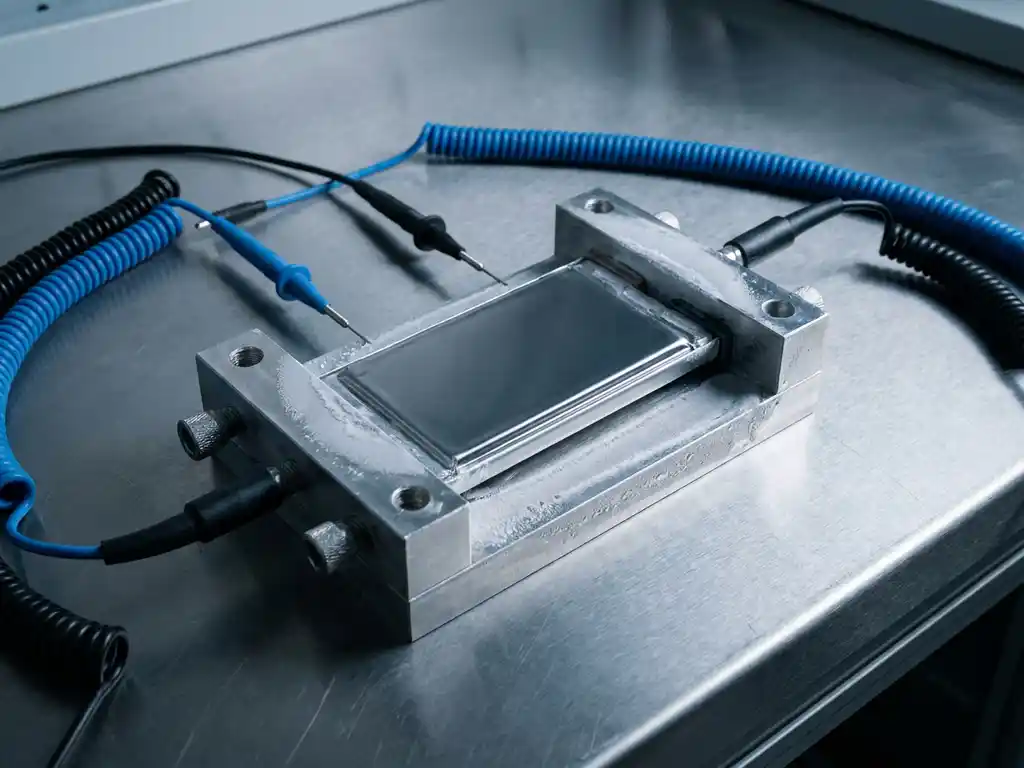
Solid-state battery testing requires specialised hardware and protocols that differ substantially from those used for conventional liquid electrolyte cells. Because solid-state electrolytes are mechanically rigid and ionically sensitive to interfacial contact, standard coin cell formats and liquid-based assumptions do not transfer directly. The sections below address the key experimental questions researchers encounter when setting up solid-state battery characterisation workflows.
What makes solid-state batteries more difficult to test than liquid electrolyte cells?
Solid-state batteries present unique testing challenges because the electrolyte is a rigid or semi-rigid solid rather than a liquid that self-wets electrode surfaces. Ionic conduction across electrode-electrolyte interfaces depends critically on physical contact, which cannot be established simply by filling a cell with solution. This means that cell assembly procedures, applied pressure, and stack geometry all become primary experimental variables rather than secondary concerns.
Several additional factors distinguish solid-state battery testing from conventional electrochemical characterisation:
- Interface resistance: Poor contact between the solid electrolyte and electrode materials generates high interfacial impedance that can dominate measured cell resistance and mask intrinsic material properties.
- Mechanical constraints: Electrode volume changes during cycling can fracture brittle solid electrolytes, making dimensional monitoring essential.
- Atmospheric sensitivity: Many solid-state electrolyte materials, particularly sulphide-based compounds, are highly sensitive to moisture and oxygen, requiring inert assembly environments.
- Temperature dependence: Ionic conductivity in solid electrolytes is strongly temperature-dependent, so isothermal control is critical for reproducible results.
What electrochemical tests are used to evaluate solid-state batteries?
Solid-state battery characterisation relies on the same core electrochemical methods used for liquid cells, but each test must be interpreted with solid-state-specific considerations in mind. The principal techniques are galvanostatic cycling, rate capability testing, electrochemical impedance spectroscopy (EIS), and cyclic voltammetry (CV).
Galvanostatic cycling at defined C-rates provides specific capacity in mAh/g (or mAh/cm² for thin-film architectures) and tracks coulombic efficiency over repeated charge-discharge cycles. Coulombic efficiency is a particularly sensitive indicator in solid-state systems because irreversible lithium consumption at interfaces is not masked by electrolyte decomposition products in the same way as in liquid cells.
Rate capability testing, in which the cell is cycled at progressively higher C-rates, quantifies how well ionic transport through the solid electrolyte sustains capacity at practical current densities. Capacity retention at high C-rates reflects the combined effect of bulk ionic conductivity, interfacial resistance, and electrode tortuosity.
CV is used to identify redox processes, detect parasitic reactions at electrode-electrolyte interfaces, and assess the electrochemical stability windows of the solid electrolyte itself.
How does stack pressure affect solid-state battery test results?
Stack pressure is one of the most consequential experimental variables in solid-state battery testing because applied mechanical load directly controls interfacial contact area between the solid electrolyte and electrode layers. Insufficient pressure results in elevated interfacial resistance and non-uniform current distribution; excessive pressure can fracture brittle electrolyte pellets or cause electrode delamination.
Reproducible results require that stack pressure be defined, maintained, and reported as part of the experimental protocol. For oxide-based solid electrolytes, pressures in the range of a few MPa are commonly used, whereas sulphide-based systems may require lower pressures due to their more deformable nature. Pressure also interacts with electrode expansion: as active materials expand during lithiation, the stack pressure rises unless the cell hardware accommodates dimensional change.
Conventional test cells do not include a force sensor — only the initial pressure is set, and mechanical settling can reduce it over time without detection. The PAT-Cell-Force addresses this directly with an integrated force sensor that monitors stack pressure throughout the experiment. An optional gas pressure sensor can also be added, allowing force changes caused by gas evolution to be distinguished from purely mechanical ones. Comparing results across laboratories or between cycling conditions is only meaningful when stack pressure is controlled and documented, making hardware with defined and measurable force application essential for systematic solid-state battery research.
What is electrochemical impedance spectroscopy and why is it essential for solid-state cells?
Electrochemical impedance spectroscopy (EIS) is a technique in which a small sinusoidal voltage or current perturbation is applied to a cell across a range of frequencies, and the resulting impedance response is measured. EIS is essential for solid-state battery characterisation because it can deconvolute contributions from bulk electrolyte resistance, grain boundary resistance, and electrode-electrolyte interfacial resistance, which are all present simultaneously in solid-state systems.
In a liquid electrolyte cell, bulk electrolyte resistance is typically small and relatively constant. In a solid-state cell, grain boundary conduction and interfacial contact resistance can each contribute substantially to total cell impedance, and these contributions appear at different characteristic frequencies in the EIS spectrum. Fitting equivalent circuit models to the impedance data allows researchers to track how each resistance component evolves with cycling, temperature, or applied pressure.
EIS is also used to monitor the formation and growth of interphases at electrode surfaces. In solid-state systems, these interphases are often referred to as solid electrolyte interphase (SEI) layers on the anode side, and their impedance contribution can be isolated from other resistive elements using frequency-resolved analysis. The PAT-Tester-i-16 supports EIS measurements across all 16 channels, enabling parallel impedance characterisation of multiple solid-state cells under controlled conditions.
How do you monitor electrode expansion in solid-state battery testing?
Electrode expansion in solid-state batteries is monitored using electrochemical dilatometry, a technique that measures the thickness change of a cell stack as a function of state of charge or cycle number. Because solid electrolytes cannot accommodate volume changes through fluid redistribution as liquid electrolytes do, dimensional changes in active materials translate directly into mechanical stress within the stack.
Dilatometric measurements provide quantitative data on the expansion and contraction of electrode materials during lithiation and delithiation. This information is relevant for several reasons:
- Irreversible thickness increase across cycles indicates structural degradation, electrolyte cracking, or lithium plating.
- Asymmetric expansion and contraction profiles can reveal kinetic limitations or phase transformation behaviour in active materials.
- Operando dilatometry combined with galvanostatic cycling allows the mechanical and electrochemical responses to be correlated directly.
High-resolution dilatometry is particularly important for thin-film solid-state architectures, where absolute dimensional changes are small. Instruments capable of sub-nanometre resolution, such as the ECD-4-nano dilatometer, are well suited to this class of measurement.
What test cell hardware is best suited for solid-state battery research?
Test cell hardware for solid-state battery research must provide controlled and measurable uniaxial stack pressure, reliable electrical contacts, and compatibility with inert atmosphere assembly. Standard coin cell hardware is generally unsuitable because it applies poorly defined and uncontrolled pressure, and does not allow pressure to be varied or monitored during cycling.
Preferred hardware formats for solid-state battery testing include:
- Pressure-controlled test cells: Cells with defined spring or screw-applied loads that maintain consistent interfacial contact throughout cycling.
- Cells with integrated force monitoring: Hardware that measures actual stack force during the experiment, allowing pressure changes caused by electrode expansion to be recorded alongside electrochemical data.
- Temperature-controlled environments: Cell chambers that maintain isothermal conditions, which is essential given the strong temperature dependence of solid electrolyte conductivity.
- Hermetic sealing: Cells designed for assembly in a glovebox and capable of maintaining an inert atmosphere during extended cycling.
Conventional test cells have a high assembly failure rate — studies cite 43%, and even experienced builders achieve only around 4 out of 5 working cells, while inexperienced ones fall below 50%. The PAT-Cell-Force and the PAT-Cell-Solid from EL-CELL standardize and simplify preparation so that nearly every cell runs without failure. Both cells use the PAT-Solid-Core insert, which features guided plane-parallel tungsten carbide plungers and a dedicated pressing tool to ensure homogeneous compression of electrode material — a significant advantage over conventional cells, which compress electrode material inhomogeneously. The tungsten carbide plungers also withstand high mechanical loads without embedding particles or degrading, unlike conventional plungers that must be ground or polished between measurements, gradually altering cell geometry.
EL-CELL cells further improve on conventional designs through their sealing approach. Where conventional cells rely on O-rings and often use PEEK housings — which absorb significant moisture and require drying at 120°C under vacuum — EL-CELL cells use aluminum seals and glass-metal feedthroughs in place of O-rings, and PPS plastic instead of PEEK. PPS absorbs less moisture, reducing contamination risk and preparation time. The PAT-Cell-Force is specifically designed for pressure-controlled electrochemical testing and allows the applied stack force to be set and monitored, making it well suited to solid-state battery research. The PAT-Cell-Solid accommodates thicker and more rigid stack configurations typical of ceramic or sulphide electrolyte systems.
How EL-Cell GmbH supports solid-state battery testing
EL-Cell GmbH offers a complete set of instruments and test cells developed with solid-state battery characterisation requirements in mind. Our product range addresses the principal experimental challenges described above, from pressure control and impedance measurement to high-resolution dilatometry. All products are part of the PAT Series, a single interoperable research ecosystem built around a common cell format and measurement philosophy.
- PAT-Cell-Force: Enables defined and monitored uniaxial stack pressure throughout galvanostatic cycling and EIS measurements, with direct force readout integrated into the experimental workflow. An integrated force sensor tracks pressure continuously, and an optional gas pressure sensor allows force changes from gas evolution to be measured separately from mechanical ones.
- PAT-Cell-Solid: Accommodates solid electrolyte pellet geometries and supports inert atmosphere assembly, suitable for oxide, sulphide, and polymer electrolyte systems. Together with the PAT-Cell-Force, it uses the PAT-Solid-Core insert with guided plane-parallel tungsten carbide plungers for homogeneous electrode compression.
- ECD-4-nano: High-resolution electrochemical dilatometer with sub-5 nm resolution for operando monitoring of electrode and stack thickness changes in solid-state cells.
- PAT-Tester-i-16: Multichannel battery tester with integrated EIS capability across all 16 channels, temperature-controlled cell chamber, and full compatibility with the PAT-Cell series, enabling parallel solid-state battery characterisation under defined conditions.
All instruments are designed as part of a single interoperable research ecosystem, so data from cycling, impedance, and dilatometry measurements can be acquired and managed within a consistent workflow. Researchers requiring guidance on experimental setup for solid-state battery testing are welcome to contact our team to discuss specific requirements. You can also learn more about the underlying PAT Core Concept that unifies the hardware and measurement approach across the full product range.
Comments are closed.