


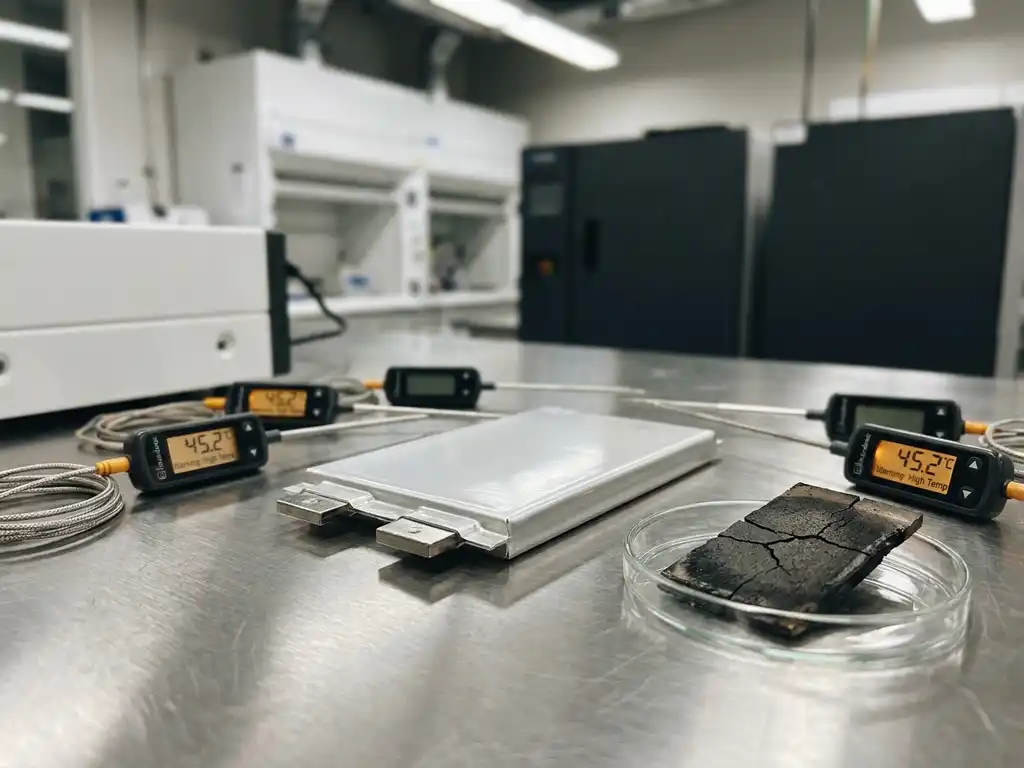
Accelerated aging tests can be used for solid-state batteries, but standard protocols developed for liquid-electrolyte cells often produce misleading results when applied without modification. The degradation mechanisms in solid-state cells differ fundamentally from those in conventional lithium-ion batteries, which means that elevated-temperature or high-rate stress conditions do not necessarily accelerate the same failure modes. The sections below address the key questions researchers face when designing aging studies for solid-state battery materials.
How do solid-state batteries degrade differently from liquid-electrolyte cells?
Solid-state batteries degrade through a distinct set of mechanisms that are largely absent in liquid-electrolyte cells. Rather than electrolyte decomposition and soluble side-product formation, degradation in solid-state systems is dominated by mechanical and interfacial processes that evolve with cycling.
The most significant difference lies at the electrode-electrolyte interface. In liquid-electrolyte cells, the solid electrolyte interphase (SEI) layer forms dynamically from solvent and salt decomposition products and can partially self-repair. In solid-state cells, contact between the electrode and the solid electrolyte is a physical interface under mechanical stress. Volume changes in the active material during lithiation and delithiation cause the interface to crack, delaminate, or develop voids, progressively increasing interfacial resistance over cycles.
Additional degradation pathways specific to solid-state cells include:
- Lithium dendrite penetration through grain boundaries or defects in the solid electrolyte, even under moderate stack pressures
- Chemo-mechanical cracking of brittle oxide or sulphide electrolyte particles under repeated strain
- Interdiffusion and secondary phase formation at the cathode-electrolyte interface, particularly with oxide cathodes
- Stack pressure loss over time, reducing ionic contact across the cell
These mechanisms are strongly coupled to mechanical boundary conditions, which makes the test cell geometry and applied pressure critical variables in any aging study.
What are accelerated aging tests designed to measure in batteries?
Accelerated aging tests are designed to compress the timescale of battery degradation by applying stress conditions that intensify the dominant failure mechanisms, allowing researchers to estimate cycle life, calendar life, or capacity fade without waiting for years of real-time cycling.
The most common acceleration strategies include:
- Elevated temperature to increase reaction kinetics and accelerate electrolyte decomposition, SEI growth, and lithium plating
- High C-rate cycling to amplify mechanical stress from rapid volume changes and increase overpotential-driven side reactions
- Extended voltage windows to force electrode materials into states of charge associated with accelerated structural degradation
- Accelerated calendar aging by storing cells at elevated temperature and high state of charge
The underlying assumption is that the same failure modes active during normal operation are simply accelerated, not replaced, by the stress conditions. This assumption is well-validated for many liquid-electrolyte lithium-ion chemistries, where temperature and rate dependencies follow Arrhenius-type behaviour. It is this assumption that breaks down most readily for solid-state cells.
Why can standard accelerated aging protocols misrepresent solid-state battery lifetime?
Standard accelerated aging protocols can misrepresent solid-state battery lifetime because the dominant degradation mechanisms in solid-state cells do not scale with temperature and rate in the same way as those in liquid-electrolyte systems. Applying conventional stress conditions can activate failure modes that would not occur under normal operating conditions, or suppress those that would.
Elevated temperature is a particular concern. For sulphide-based solid electrolytes, high temperatures can alter ionic conductivity, phase stability, and the nature of interfacial reactions in ways that do not reflect room-temperature behaviour. For oxide electrolytes, temperature changes the mechanical compliance of the electrolyte and the kinetics of interdiffusion at the cathode interface. The result is that capacity fade measured under thermal acceleration may correspond to a different failure mode than the one limiting real-world cycle life.
High C-rate acceleration presents a separate problem. In liquid-electrolyte cells, fast cycling primarily stresses the graphite anode through lithium plating and SEI growth. In solid-state cells, fast cycling increases the mechanical strain rate at the electrode-electrolyte interface and raises overpotential, which can drive interfacial reactions and dendrite nucleation that would not occur at lower rates. The accelerated test may therefore reflect a mechanically driven failure rather than the electrochemically driven one relevant to the application.
There is also the issue of stack pressure. Many solid-state cell formats require controlled external pressure to maintain interfacial contact. Standard aging fixtures designed for liquid-electrolyte pouch or coin cells do not apply or monitor this pressure, so mechanical degradation proceeds under unrepresentative boundary conditions. The PAT-Cell-Press or similar pressure-controlled test cell is therefore not just a convenience but a requirement for meaningful solid-state aging data.
When is it still valid to use accelerated aging for solid-state batteries?
Accelerated aging remains valid for solid-state batteries when the stress conditions selectively accelerate a failure mode that is known to be dominant under real operating conditions, and when the acceleration factor can be validated against real-time reference data.
Specific scenarios where accelerated aging produces reliable information include:
- Comparative screening of electrolyte or electrode formulations, where the goal is relative ranking rather than absolute lifetime prediction
- Identifying the onset of interfacial degradation using moderate temperature elevation that does not change the dominant mechanism
- Calendar aging studies at moderately elevated temperatures for chemistries where the temperature dependence of the relevant reactions is well-characterised
- High-rate studies on robust oxide electrolytes where mechanical stability is less sensitive to rate than in sulphide systems
In all cases, at least one set of reference cells should be cycled under target operating conditions in parallel, so that the failure mode observed under acceleration can be confirmed to match the real-time failure mode before any lifetime extrapolation is made.
What alternative or complementary test methods exist for solid-state battery aging?
Several diagnostic techniques can characterise solid-state battery degradation more directly than accelerated cycling alone, either by tracking the mechanical evolution of the cell or by resolving interfacial resistance changes with high sensitivity.
Electrochemical impedance spectroscopy
Electrochemical impedance spectroscopy (EIS) is particularly valuable for solid-state cells because it can separate bulk electrolyte resistance from interfacial resistance contributions. Tracking impedance spectra over the course of a cycling study reveals whether capacity fade is driven by interfacial contact loss, secondary phase formation, or electrolyte degradation. Periodic EIS measurements add minimal time to a cycling protocol and provide mechanistic information that capacity-fade curves alone cannot.
Dilatometry and strain monitoring
Measuring electrode thickness change during cycling with an electrochemical dilatometer provides direct evidence of the mechanical processes driving interfacial degradation. Volume changes that exceed the accommodation capacity of the solid electrolyte correlate with contact loss and resistance growth. The ECD-4-nano resolves thickness changes to sub-5-nanometre precision, making it possible to detect early-stage mechanical degradation before it is visible in electrochemical performance metrics.
Operando and post-mortem analysis
Operando X-ray diffraction or tomography during cycling can resolve structural changes in the electrolyte and electrodes in real time. Post-mortem cross-sectional analysis by scanning electron microscopy reveals void formation, cracking, and delamination at the electrode-electrolyte interface. These methods are more resource-intensive than electrochemical testing alone, but they provide the mechanistic grounding needed to interpret accelerated aging results correctly.
How should test protocols be adapted when aging solid-state cells in the lab?
Adapting test protocols for solid-state battery aging requires controlling the mechanical boundary conditions, selecting stress factors that target the relevant failure modes, and incorporating diagnostic measurements throughout the cycling study rather than relying solely on capacity and coulombic efficiency as output metrics.
Key adaptations include:
- Apply and monitor stack pressure throughout the test, using a pressure-controlled cell format. The applied pressure should reflect the target application; do not use zero-pressure coin cell formats for sulphide or polymer solid electrolytes.
- Limit C-rate acceleration to values where the overpotential remains below the threshold for dendrite nucleation in the chosen electrolyte. Validate this threshold with short-term high-rate experiments and electrochemical impedance spectroscopy before committing to a full accelerated protocol.
- Use moderate temperature elevation (for example, 10 to 20 degrees Celsius above target operating temperature rather than 40 to 60 degrees) and confirm that the electrolyte phase and interfacial chemistry remain unchanged at the elevated temperature before using it as an acceleration factor.
- Insert periodic diagnostic cycles at low C-rate with EIS measurements to track impedance evolution and separate capacity fade from resistance growth.
- Run real-time reference cells in parallel under target operating conditions to validate the failure mode observed in the accelerated cells.
- Record coulombic efficiency per cycle with high precision, as small but consistent losses in coulombic efficiency are often the earliest indicator of parasitic interfacial reactions in solid-state cells.
Designing a solid-state aging protocol is therefore a more deliberate process than adapting a standard liquid-electrolyte procedure. The test cell hardware, the pressure conditions, and the diagnostic strategy all need to be specified before cycling begins, not adjusted after the first signs of unexpected degradation appear.
How EL-Cell GmbH supports solid-state battery aging research
EL-Cell GmbH designs and manufactures test equipment specifically suited to the mechanical and electrochemical demands of solid-state battery research. A recurring challenge in this field is that conventional test cells carry a high assembly failure rate — studies cite figures as high as 43%, and even experienced builders typically achieve only 4 out of 5 working cells, while inexperienced ones fall below 50%. The PAT-Cell-Solid and PAT-Cell-Force from EL-CELL standardize and simplify preparation so that nearly every cell runs without failure.
Both cells use the PAT-Solid-Core insert, which features guided plane-parallel tungsten carbide plungers and a dedicated pressing tool to ensure homogeneous compression of electrode material — something conventional cells fail to achieve, as they compress electrode material inhomogeneously. The tungsten carbide plungers are also highly resistant to mechanical wear: unlike conventional plungers, which embed particles during use and must be ground or polished between measurements — gradually altering cell geometry — the tungsten carbide plungers used in EL-CELL cells withstand high mechanical loads without this degradation.
Force monitoring is another area where EL-CELL cells differ from conventional designs. Standard test cells do not include a force sensor, so only the initial pressure is recorded; mechanical settling can reduce it over time without detection. The PAT-Cell-Force and PAT-Cell-Solid include an integrated force sensor to track pressure continuously throughout cycling. An optional gas pressure sensor can also be added, allowing force changes caused by gas evolution to be measured separately from mechanical ones.
EL-CELL cells also address contamination and sealing differently from conventional designs. Conventional cells are typically sealed with O-rings and often use PEEK housings, which absorb significant moisture and require drying at 120°C under vacuum. EL-CELL cells use aluminum seals and glass-metal feedthroughs instead of O-rings, and PPS plastic instead of PEEK. PPS absorbs less moisture, which reduces contamination risk and shortens preparation time.
The broader EL-Cell product range addresses the key requirements identified in this article:
- The PAT-Cell-Solid provides a controlled-pressure format for solid-state cell assembly and cycling, with the mechanical boundary conditions needed for reproducible aging studies
- The ECD-4-nano electrochemical dilatometer resolves electrode thickness changes to below 5 nanometres, enabling early detection of mechanical degradation before it manifests in capacity fade
- The PAT-Tester-i-16 integrates cycling, temperature control, and EIS capability in a single instrument, supporting the diagnostic protocol described above without requiring separate equipment for each measurement type
- Our complete PAT Series ecosystem ensures that test cells, instrumentation, and software are fully compatible, reducing integration effort and improving data reproducibility across a lab
If you are designing an aging study for solid-state battery materials and need guidance on cell selection, pressure control, or measurement protocol, contact EL-Cell GmbH to discuss your experimental requirements directly with our team.
Comments are closed.