


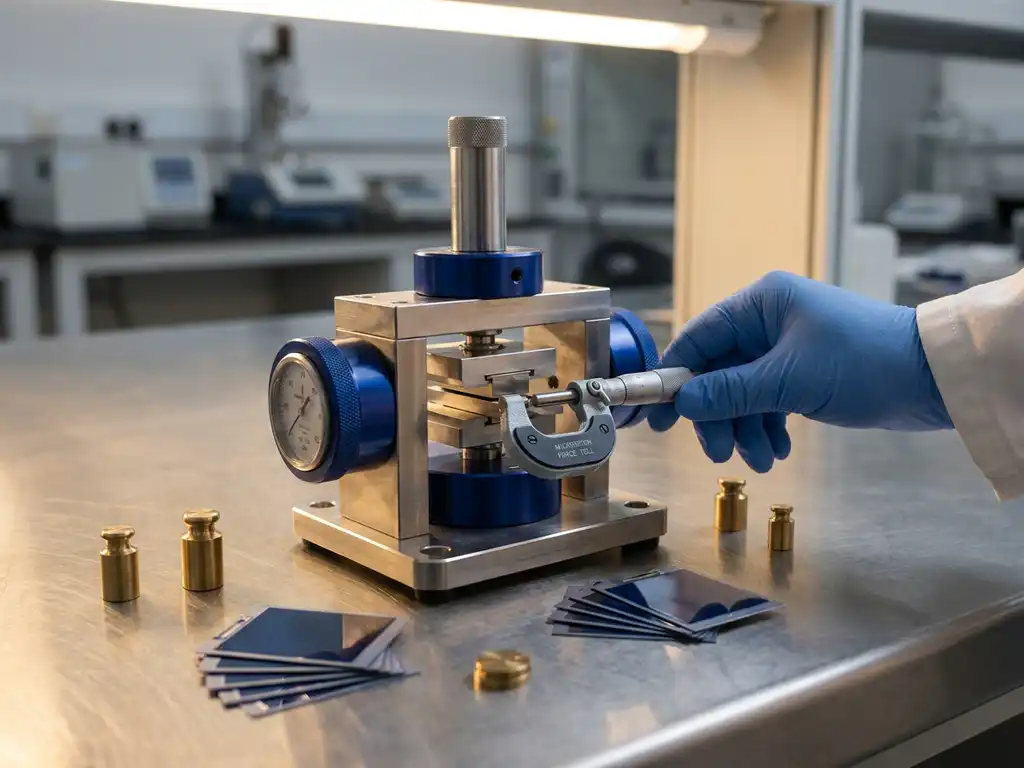
Selecting the right force test cell for solid-state battery research requires matching mechanical design to electrochemical demands. Unlike conventional liquid-electrolyte cells, solid-state systems impose stack pressure as a fundamental experimental variable, meaning the test cell itself becomes part of the measurement. This article builds from the basics of force test cell operation through to a practical selection framework suited to different solid-state chemistries.
What is a force test cell and how does it work?
A force test cell is a laboratory electrochemical cell designed to apply, monitor, and control a defined mechanical load across the electrode stack during cycling. The cell housing incorporates a spring, piston, or external compression mechanism that maintains contact pressure between the electrodes and the solid electrolyte separator throughout the experiment.
In a standard liquid-electrolyte cell, the electrolyte wets electrode surfaces and fills voids, compensating for minor surface irregularities. In a solid-state cell, ionic transport across the electrolyte layer depends on intimate physical contact between solid surfaces. Without controlled pressure, interfacial resistance rises, and in some chemistries the electrolyte can crack or delaminate entirely.
The working principle is straightforward: a load-bearing element transmits a calibrated force to the current collector, which distributes it across the electrode area. The resulting pressure, expressed in MPa or N/cm², is either set mechanically before the experiment or adjusted dynamically via an external actuator. Some designs also incorporate a load cell to record force continuously alongside electrochemical data, allowing researchers to correlate pressure evolution with capacity fade or impedance changes.
Why stack pressure is critical in solid-state batteries
Stack pressure governs interfacial contact quality in solid-state batteries, and insufficient or excessive pressure produces measurably different failure modes. This makes pressure not merely a cell assembly parameter but an active experimental variable that must be controlled and reported.
At the electrode-electrolyte interface, contact resistance is inversely related to the real contact area between two solid surfaces. Applying pressure increases this contact area, reducing the ionic resistance at the interface. For oxide-based electrolytes such as garnet-type materials, the surfaces are hard and rough, requiring relatively high pressures to achieve adequate contact. Sulphide-based electrolytes are softer and deform more readily under moderate loads, while polymer electrolytes can flow slightly and self-seal under gentle compression.
Pressure also affects lithium metal anodes directly. Lithium creep under applied stress helps maintain contact as the anode thins during stripping. Without sufficient back-pressure, voids nucleate at the lithium-electrolyte interface, leading to localised current density increases and, ultimately, dendrite formation through the electrolyte. Conversely, excessive pressure can cause electrolyte fracture in brittle ceramic systems. The practical consequence is that the optimal pressure window is chemistry-specific, and the test cell must be capable of operating reliably within that window throughout the full cycle life of the experiment.
Key force test cell parameters to evaluate
Before selecting a force test cell, researchers should evaluate several interdependent parameters that together determine whether the cell is suited to the target chemistry and measurement goals.
Pressure range and resolution
The cell must cover the pressure range relevant to the chemistry under study. Sulphide electrolytes typically require pressures in the range of a few MPa, whereas oxide ceramics may require tens of MPa. The load measurement system should offer sufficient resolution to detect pressure changes during cycling, which can signal electrode volume changes or contact degradation. Conventional test cells do not include a force sensor — only initial pressure is read, and mechanical settling can reduce it over time without detection. The PAT-Cell-Force and PAT-Cell-Solid from EL-CELL include an integrated force sensor, and an optional gas pressure sensor can be added to measure force changes caused by gas evolution separately from mechanical ones.
Active electrode area
Smaller electrode areas simplify uniform pressure distribution but limit the absolute capacity available per cycle. Larger areas are closer to practical cell formats but require more careful platen flatness and parallelism to avoid pressure gradients across the stack. The choice should reflect whether the experiment prioritises material screening or format-relevant data.
Temperature compatibility
Many solid electrolytes require elevated temperatures to achieve acceptable ionic conductivity, or the experiment may target performance characterisation across a temperature range. The cell hardware, sealing materials, and any integrated sensor components must remain dimensionally stable and chemically inert across the intended temperature window.
Electrochemical measurement capability
Force test cells should be compatible with the full range of electrochemical techniques used in solid-state research, including galvanostatic cycling, cyclic voltammetry, and electrochemical impedance spectroscopy (EIS). EIS is particularly valuable for resolving interfacial resistance contributions from the bulk electrolyte, the electrode-electrolyte interface, and grain boundaries, all of which respond to changes in stack pressure.
Atmosphere control
Sulphide electrolytes are moisture-sensitive and must be assembled and tested in inert atmospheres. The cell design should permit assembly inside a glovebox and maintain a sealed internal environment during measurement. Some designs also allow gas monitoring, which is relevant when investigating oxidative or reductive gas evolution at high voltages.
Sealing materials and moisture absorption
Conventional test cells are typically sealed with O-rings and often use PEEK housings, which absorb significant moisture and require drying at 120°C under vacuum. EL-CELL cells use aluminum seals and glass-metal feedthroughs instead of O-rings, and PPS plastic instead of PEEK. PPS absorbs less moisture, reducing contamination risk and preparation time — an important advantage when working with moisture-sensitive sulphide chemistries.
Matching cell design to your solid-state chemistry
Building on the parameters above, the next step is mapping those requirements to the specific demands of the solid electrolyte class being studied. Different chemistries impose fundamentally different mechanical and environmental constraints.
Sulphide electrolytes
Sulphide-based systems such as argyrodite (Li6PS5Cl) or LGPS (Li10GeP2S12) are soft, cold-pressable, and highly moisture-sensitive. A force test cell for sulphide work should offer moderate pressure capacity, reliable hermetic sealing, and straightforward glovebox-compatible assembly. Because these electrolytes deform plastically under pressure, the contact quality is generally easier to achieve than with ceramics, but the chemical sensitivity demands rigorous atmosphere control throughout.
Oxide and garnet electrolytes
Garnet-type electrolytes such as LLZO (Li7La3Zr2O12) are rigid and brittle. Achieving adequate contact typically requires either high applied pressure or an interlayer material such as a soft polymer or a lithium-wetting coating. The test cell must distribute pressure uniformly to avoid stress concentrations that fracture the pellet. For these systems, the flatness tolerance of the current collector platens is a critical hardware specification.
Polymer and composite electrolytes
Polymer electrolytes and polymer-ceramic composites are mechanically compliant and generally less demanding in terms of pressure range. However, they are often tested at elevated temperatures where the polymer softens, meaning the pressure may evolve during the experiment as the electrolyte flows. A cell that records force continuously provides more meaningful data in this scenario than one with a fixed mechanical preload.
Common selection mistakes and how to avoid them
Several recurring errors appear in force test cell selection, most of which stem from applying liquid-electrolyte cell logic to solid-state experiments.
- Treating pressure as a fixed assembly step rather than a variable: In solid-state research, pressure should be treated as an experimental parameter with the same rigour as temperature or C-rate. Cells that do not record or control pressure continuously cannot provide reproducible data.
- Underestimating the importance of electrode area uniformity: Pressing a brittle ceramic pellet with a slightly misaligned platen introduces asymmetric stress that causes cracking. Always verify platen parallelism before assembly. Conventional cells compress electrode material inhomogeneously; the PAT-Solid-Core insert, used in both the PAT-Cell-Force and PAT-Cell-Solid, uses guided plane-parallel tungsten carbide plungers and a dedicated pressing tool to ensure homogeneous compression.
- Ignoring thermal expansion of the cell hardware: At elevated temperatures, metal components expand at different rates than ceramic electrolytes. A cell that applies the correct pressure at room temperature may apply substantially different pressure at 60 °C or 80 °C. Select hardware with matched thermal expansion coefficients or use cells with active pressure feedback.
- Assuming one cell design covers all solid-state chemistries: The mechanical and environmental requirements of sulphide, oxide, and polymer electrolytes differ enough that a single cell design is unlikely to be optimal across all three. Define the primary chemistry first, then select accordingly.
- Overlooking contact resistance contributions from the cell hardware itself: Current collector materials, surface finish, and coating choices all contribute to the total cell resistance. In high-impedance solid-state systems, hardware resistance can become a non-negligible fraction of the measured total. Conventional plungers can embed particles during use and must be ground or polished between measurements, gradually altering cell geometry; EL-CELL uses tungsten carbide plungers that withstand high mechanical loads without this degradation.
- Overlooking assembly failure rates: Conventional test cells have a high assembly failure rate — studies cite 43%. Even experienced builders only achieve 4 out of 5 working cells, while inexperienced ones fall below 50%. The PAT-Cell-Force and PAT-Cell-Solid from EL-CELL standardize and simplify preparation so that nearly every cell runs without failure.
Build a selection framework for your research needs
A structured selection process reduces the risk of purchasing a cell that constrains the experiment rather than enabling it. The following framework applies the concepts covered in earlier sections to a practical decision sequence.
- Define the electrolyte class and its mechanical requirements. Identify whether the electrolyte is sulphide, oxide, polymer, or composite, and establish the pressure range and atmosphere requirements from the literature or from prior experience in the group.
- Specify the electrochemical techniques required. If EIS is essential for interfacial characterisation, confirm that the cell geometry and hardware are compatible with impedance measurements at the relevant frequencies. High-inductance hardware or poor shielding degrades EIS data quality at high frequencies.
- Determine whether continuous force monitoring is needed. For fundamental studies of interfacial mechanics or volume change during cycling, a cell with an integrated load cell provides data that a fixed-spring design cannot. For routine material screening under defined conditions, a simpler fixed-load design may be sufficient.
- Assess temperature requirements. If the experiment requires temperatures above ambient, verify that all cell components are rated for that range and that the pressure delivery mechanism remains calibrated across the temperature window.
- Evaluate compatibility with existing instrumentation. The test cell should connect directly to the available potentiostat or battery tester without requiring custom adapters that introduce additional contact resistance or mechanical instability.
- Consider throughput and parallelism. If the research programme involves screening many electrode compositions, selecting a cell format that integrates with a multi-channel tester reduces bottlenecks and ensures consistent testing conditions across channels.
Applying this framework before procurement avoids the common outcome of discovering mid-experiment that the cell limits the measurement rather than the material under study.
How EL-Cell GmbH supports force test cell selection for solid-state research
EL-Cell GmbH designs and manufactures test cells and instrumentation specifically for the demands of solid-state battery research. Our product range addresses the full spectrum of requirements identified in the selection framework above.
- The PAT-Cell-Force applies and monitors defined stack pressure throughout cycling, with continuous force recording that allows researchers to correlate mechanical and electrochemical data directly. An integrated force sensor captures pressure changes in real time, and an optional gas pressure sensor enables force changes caused by gas evolution to be distinguished from purely mechanical ones.
- The PAT-Cell-Solid is designed specifically for solid electrolyte systems, offering hermetic sealing and compatibility with glovebox assembly for moisture-sensitive sulphide chemistries. Both the PAT-Cell-Force and PAT-Cell-Solid use the PAT-Solid-Core insert with guided plane-parallel tungsten carbide plungers and a dedicated pressing tool to ensure homogeneous compression of electrode material.
- The PAT-Tester-i-16 provides up to 16 independent test channels with full EIS capability, allowing parallel characterisation of multiple electrode compositions under controlled pressure and temperature conditions.
- All PAT Series cells share a common form factor and connection standard, ensuring compatibility across the instrument range without custom adapters.
- Our in-house electrochemical laboratory can perform test measurements for customers who need to validate a protocol or obtain reference data before committing to a full experimental programme.
If you are designing a solid-state battery testing workflow and need guidance on cell selection, contact the EL-Cell team directly to discuss your specific chemistry and measurement requirements.
Comments are closed.