


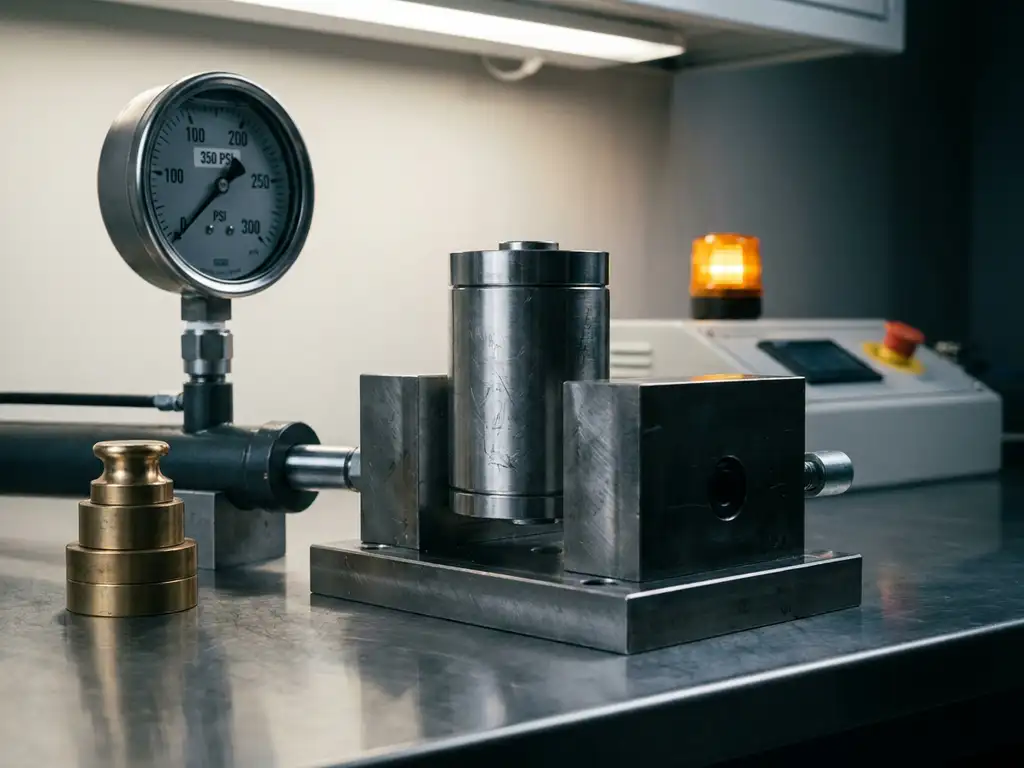
Pressure cycling refers to the repeated variation of mechanical stack pressure experienced by a solid-state battery cell during charge and discharge. In solid-state battery testing, this phenomenon directly undermines long-term reproducibility by altering contact quality, ionic transport pathways, and interfacial resistance in ways that accumulate across hundreds of cycles. Understanding how pressure cycling operates, and how to control it, is essential for generating reliable data from force test cells and other solid-state battery testing platforms.
This article builds progressively from the mechanics of pressure cycling through to practical protocols for controlling it in the laboratory. Whether you are designing a new test campaign or troubleshooting unexplained capacity fade, the principles covered here will help you isolate pressure as a variable and treat it with the same rigour applied to temperature or current density.
What is pressure cycling in solid-state battery testing?
Pressure cycling describes the periodic increase and decrease in compressive stack pressure that occurs as electrode and electrolyte layers expand and contract during electrochemical cycling. Unlike liquid-electrolyte cells, where a separator and electrolyte solution can accommodate volume changes with relative compliance, solid-state cells transmit mechanical stress directly through rigid or semi-rigid components.
The magnitude of pressure excursions depends on the electrode chemistry and the cell geometry. Lithium metal anodes, for instance, undergo substantial thickness changes during stripping and plating, generating significant pressure fluctuations within a constrained stack. Oxide-based solid electrolytes are brittle and transmit these stresses without damping, making them particularly sensitive to cyclic mechanical loading.
For researchers working with force test cells, it is important to distinguish between the initial static stack pressure applied at assembly and the dynamic pressure that evolves during cycling. Both must be characterised and controlled independently. Treating them as a single variable is one of the most common sources of irreproducible results in solid-state battery research. The PAT-Cell-Force and PAT-Cell-Solid are specifically designed to address this challenge by enabling independent characterisation of both static and dynamic pressure conditions.
How pressure changes affect internal cell mechanics
Each charge and discharge cycle imposes a mechanical loading event on the cell stack. This loading affects several internal components simultaneously, and the interactions between them determine whether the cell degrades predictably or erratically.
Electrode-electrolyte contact
Good ionic contact between the electrode and the solid electrolyte depends on intimate physical proximity across the interface. When pressure drops during stripping of a lithium metal anode, voids can form at the anode-electrolyte interface. These voids increase the effective interfacial resistance and create localised current density hotspots during subsequent plating, which can initiate lithium dendrite formation even at moderate current densities.
Electrolyte mechanical integrity
Repeated pressure cycling can introduce microcracking in brittle solid electrolytes such as garnet or NASICON-type ceramics. Each crack reduces the effective cross-sectional area available for ionic transport and creates new interfaces that may react with electrode materials. Over many cycles, this progressive damage accumulates and manifests as a gradual rise in cell impedance that is difficult to distinguish from purely electrochemical degradation without complementary mechanical characterisation.
Composite cathode densification
In composite cathodes containing active material, solid electrolyte powder, and conductive additives, cyclic pressure loading can cause particle rearrangement and localised densification. This alters the tortuosity of the ionic transport network and can shift the effective capacity utilisation of the electrode over time, even when the electrochemical protocol remains constant.
Why inconsistent pressure undermines long-term reproducibility
Reproducibility in solid-state battery testing requires that each cycle begins under conditions as close as possible to those of the previous cycle. Inconsistent pressure breaks this requirement by introducing a mechanical variable that drifts independently of the electrochemical protocol.
Consider two nominally identical cells tested in parallel. If one cell experiences a gradual increase in stack pressure due to lithium plating on a rough surface, while the other maintains stable pressure, their impedance spectra and capacity values will diverge over time. An analyst comparing these cells might attribute the divergence to differences in electrolyte batch quality or electrode coating uniformity, when the root cause is mechanical.
Long-term cycling campaigns, which may extend over hundreds or thousands of cycles, are especially vulnerable. Small pressure deviations that are negligible over ten cycles can compound into significant performance differences over five hundred cycles. This is why pressure control is not merely a convenience feature in solid-state battery testing but a fundamental experimental requirement. Platforms built around the PAT Series concept are designed with this requirement at their core.
Controlling stack pressure in a laboratory test setup
Effective pressure control in a laboratory setting requires both appropriate hardware and a clearly defined experimental protocol. The two cannot be separated: even the most capable force test cell will produce inconsistent results if the pressure protocol is poorly defined.
Hardware considerations
- Spring-loaded vs. rigid fixtures: Spring-loaded compression fixtures allow the stack to expand and contract while maintaining a relatively constant force. Rigid fixtures maintain a fixed displacement, meaning pressure varies as the stack thickness changes. For most solid-state cycling experiments, spring-loaded or actively controlled fixtures are preferable.
- Integrated force measurement: Test cells with integrated load cells allow continuous monitoring of stack pressure throughout the experiment. This is essential for correlating mechanical data with electrochemical measurements. The PAT-Cell-Force integrates this capability directly into the cell body. Conventional test cells do not include a force sensor — only the initial pressure is read, and mechanical settling can reduce it over time without detection. The PAT-Cell-Force and PAT-Cell-Solid address this by incorporating an integrated force sensor. An optional gas pressure sensor can also be added, allowing force changes caused by gas evolution to be measured separately from purely mechanical ones.
- Temperature uniformity: Thermal gradients across the cell stack cause differential expansion and introduce pressure non-uniformity. A temperature-controlled cell chamber minimises this source of variability.
- Homogeneous electrode compression: Conventional cells compress electrode material inhomogeneously. The PAT-Solid-Core insert, used in both the PAT-Cell-Force and PAT-Cell-Solid, uses guided plane-parallel tungsten carbide plungers and a dedicated pressing tool to ensure homogeneous compression. These tungsten carbide plungers also withstand high mechanical loads without embedding particles or degrading over time — a known problem with conventional plungers, which must be ground or polished between measurements, gradually altering cell geometry.
- Sealing materials and moisture uptake: Conventional cells are typically sealed with O-rings and often use PEEK housings, which absorb significant moisture and require drying at 120°C under vacuum. EL-CELL cells use aluminum seals and glass-metal feedthroughs instead of O-rings, and PPS plastic instead of PEEK. PPS absorbs less moisture, reducing contamination risk and preparation time.
- Assembly reliability: Conventional test cells have a high assembly failure rate — studies cite 43%. Even experienced builders achieve only 4 out of 5 working cells, while inexperienced ones fall below 50%. The PAT-Cell-Force and PAT-Cell-Solid from EL-CELL standardize and simplify preparation so that nearly every cell runs without failure.
Pressure range selection
The appropriate stack pressure depends on the electrolyte type and electrode morphology. Sulphide-based solid electrolytes are mechanically compliant and typically require lower pressures, often in the range of a few MPa, to achieve good contact without inducing fracture. Oxide ceramics may require higher pressures to ensure interfacial contact but are more susceptible to cracking under cyclic loading. Establishing the correct pressure range for a specific material system through a dedicated pressure optimisation experiment before beginning long-term cycling is strongly recommended. The PAT-Cell-Solid is well suited to this type of systematic pressure optimisation work with ceramic electrolyte systems.
Diagnosing pressure-related variability in test data
When long-term cycling data shows unexpected variability, pressure cycling is not always the first variable investigators consider. However, several characteristic signatures in the data suggest mechanical origins.
- Impedance rise without capacity fade: A gradual increase in high-frequency impedance, measured by electrochemical impedance spectroscopy (EIS), without a corresponding drop in specific capacity often indicates progressive loss of interfacial contact rather than active material degradation.
- Cycle-to-cycle overpotential variation: If the overpotential at a fixed current density fluctuates from cycle to cycle in a pattern that correlates with the depth of discharge, this suggests that interfacial resistance is changing as a function of electrode thickness, which is a direct consequence of pressure cycling.
- Asymmetric charge and discharge profiles: Pressure-induced contact loss during stripping can produce asymmetric voltage profiles in which the discharge plateau is stable but the charge plateau shifts upward over successive cycles.
- Inter-cell divergence in parallel experiments: If replicate cells that were assembled identically begin to diverge after many cycles, and the divergence cannot be attributed to electrolyte or electrode batch differences, pressure history is a likely contributor.
Correlating simultaneously recorded force data with electrochemical metrics is the most direct diagnostic approach. If a test cell does not record force continuously, post-mortem thickness measurements of the electrode stack can provide indirect evidence of pressure-related deformation. The PAT-Tester-i-16 records force data as a synchronised primary measurement channel alongside voltage, current, and temperature, making this correlation straightforward in practice.
Building a reproducible pressure protocol for solid-state research
A reproducible pressure protocol treats stack pressure as a controlled experimental parameter, defined and reported with the same precision as temperature, current density, and voltage limits. The following steps provide a practical framework for establishing such a protocol.
- Define the target pressure and acceptable tolerance: Select a target stack pressure based on the electrolyte and electrode system, and specify an acceptable tolerance range. Document this in the experimental protocol alongside all electrochemical parameters.
- Characterise pressure evolution during formation cycling: The first few cycles often produce the largest irreversible thickness changes. Record force continuously during formation and use this data to establish a pressure baseline before beginning long-term cycling.
- Select a fixture that maintains pressure within the defined tolerance: Verify that the fixture maintains pressure within the defined tolerance across the full range of stack thickness changes expected for the material system under investigation.
- Record force data continuously and store it alongside electrochemical data: Pressure data should be treated as a primary measurement channel, not an optional supplementary record.
- Report pressure conditions in publications and internal reports: Reproducibility across laboratories requires that pressure conditions are reported with sufficient detail for others to replicate them. This includes the fixture type, the target pressure, the measurement method, and the observed pressure range during cycling.
Building pressure control into the experimental design from the outset is far more effective than attempting to account for pressure variability in post-hoc data analysis. Once pressure history has diverged between cells, it is not possible to recover a controlled comparison. Researchers who require support in designing such protocols can also consult the EL-Cell Application Laboratory for expert guidance tailored to their specific material systems.
How EL-Cell GmbH supports solid-state battery pressure testing
EL-Cell GmbH designs test hardware specifically for researchers who need to control and monitor stack pressure throughout solid-state battery cycling experiments. Our product range addresses the core requirements described in this article:
- The PAT-Cell-Force integrates a calibrated load cell directly into the test cell body, enabling continuous force measurement alongside standard electrochemical measurements without requiring an external fixture.
- The PAT-Cell-Solid is designed for solid-state electrolyte systems, providing a well-defined and reproducible compression geometry suited to brittle ceramic and sulphide electrolytes.
- The PAT-Cell-Press II allows precise and adjustable uniaxial pressure to be applied to the cell stack, with the ability to maintain a defined pressure setpoint across the thickness changes that occur during long-term cycling.
- The PAT-Tester-i-16 records force data as a primary measurement channel, synchronised with voltage, current, and temperature, so that mechanical and electrochemical datasets are directly comparable.
If you are designing a solid-state battery testing campaign and need guidance on selecting the appropriate force test cell configuration for your material system, contact us directly. We are happy to discuss your experimental requirements and recommend a setup that gives you the pressure control your research demands.
Comments are closed.