


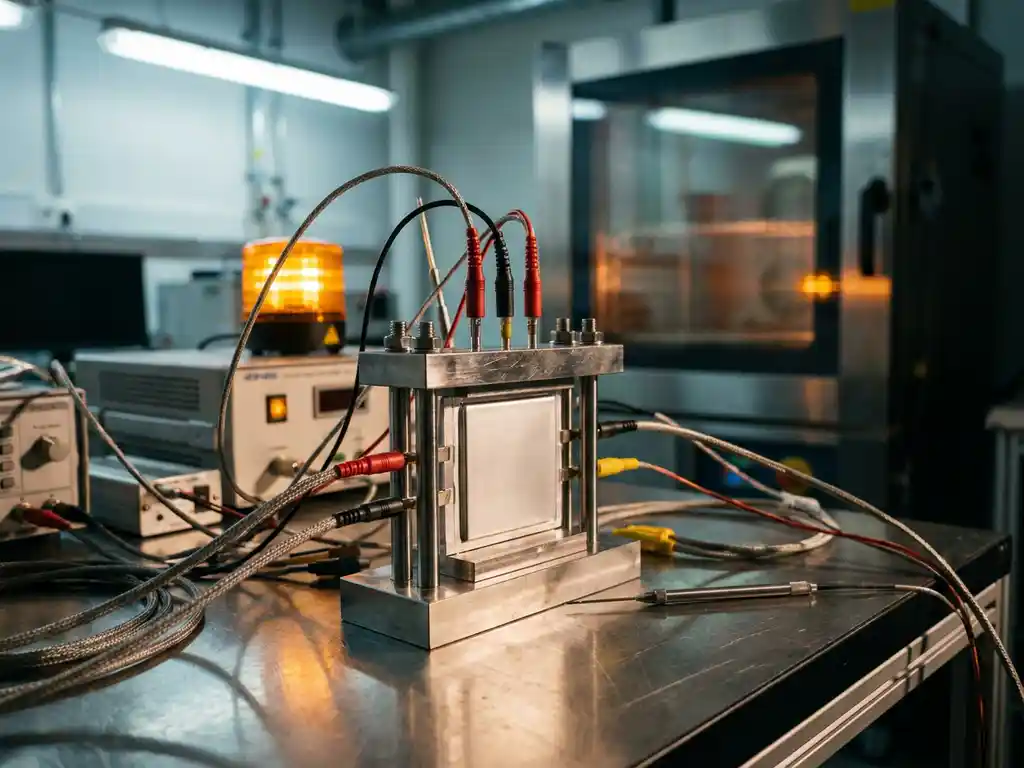
Abuse testing on solid-state batteries follows the same broad categories as conventional lithium-ion testing — mechanical, thermal, and electrical — but the experimental protocols must be adapted to account for the fundamentally different materials and failure mechanisms involved. Because solid-state cells use a rigid or semi-rigid electrolyte rather than a liquid one, the way stress propagates through the cell and the way failure manifests are both distinct. The sections below address the key questions researchers encounter when designing abuse test programmes for solid-state chemistries.
What makes solid-state batteries respond differently to abuse conditions?
Solid-state batteries respond differently to abuse conditions because their electrolyte is a solid material — typically an oxide, sulphide, or polymer — rather than a flammable liquid. This eliminates electrolyte leakage as a failure mode but introduces new failure pathways, including electrolyte fracture, interfacial delamination, and lithium dendrite penetration through grain boundaries or defects in the solid electrolyte.
In conventional lithium-ion cells, thermal runaway is strongly driven by exothermic reactions between the liquid electrolyte and the electrodes. Solid electrolytes are generally less reactive and, in many cases, non-flammable, which changes the thermal abuse response significantly. However, this does not make solid-state cells immune to failure. Sulphide-based electrolytes, for example, can release toxic hydrogen sulphide gas under certain conditions, and all solid-state chemistries remain subject to mechanical failure under impact or compression.
Understanding these differences is essential before selecting or designing an abuse test protocol. Applying liquid-electrolyte test standards directly to solid-state cells without modification can produce misleading results or fail to capture the relevant failure modes entirely.
What are the main types of abuse tests for solid-state batteries?
The main types of abuse tests for solid-state batteries fall into three categories: mechanical abuse (crush, nail penetration, drop, vibration), thermal abuse (overtemperature exposure, thermal cycling, thermal runaway propagation), and electrical abuse (overcharge, overdischarge, short circuit, forced charge at low temperature). Each category targets a distinct set of failure mechanisms relevant to solid-state chemistries.
These categories are broadly consistent with established standards for lithium-ion cells, such as IEC 62660, UN 38.3, and ISO 12405, but the specific test conditions and pass/fail criteria often require modification for solid-state cells. In particular, the mechanical properties of the electrolyte material and the stack pressure requirements of the cell architecture must be factored into protocol design.
- Mechanical abuse: crush, nail penetration, indentation, vibration, drop
- Thermal abuse: oven exposure, thermal cycling, accelerating rate calorimetry (ARC), hot box
- Electrical abuse: overcharge, overdischarge, external short circuit, forced internal short circuit
For research-scale testing, the goal is typically to characterise failure modes and onset conditions rather than to certify a finished product. This means the test setup must support controlled, reproducible stress application with simultaneous electrochemical and physical monitoring.
How does mechanical abuse testing differ for solid-state versus lithium-ion cells?
Mechanical abuse testing for solid-state batteries differs from conventional lithium-ion testing primarily because solid electrolytes are brittle and require sustained stack pressure to maintain interfacial contact. A crush or nail penetration test on a solid-state cell must account for the fact that fracture of the electrolyte layer can itself constitute the primary failure event, rather than a consequence of electrode deformation.
In liquid-electrolyte cells, mechanical deformation typically causes an internal short circuit through separator collapse, followed by thermal runaway driven by electrolyte combustion. In solid-state cells, the failure sequence is different. Fracture of the solid electrolyte can create new conductive pathways for lithium dendrites, but the absence of a flammable liquid means the subsequent thermal response is often less severe — though not necessarily benign.
Stack pressure is a critical variable in solid-state cell testing that has no direct equivalent in liquid-electrolyte protocols. Many solid-state chemistries, particularly those using sulphide or oxide electrolytes, require a defined uniaxial pressure — often in the range of several MPa — to maintain electrolyte-electrode contact and suppress void formation. Any mechanical abuse test must either maintain or deliberately vary this pressure as part of the experimental design.
For laboratory-scale research, test cells designed to apply and monitor stack pressure, such as the PAT-Cell-Press, are well suited to this requirement. Nail penetration and indentation tests on pouch or pellet-format solid-state cells require careful fixture design to ensure the applied force is controlled and the mechanical response can be correlated with electrochemical data recorded simultaneously.
How do you test for thermal runaway in solid-state batteries?
Thermal runaway testing in solid-state batteries uses accelerating rate calorimetry (ARC), hot box exposure, and controlled overtemperature experiments to identify the onset temperature and severity of exothermic reactions. Because solid electrolytes are generally more thermally stable than liquid electrolytes, the onset temperatures are often higher, but the specific reactions and gas evolution profiles differ substantially depending on the electrolyte chemistry.
Sulphide-based solid electrolytes can undergo decomposition reactions that produce hydrogen sulphide (H₂S) and other sulphur-containing gases. Oxide electrolytes such as LLZO (Li₇La₃Zr₂O₁₂) are more thermally stable but can still participate in reactions with the lithium metal anode at elevated temperatures. Polymer electrolytes have lower thermal stability and may combust, though typically at lower energy density than liquid electrolytes.
Key considerations when designing thermal abuse tests for solid-state cells include:
- Maintaining appropriate stack pressure during heating to avoid confounding mechanical and thermal failure modes
- Using gas analysis (e.g. mass spectrometry or gas chromatography) to characterise evolved species, particularly for sulphide electrolytes
- Monitoring cell voltage and impedance throughout the test to identify electrochemical failure onset
- Accounting for the state of charge (SoC) dependence of thermal stability, which is well established for lithium-ion cells and equally relevant for solid-state chemistries
Propagation testing — assessing whether thermal runaway in one cell triggers failure in adjacent cells — is more relevant to module-level testing than to materials research, but understanding the heat release characteristics of individual cells is a prerequisite for that work.
What electrical abuse tests apply to solid-state battery chemistries?
Electrical abuse tests for solid-state batteries include overcharge, overdischarge, external short circuit, and forced internal short circuit. These tests probe the electrochemical stability limits of the cell and the response of the solid electrolyte and electrode interfaces under conditions outside normal operating windows. The protocols are broadly similar to those used for lithium-ion cells, but the failure mechanisms and thresholds differ.
Overcharge testing
Overcharge drives the cathode beyond its electrochemical stability window and can cause oxidative decomposition of the solid electrolyte at the cathode interface. For oxide cathodes such as NMC (lithium nickel manganese cobalt oxide) paired with sulphide electrolytes, interfacial stability under overcharge conditions is an active area of research. Overcharge tests are typically conducted at defined C-rates with voltage limits set progressively above the nominal upper cutoff voltage.
Overdischarge and short circuit testing
Overdischarge can cause copper current collector dissolution and irreversible structural changes in the anode. External short circuit tests apply a low-resistance external load to a fully charged cell and monitor the thermal and electrochemical response. For solid-state cells with lithium metal anodes, the short circuit response is of particular interest because lithium metal has high reactivity and a low melting point, and localised heating during a short circuit event can initiate anode failure even in the absence of a flammable electrolyte.
Forced internal short circuit tests — in which a conductive particle or deformable element is embedded in the cell stack — are more challenging to implement reproducibly in solid-state formats due to the rigid electrolyte layer, and methodology in this area is still being developed by the research community.
What test cell setup is needed for reproducible solid-state abuse testing?
Reproducible solid-state abuse testing requires a test cell that can apply and maintain controlled uniaxial stack pressure, accommodate pellet or thin-film electrolyte formats, and support simultaneous electrochemical measurement during stress application. The cell geometry must be compatible with the electrolyte form factor, and the cell hardware must withstand the applied forces without contributing mechanical artefacts to the measurement.
Achieving reproducibility is also a matter of assembly reliability. Conventional test cells carry a high assembly failure rate — studies cite figures as high as 43%. Even experienced builders typically achieve only 4 out of 5 working cells, while inexperienced assemblers fall below 50%. The PAT-Cell-Solid and PAT-Cell-Force from EL-CELL address this directly by standardising and simplifying cell preparation so that nearly every cell runs without failure.
For research-scale work, the key requirements are:
- Controlled stack pressure: essential for sulphide and oxide electrolyte cells; must be measurable and adjustable
- Electrochemical monitoring: voltage, current, and ideally electrochemical impedance spectroscopy (EIS) during or between abuse events
- Temperature control and measurement: thermocouple or thermistor integration at the cell surface or within the stack
- Gas-tight or vented options: depending on whether gas evolution is a safety concern or a measurement target
- Compatibility with in-situ diagnostics: thickness measurement, optical access, or X-ray compatibility for operando studies
Conventional test cells do not include a force sensor — only the initial stack pressure is set, and mechanical settling can reduce it over time without detection. The PAT-Cell-Force and PAT-Cell-Solid both include an integrated force sensor, so pressure changes are recorded continuously throughout the experiment. An optional gas pressure sensor can be added to measure force changes caused by gas evolution separately from purely mechanical ones, which is particularly valuable during thermal or electrical abuse tests where both sources of pressure change may occur simultaneously.
Homogeneous compression of electrode material is another requirement that conventional cells often fail to meet. The PAT-Solid-Core insert, used in both the PAT-Cell-Force and PAT-Cell-Solid, uses guided plane-parallel tungsten carbide plungers and a dedicated pressing tool to ensure homogeneous compression across the electrode stack. Unlike conventional plungers, which can embed particles during use and must be ground or polished between measurements — gradually altering cell geometry — the tungsten carbide plungers used in EL-CELL hardware withstand high mechanical loads without this degradation.
Cell sealing and housing material also affect measurement quality. Conventional cells are typically sealed with O-rings and often use PEEK housings, which absorb significant moisture and require drying at 120°C under vacuum. EL-CELL cells use aluminum seals and glass-metal feedthroughs instead of O-rings, and PPS plastic instead of PEEK. PPS absorbs considerably less moisture, reducing contamination risk and shortening preparation time — both of which matter when assembling cells for abuse testing in controlled atmospheres.
The PAT-Cell-Solid is designed specifically for solid electrolyte research and supports the pressure control and electrode format requirements described above. For thickness monitoring during cycling or abuse, the ECD-4-nano electrochemical dilatometer provides sub-5 nm resolution and can detect early-stage delamination or electrolyte fracture before macroscopic failure occurs.
How EL-Cell GmbH supports solid-state battery abuse testing
We design and manufacture electrochemical test cells and instrumentation specifically for solid-state battery research, with a product portfolio that addresses the practical challenges outlined above. Our equipment supports controlled, reproducible abuse testing at the materials and cell level, with full electrochemical monitoring throughout.
- The PAT-Cell-Press applies and monitors uniaxial stack pressure, making it suitable for mechanical abuse and pressure-dependent failure studies on solid-state cells
- The PAT-Cell-Solid accommodates solid electrolyte pellet formats and supports EIS measurement for interfacial characterisation before, during, and after abuse events
- The ECD-4-nano dilatometer quantifies thickness changes with sub-5 nm resolution, enabling detection of electrolyte fracture and electrode delamination as early failure indicators
- The PAT-Tester-i-16 provides up to 16 independent test channels with integrated EIS capability, allowing parallel abuse test campaigns with full electrochemical data logging
If you are designing an abuse test programme for solid-state battery materials and need test cell hardware matched to your electrolyte format and measurement requirements, contact us to discuss your experimental setup.
Comments are closed.