


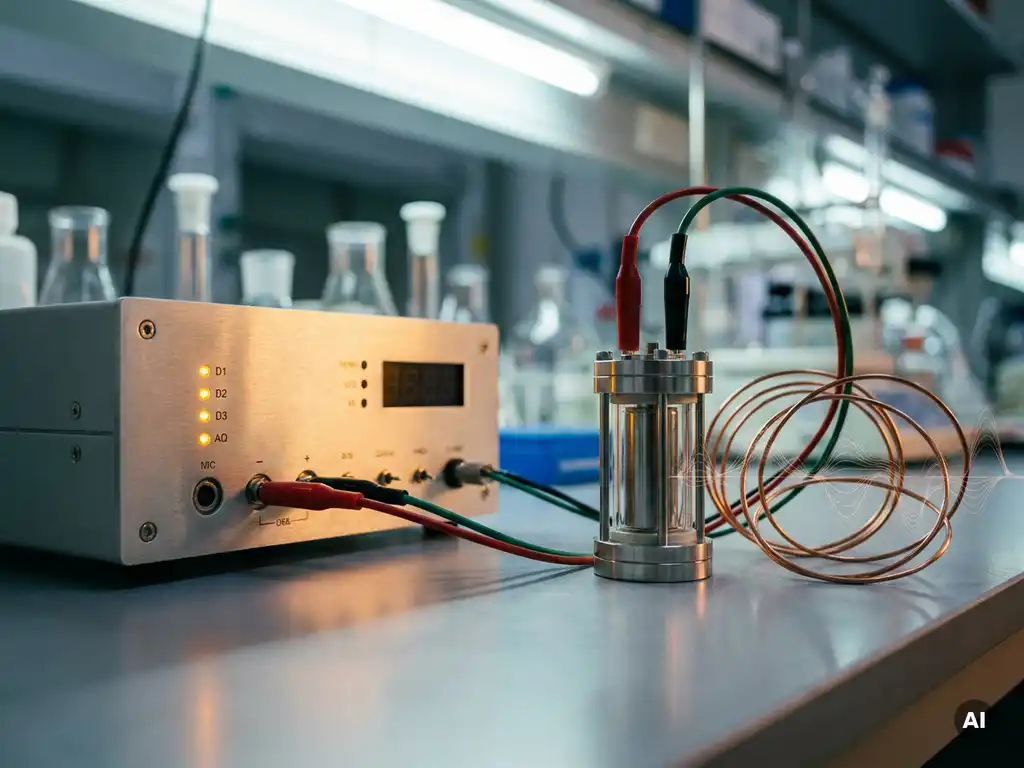
A potentiostat supports a broad range of electrochemical measurement techniques beyond simple charge/discharge cycling. Core methods include electrochemical impedance spectroscopy (EIS), cyclic voltammetry (CV), chronoamperometry, and chronopotentiometry. When combined with galvanostatic control, the same instrument can drive constant-current protocols essential for capacity and rate-capability measurements. The sections below address each technique in turn, from foundational principles to instrument specification considerations.
What electrochemical techniques does a potentiostat enable beyond basic cycling?
A potentiostat enables a wide set of electrochemical techniques beyond galvanostatic cycling, including cyclic voltammetry, electrochemical impedance spectroscopy, chronoamperometry, linear sweep voltammetry, and open-circuit voltage monitoring. Each technique interrogates different aspects of electrode and electrolyte behaviour, making the potentiostat a versatile core instrument in any battery research laboratory.
In practice, modern instruments combine potentiostatic and galvanostatic control in a single unit, often referred to as a potentiostat/galvanostat (PStat/GStat). This means researchers can sequence techniques within a single experimental protocol: for example, running galvanostatic cycling at a defined C-rate, pausing at a set state of charge, and immediately acquiring an EIS spectrum without disconnecting the cell.
- Cyclic voltammetry (CV): sweeps potential at a controlled scan rate to reveal redox reaction thermodynamics and kinetics
- Electrochemical impedance spectroscopy (EIS): applies a small sinusoidal perturbation across a frequency range to resolve resistive, capacitive, and diffusive contributions
- Chronoamperometry: holds potential constant and records current transients, useful for studying diffusion coefficients
- Galvanostatic intermittent titration technique (GITT): alternates current pulses and rest periods to determine solid-state diffusion coefficients and thermodynamic open-circuit potentials
- Linear sweep voltammetry (LSV): scans potential in one direction to determine electrolyte stability windows
The ability to combine these techniques in a single, programmable sequence is one reason the potentiostat has become the central instrument in battery materials characterisation workflows.
What is electrochemical impedance spectroscopy and what does it reveal?
Electrochemical impedance spectroscopy (EIS) is a technique in which a small sinusoidal voltage or current perturbation, typically a few millivolts in amplitude, is applied to an electrochemical cell across a range of frequencies, commonly from a few millihertz up to several megahertz. The frequency-dependent response is analysed to separate and quantify individual physical and chemical processes occurring inside the cell.
EIS is particularly valuable in battery research because different processes respond at different timescales. By sweeping frequency, a single measurement can simultaneously resolve:
- Ohmic resistance of the electrolyte and current collectors (visible at high frequency)
- Charge-transfer resistance at the electrode/electrolyte interface (mid-frequency semicircle)
- Solid Electrolyte Interphase (SEI) layer impedance, which grows during formation cycles and ageing
- Solid-state diffusion of lithium ions within active material particles (low-frequency Warburg element)
Equivalent circuit modelling is used to fit EIS spectra and extract quantitative parameters. Changes in SEI resistance over cycling, for example, can be tracked non-destructively to monitor degradation mechanisms. EIS is equally applicable to half cells and full cells, provided the instrument’s frequency range and signal resolution are matched to the cell impedance.
How does cyclic voltammetry characterise battery electrode materials?
Cyclic voltammetry characterises battery electrode materials by sweeping the working electrode potential between two defined limits at a fixed scan rate and recording the resulting current. The resulting current-versus-potential curve reveals the potentials at which faradaic reactions occur, the reversibility of those reactions, and whether multiple distinct redox processes are present.
In battery research, CV is routinely used to identify:
- Oxidation and reduction peak potentials for intercalation and conversion reactions
- Peak separation, which reflects kinetic overpotential and indicates reaction reversibility
- Integrated charge under each peak, which can be compared to theoretical specific capacity in mAh/g
- Capacity contributions from surface-controlled (capacitive) versus diffusion-controlled (bulk intercalation) processes, separated by scan-rate-dependent analysis
Scan rate variation is particularly informative. At slow scan rates, diffusion-limited processes dominate; at fast scan rates, capacitive surface processes become proportionally larger. Plotting peak current against the square root of scan rate (for diffusion-limited systems) or directly against scan rate (for capacitive systems) allows quantification of each contribution, a method frequently applied to characterise pseudocapacitive electrode materials.
CV also serves a diagnostic role during the initial formation cycles of a cell. The appearance of irreversible reduction peaks in the first cycle, which subsequently disappear, is characteristic of SEI layer formation on the anode.
What is the difference between potentiostatic and galvanostatic control?
Potentiostatic control holds the working electrode at a fixed potential relative to a reference electrode and measures the resulting current. Galvanostatic control applies a fixed current and measures the resulting potential. The two modes interrogate different aspects of electrode behaviour, and most modern battery testers implement both within a single instrument.
The practical distinction matters significantly in battery research:
- Potentiostatic mode is used when potential precision is critical, for example, when holding a cell at a defined voltage during constant-voltage (CV) charging, or measuring electrolyte stability windows by LSV
- Galvanostatic mode is used for standard charge/discharge cycling at defined C-rates, GITT measurements, and rate-capability tests where current is the controlled variable
In full-cell cycling, a combined protocol is standard: a constant-current (galvanostatic) phase charges the cell to a voltage limit, followed by a constant-voltage (potentiostatic) phase that holds that voltage until current drops below a defined threshold. This combined CC/CV protocol more accurately replicates practical charging conditions and ensures complete lithiation of the cathode material.
The reference electrode configuration distinguishes the two modes at a hardware level. In a three-electrode half-cell setup, a stable reference electrode (such as lithium metal) allows true potentiostatic control with a defined potential scale. In a two-electrode full-cell, only the cell voltage is accessible, and the individual electrode potentials cannot be independently resolved without an additional reference.
Can a potentiostat perform in-situ and operando measurements?
A potentiostat can perform in-situ and operando measurements when paired with a compatible test cell that provides the necessary physical access, such as optical windows, X-ray transparent windows, gas inlet/outlet ports, or integrated force and pressure sensors. The potentiostat itself controls the electrochemical state of the cell while the auxiliary measurement records a physical or structural property simultaneously.
Common in-situ and operando configurations in battery research include:
- Dilatometry: measuring electrode thickness change as a function of state of charge, using a high-resolution displacement sensor integrated into the cell
- Optical microscopy or spectroscopy: observing electrode surface changes, lithium plating, or gas bubble formation through a transparent window
- Gas analysis: quantifying gas evolution (e.g. CO₂, H₂) during formation or overcharge using differential electrochemical mass spectrometry (DEMS) or pressure sensing
- Force measurement: monitoring stack pressure changes during cycling, which reflect volume changes in active materials and can signal mechanical degradation
The key requirement is synchronisation: the potentiostat’s measurement timestamps must align with the auxiliary instrument’s data acquisition so that electrochemical state and physical response can be correlated accurately. Many research-grade battery testers provide trigger outputs or software synchronisation protocols for this purpose. Cells designed specifically for in-situ work, with integrated sensors and appropriate feedthroughs, are essential for reliable operando data.
Which potentiostat specifications matter most for battery research accuracy?
The specifications that matter most for battery research accuracy are current range and resolution, potential accuracy, EIS frequency range and impedance resolution, and input impedance. The relative importance of each depends on the cell format and the techniques being applied.
Current range and resolution
Battery test cells span a wide range of electrode masses and geometric areas. A potentiostat must cover the full current range required, from nanoamperes for thin-film or microelectrode measurements to hundreds of milliamperes for larger coin or pouch-format cells. Current resolution determines the minimum detectable signal, which is critical for accurate coulombic efficiency measurements. Coulombic efficiency differences between cycles can be as small as a fraction of a percent, requiring high-resolution current measurement to detect meaningful trends.
EIS frequency range and signal integrity
For EIS, the usable frequency range defines which physical processes can be resolved. High-frequency response (above 100 kHz) accesses inductive and ohmic contributions; low-frequency response (below 10 mHz) accesses solid-state diffusion. Phase accuracy and impedance resolution at both extremes determine the quality of equivalent circuit fits. A potentiostat with limited phase accuracy at high frequency will produce artefacts in the high-frequency semicircle, leading to systematic errors in ohmic resistance extraction.
Additional specifications worth evaluating include:
- Potential accuracy and drift: relevant for long-duration experiments where small potential errors accumulate
- Input impedance: must be sufficiently high (typically greater than 1 GΩ) to avoid loading the reference electrode circuit
- Number of independent channels: for parallel testing of multiple cells under identical conditions, channel independence and isolation are critical to prevent cross-talk
- Temperature control integration: electrochemical measurements are temperature-sensitive; instruments that integrate cell chamber temperature control eliminate a significant source of variability
How EL-Cell GmbH supports potentiostat-based battery research
EL-Cell GmbH designs and manufactures battery testing equipment specifically for the measurement techniques described above. Our instruments and test cells are developed as an interoperable research ecosystem, so that the potentiostat, the cell, and the auxiliary measurement tools are designed to work together from the outset.
- The PAT-Tester-i-16 provides up to 16 independent channels with full PStat/GStat and EIS capability, an integrated temperature-controlled cell chamber, and a docking station, covering galvanostatic cycling, CV, EIS, and GITT within a single instrument
- Our PAT battery tester series is designed for high-accuracy current measurement at the low currents typical of research-scale electrodes, supporting reliable coulombic efficiency tracking over long cycling campaigns
- PAT-Cell-Force and PAT-Cell-Solid include integrated force sensors and use glass-metal feedthroughs rather than O-rings, enabling in-situ force and pressure monitoring alongside electrochemical data without the risk of moisture contamination
- The ECD-4-nano dilatometer achieves thickness resolution better than 5 nm, allowing operando electrode expansion measurements to be synchronised directly with potentiostat data
If you are specifying a potentiostat setup for a new research programme or upgrading an existing laboratory, we are glad to discuss which configuration best matches your electrode formats, technique requirements, and throughput needs. Contact our team to arrange a technical consultation.
Comments are closed.