


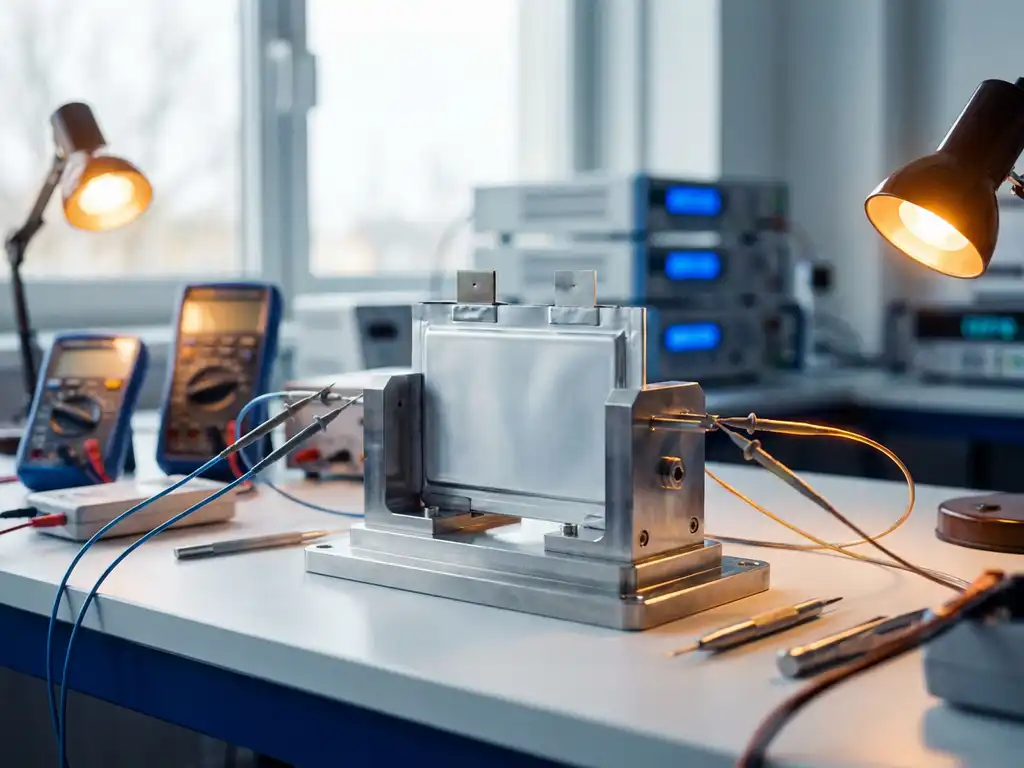
Solid-state battery testing technology is advancing rapidly, driven by the shift from liquid to solid electrolytes and the experimental demands this creates. Existing liquid-electrolyte testing protocols cannot be transferred directly to solid-state cells, and new instrumentation approaches are required to generate reliable, reproducible data. The sections below address the most pressing technical questions facing researchers working in this field in 2026.
How does solid-state battery testing differ from lithium-ion testing?
Solid-state battery testing differs from conventional lithium-ion testing primarily because solid electrolytes introduce mechanical, interfacial, and processing constraints that liquid electrolytes do not. In a liquid-electrolyte cell, the electrolyte conforms to electrode surfaces spontaneously. In a solid-state cell, intimate contact between the solid electrolyte and electrodes must be engineered and maintained throughout cycling.
Several practical differences follow from this:
- Cell assembly requires controlled pressure application to ensure electrolyte-electrode contact, rather than simple electrolyte filling.
- Electrochemical impedance spectroscopy (EIS) spectra from solid-state cells contain additional interfacial arcs that are absent in liquid-electrolyte systems and require careful deconvolution.
- Coulombic efficiency measurements in the first cycles are more sensitive to interfacial quality than in conventional cells, making precise current control critical.
- Temperature management is more complex because ionic conductivity in solid electrolytes is strongly temperature-dependent.
These differences mean that battery testing equipment designed for solid-state research must accommodate mechanical loading, precise temperature control, and higher-resolution impedance measurement than standard liquid-electrolyte setups require.
What are the biggest technical challenges in solid-state battery testing today?
The biggest technical challenges in solid-state battery testing today are maintaining reproducible interfacial contact, managing electrode volume changes under constraint, and preventing electrolyte degradation during cell assembly and cycling. Each of these challenges affects data quality in ways that are difficult to separate without well-controlled experimental conditions.
Interfacial contact and resistance
The interface between a solid electrolyte and an electrode is inherently more resistive than a wetted liquid interface. Small variations in applied pressure, surface roughness, or particle size distribution produce measurable differences in interfacial resistance. This makes it difficult to compare results across laboratories unless cell geometry and assembly pressure are standardised.
Conventional test cells also compress electrode material inhomogeneously. The PAT-Solid-Core insert, used in both the PAT-Cell-Force and PAT-Cell-Solid, addresses this by using guided plane-parallel tungsten carbide plungers together with a dedicated pressing tool to ensure homogeneous compression across the electrode stack.
Electrolyte stability during testing
Many solid electrolytes, particularly sulphide-based materials, are sensitive to atmospheric moisture and require inert-atmosphere assembly and testing. Oxide-based electrolytes are more stable but require high sintering temperatures that complicate integration with electrode materials. Polymer electrolytes introduce their own temperature sensitivity. Each class demands different handling protocols, and a test cell design that works for one electrolyte type may not be appropriate for another.
Cell housing materials also affect contamination risk. Conventional cells often use PEEK housings, which absorb significant moisture and require drying at 120°C under vacuum. EL-CELL cells use PPS plastic instead of PEEK. PPS absorbs less moisture, which reduces both contamination risk and preparation time. Similarly, conventional cells are typically sealed with O-rings, whereas EL-CELL cells use aluminum seals and glass-metal feedthroughs, further limiting moisture ingress.
Assembly failure rate and reproducibility
Conventional test cells have a high assembly failure rate — studies cite 43%. Even experienced builders achieve only around 4 out of 5 working cells, while inexperienced ones fall below 50%. The PAT-Cell-Force and PAT-Cell-Solid from EL-CELL standardize and simplify preparation so that nearly every cell runs without failure, which is a meaningful practical advantage when working with expensive or scarce solid electrolyte materials.
How do in-situ and operando techniques apply to solid-state cells?
In-situ and operando techniques apply to solid-state cells by allowing researchers to monitor structural, mechanical, and chemical changes within the cell during electrochemical cycling, rather than relying solely on post-mortem analysis. Because solid-state cells cannot be disassembled and reassembled as readily as liquid-electrolyte cells without disturbing interfaces, continuous measurement during operation is particularly valuable.
Techniques that are actively being adapted for solid-state research include:
- In-situ dilatometry: Quantifying electrode thickness changes during cycling reveals how volume expansion and contraction affect contact with the solid electrolyte. Instruments such as the ECD-4-nano electrochemical dilatometer can resolve thickness changes at sub-nanometre resolution, which is relevant when monitoring thin solid electrolyte layers.
- Operando X-ray diffraction: Tracking phase changes in electrode and electrolyte materials under applied current requires test cells with X-ray transparent windows. This technique is well established for oxide systems and is being extended to sulphide electrolytes.
- Operando EIS: Continuous impedance monitoring during cycling allows researchers to track the evolution of interfacial resistance and bulk electrolyte conductivity in real time, providing mechanistic insight that endpoint measurements cannot offer.
The practical constraint is that solid-state cells must maintain mechanical integrity and defined pressure during these measurements, which places additional demands on cell design.
What role does stack pressure play in solid-state battery test results?
Stack pressure plays a central role in solid-state battery test results because it directly controls the quality of contact between the solid electrolyte and the electrodes. Insufficient pressure leads to high interfacial resistance and poor ionic transport across the electrolyte-electrode interface. Excessive pressure can fracture brittle electrolyte pellets or cause delamination in composite electrodes.
Reproducible pressure control is therefore a prerequisite for generating comparable data. In research settings, this means using test cells that apply a defined, measurable uniaxial load rather than relying on spring clips or bolted assemblies where the actual contact force is unknown. The relationship between applied pressure and cell performance is itself a useful experimental variable: pressure-dependent EIS measurements can reveal whether observed resistance changes are mechanical or electrochemical in origin.
Researchers also need to distinguish between static pressure applied during assembly and dynamic pressure changes that occur as electrodes expand and contract during cycling. A cell that cannot accommodate these dimensional changes will show artificially degraded cycling performance that does not reflect the intrinsic properties of the materials under test. Conventional cells do not include a force sensor — only initial pressure is read, and mechanical settling can reduce it over time without detection. The PAT-Cell-Force addresses this directly by integrating a calibrated force sensor into the cell body, enabling continuous monitoring of stack pressure throughout the experiment. An optional gas pressure sensor can also be added, making it possible to measure force changes caused by gas evolution separately from those caused by mechanical settling.
What test cell designs are emerging for solid-state research?
Test cell designs emerging for solid-state research are characterised by integrated pressure control, compatibility with inert-atmosphere assembly, and modularity that allows the same cell hardware to be used with different electrolyte types. The trend is away from adapted liquid-electrolyte formats and towards purpose-built solid-state cell architectures.
Key design features in current solid-state test cells include:
- Defined uniaxial load application: Cells that incorporate a force sensor or spring-loaded plunger allow pressure to be set and monitored independently of cell assembly torque.
- Heated cell bodies: For polymer and some ceramic electrolytes, temperature control integrated into the cell body is more precise than external oven heating.
- Optical and X-ray access ports: Cells with transparent windows or low-absorption windows enable operando optical and diffraction measurements without requiring synchrotron-specific hardware for all experiments.
- Scalable electrode area: Research cells that accommodate a range of electrode diameters allow specific capacity (mAh/cm²) measurements to be made at consistent areal loading, which is important for comparing materials across studies.
- Durable plunger materials: Conventional plungers embed particles during use and must be ground or polished between measurements, gradually altering cell geometry. EL-CELL uses tungsten carbide plungers that withstand high mechanical loads without this degradation, preserving cell geometry across experiments.
The PAT-Cell-Solid represents one approach to this challenge, designed specifically for solid and quasi-solid electrolyte systems with integrated pressure application and compatibility with the PAT Series instrument platform.
Where is solid-state battery testing technology headed in the next decade?
Solid-state battery testing technology is headed towards greater standardisation of test protocols, higher levels of in-situ measurement integration, and closer coupling between experimental data and computational modelling. The field is currently fragmented, with different research groups using incompatible cell designs and pressure conditions, which makes cross-laboratory comparison of materials data difficult.
Several directions are likely to shape the next decade:
- Standardised pressure protocols: As the field matures, consensus on reference pressure conditions for different electrolyte classes will improve data comparability, much as standard C-rate protocols improved comparability in liquid-electrolyte research.
- Multi-modal operando platforms: Test cells that simultaneously support EIS, dilatometry, and optical or spectroscopic access will become more common, allowing researchers to correlate mechanical, structural, and electrochemical data from a single experiment.
- Automation and high-throughput screening: Solid electrolyte material discovery involves large compositional spaces. Automated test platforms that can cycle many cells in parallel with consistent pressure and temperature control will accelerate materials screening.
- Improved interfacial characterisation: New techniques for quantifying the solid-solid interface at the nanometre scale, combined with operando EIS, will provide better mechanistic understanding of degradation pathways specific to solid-state systems.
For researchers working in this space, the immediate priority is ensuring that the test equipment they use today can generate data that will remain comparable as protocols converge. Investing in instrumentation with defined, controllable experimental parameters is more valuable than optimising for throughput at the expense of reproducibility.
How EL-Cell GmbH supports solid-state battery research
EL-Cell GmbH designs and manufactures battery test cells and electrochemical instrumentation specifically for the demands of solid-state battery research. Our product portfolio addresses the core experimental requirements that distinguish solid-state testing from conventional liquid-electrolyte work:
- The PAT-Cell-Solid provides defined uniaxial pressure application for solid and quasi-solid electrolyte systems, with compatibility across the PAT Series platform.
- The PAT-Cell-Force integrates a calibrated force sensor directly into the cell body, enabling continuous monitoring of stack pressure during cycling. An optional gas pressure sensor allows force changes from gas evolution to be measured independently of mechanical ones.
- The ECD-4-nano electrochemical dilatometer measures electrode thickness changes with a resolution of better than 5 nm, supporting in-situ monitoring of volume changes in solid-state electrode stacks.
- The PAT-Tester-i-16 combines galvanostatic and potentiostatic control with EIS capability across up to 16 channels, with integrated temperature-controlled cell chambers suited to solid electrolyte testing requirements.
All instruments are designed as part of an interoperable research ecosystem, so data from dilatometry, EIS, and cycling measurements can be acquired and analysed within a single workflow. If you are setting up or expanding a solid-state battery research programme, contact us to discuss which cell formats and instrument configurations are appropriate for your electrolyte system and experimental objectives.
Comments are closed.