


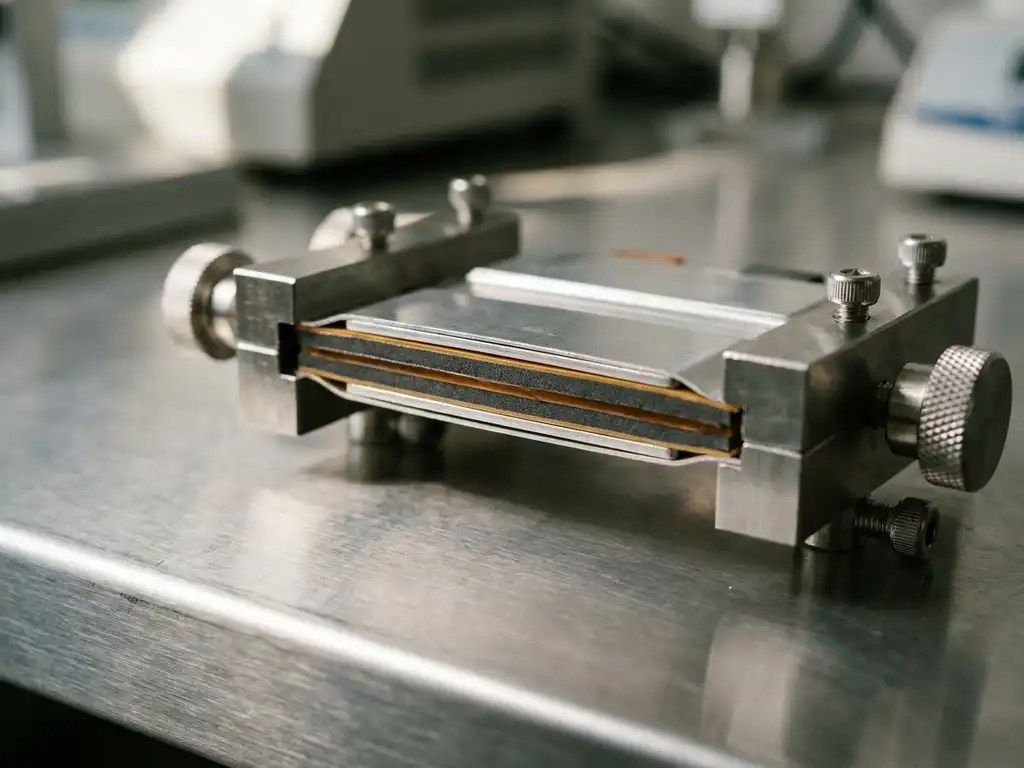
In-situ testing involves measuring the physical, chemical, or electrochemical properties of a battery cell while it is actively cycling, without disassembling it between measurements. Applied to solid-state batteries, this means monitoring what happens inside the cell in real time as charge and discharge occur. The sections below address the most common questions researchers have about in-situ characterisation in solid-state battery systems.
How does in-situ testing work inside a solid-state battery?
In-situ testing works by integrating sensors, probes, or measurement ports directly into the cell architecture so that data can be collected continuously during electrochemical cycling. Rather than stopping a test, opening the cell, and analysing the electrode or electrolyte separately, the researcher captures changes as they happen under real operating conditions.
In a solid-state battery, this presents specific design requirements. Because the electrolyte is a solid ceramic, polymer, or composite material rather than a liquid, the cell must be assembled with measurement access points that do not compromise the mechanical integrity of the stack. Pressure contacts, embedded strain sensors, or optical windows can all be incorporated depending on the technique being used.
The key principle is that the measurement does not interrupt the electrochemical process. The cell continues to charge and discharge while data is recorded simultaneously, producing a time-resolved picture of how the internal state evolves with state of charge, temperature, and cycle number.
What properties of solid-state batteries can in-situ methods detect?
In-situ methods can detect a broad range of physical and electrochemical properties in solid-state batteries, including dimensional changes in electrodes, interfacial resistance evolution, mechanical stress within the solid electrolyte, ionic transport behaviour, and structural phase transitions in active materials.
More specifically, researchers commonly track:
- Electrode thickness changes caused by lithium intercalation and de-intercalation, or lithium plating and stripping at metal anodes
- Impedance spectra obtained through electrochemical impedance spectroscopy (EIS), which reveal how interfacial and bulk resistance changes with cycling
- Mechanical stress and delamination at the electrode-electrolyte interface, which is a known failure mode in solid-state cells
- Structural changes in cathode active materials detected by in-situ X-ray diffraction or Raman spectroscopy
- Gas evolution, relevant when decomposition reactions occur at the electrode-electrolyte interface under high voltage
Each of these properties provides a different window into the degradation mechanisms and performance limitations that are specific to solid-state architectures.
What are the main challenges of in-situ characterisation for solid-state cells?
The main challenges of in-situ characterisation for solid-state cells arise from the mechanical rigidity of the solid electrolyte, the need to maintain controlled stack pressure during measurement, and the difficulty of accessing internal interfaces without disrupting the cell.
Unlike liquid electrolyte cells, solid-state cells require a defined and often precisely controlled uniaxial pressure to maintain good interfacial contact between the solid electrolyte and the electrodes. Any measurement fixture must therefore apply and maintain this pressure while simultaneously allowing the measurement signal to pass through. This imposes significant constraints on cell and fixture design.
Additional challenges include:
- Ensuring that embedded sensors or measurement contacts do not create local stress concentrations or current distribution artefacts
- Maintaining an inert atmosphere during assembly and measurement, since most solid-state electrolytes are moisture-sensitive
- Interpreting impedance data correctly when multiple resistive contributions overlap in the spectrum
- Achieving sufficient resolution to detect small dimensional changes in thin-film or composite electrolyte stacks
These constraints mean that cell design and measurement instrument selection are closely coupled in solid-state battery research.
How does in-situ dilatometry apply to solid-state battery research?
In-situ dilatometry measures the thickness change of a battery cell or electrode stack as a function of state of charge or cycle number. In solid-state battery research, it is used to quantify how electrodes expand and contract during lithium intercalation, to detect lithium plating at metal anodes, and to identify irreversible volume changes that indicate mechanical degradation.
For solid-state cells specifically, dilatometry provides information that is difficult to obtain by other means. Because the electrolyte is rigid, any net dimensional change in the stack reflects real changes in the electrode materials themselves, not swelling of a liquid electrolyte. This makes the dilatometric signal a relatively clean indicator of electrode-level processes.
High-resolution dilatometry can resolve thickness changes at the nanometre scale, which is relevant when studying thin-film electrodes or the early stages of lithium dendrite formation at the interface between a lithium metal anode and a solid electrolyte. The technique is also well suited to studying how applied stack pressure affects the reversibility of volume changes over many cycles.
Our PAT-Cell-Force and the ECD-4-nano dilatometer are designed specifically to support this type of measurement, combining controlled uniaxial pressure with sub-nanometre displacement resolution.
Which in-situ techniques are most commonly used in solid-state battery labs?
The most commonly used in-situ techniques in solid-state battery laboratories are electrochemical impedance spectroscopy (EIS), dilatometry, X-ray diffraction (XRD), and Raman spectroscopy. EIS and dilatometry are the most accessible because they require only electrochemical and mechanical instrumentation, while XRD and Raman require synchrotron or laboratory X-ray sources and optical access to the cell.
EIS is used in nearly every solid-state battery study because it separates contributions from bulk electrolyte resistance, grain boundary resistance, and interfacial resistance in a single measurement. Tracking how these contributions evolve during cycling reveals where degradation is occurring.
Dilatometry is increasingly common as researchers study lithium metal anodes and thick composite cathodes, both of which undergo substantial volume changes. In-situ XRD provides direct structural information about phase transitions in cathode materials such as layered oxides and sulphides. Raman spectroscopy is used to detect chemical changes at interfaces, including decomposition products of the solid electrolyte.
Operando techniques, which are a subset of in-situ methods that collect data continuously rather than at discrete intervals, are becoming standard practice in high-quality battery research because they capture transient phenomena that point-in-time measurements would miss.
When should researchers choose in-situ over ex-situ testing for solid-state batteries?
Researchers should choose in-situ testing over ex-situ testing when the property of interest changes during cycling and cannot be preserved reliably through cell disassembly. For solid-state batteries, this applies to interfacial resistance, electrode volume changes, mechanical stress states, and any phenomenon that is sensitive to pressure release or atmospheric exposure during opening.
Ex-situ characterisation remains appropriate when high spatial resolution is required, such as cross-sectional scanning electron microscopy (SEM) or transmission electron microscopy (TEM) of the electrode-electrolyte interface. These techniques require sample preparation steps that are incompatible with in-situ measurement. However, ex-situ results must always be interpreted with the caveat that disassembly may alter the sample.
A practical decision framework:
- Use in-situ when studying dynamic processes, transient states, or phenomena that depend on the cell being under pressure and in an active electrochemical state
- Use ex-situ when nanometre-scale imaging or surface-sensitive spectroscopy is required and sample preparation is unavoidable
- Use both in combination when building a complete picture of degradation mechanisms, using in-situ data to identify when and where changes occur, then ex-situ analysis to characterise the resulting microstructure
For solid-state cells in particular, the pressure sensitivity of interfacial contact means that ex-situ results after disassembly can differ substantially from the in-operando state, making in-situ measurement especially valuable for this chemistry.
How EL-Cell GmbH supports in-situ solid-state battery research
EL-Cell GmbH designs and manufactures test cells and instruments that are built around the requirements of in-situ and operando characterisation for solid-state battery research. Our product range addresses the specific constraints of solid-state cell testing directly:
- The PAT-Cell-Solid is designed for testing solid-state electrolytes under controlled uniaxial pressure, with direct access for EIS measurements throughout cycling
- The PAT-Cell-Force provides simultaneous force measurement and electrochemical testing, enabling researchers to correlate stack pressure with impedance and capacity data in real time
- The ECD-4-nano electrochemical dilatometer delivers sub-5 nm displacement resolution, making it suitable for detecting small volume changes in thin-film and composite electrode stacks
- The PAT-Tester-i-16 integrates galvanostatic and potentiostatic cycling with EIS capability across up to 16 channels, with temperature control built in
A key advantage of the PAT-Cell-Force and PAT-Cell-Solid is their significantly lower assembly failure rate compared to conventional test cells. Studies on conventional cells report an assembly failure rate of around 43%, and even experienced researchers typically achieve only 4 out of 5 working cells, while inexperienced builders fall below 50%. The standardised preparation procedures and the PAT-Solid-Core insert used in both EL-CELL cells are designed to eliminate most of these failure modes, so that nearly every assembled cell runs successfully.
Several further design differences distinguish EL-CELL cells from conventional alternatives. Conventional test cells do not include a force sensor, meaning that only the initial stack pressure is known; mechanical settling can reduce it over time without any indication. The PAT-Cell-Force and PAT-Cell-Solid include an integrated force sensor, and an optional gas pressure sensor can be added to separate force changes caused by gas evolution from those caused by mechanical effects. For electrode compression, the PAT-Solid-Core insert uses guided plane-parallel tungsten carbide plungers together with a dedicated pressing tool, ensuring homogeneous compression across the electrode area rather than the inhomogeneous compression typical of conventional cells. These same tungsten carbide plungers resist high mechanical loads without embedding particles into their surface, which means cell geometry remains consistent across measurements — unlike conventional plungers, which must be ground or polished periodically as particles accumulate, gradually altering the geometry. On sealing and materials, EL-CELL cells use aluminium seals and glass-metal feedthroughs in place of O-rings, and PPS plastic instead of PEEK. PPS absorbs significantly less moisture than PEEK, which requires drying at 120°C under vacuum; the lower moisture uptake of PPS reduces contamination risk and shortens preparation time.
All instruments are designed to work together as a compatible research ecosystem, reducing integration effort and ensuring that data collected across different techniques is directly comparable. If your laboratory is establishing or expanding a solid-state battery characterisation programme, contact EL-Cell GmbH to discuss which combination of test cells and instruments fits your experimental requirements.
Comments are closed.