


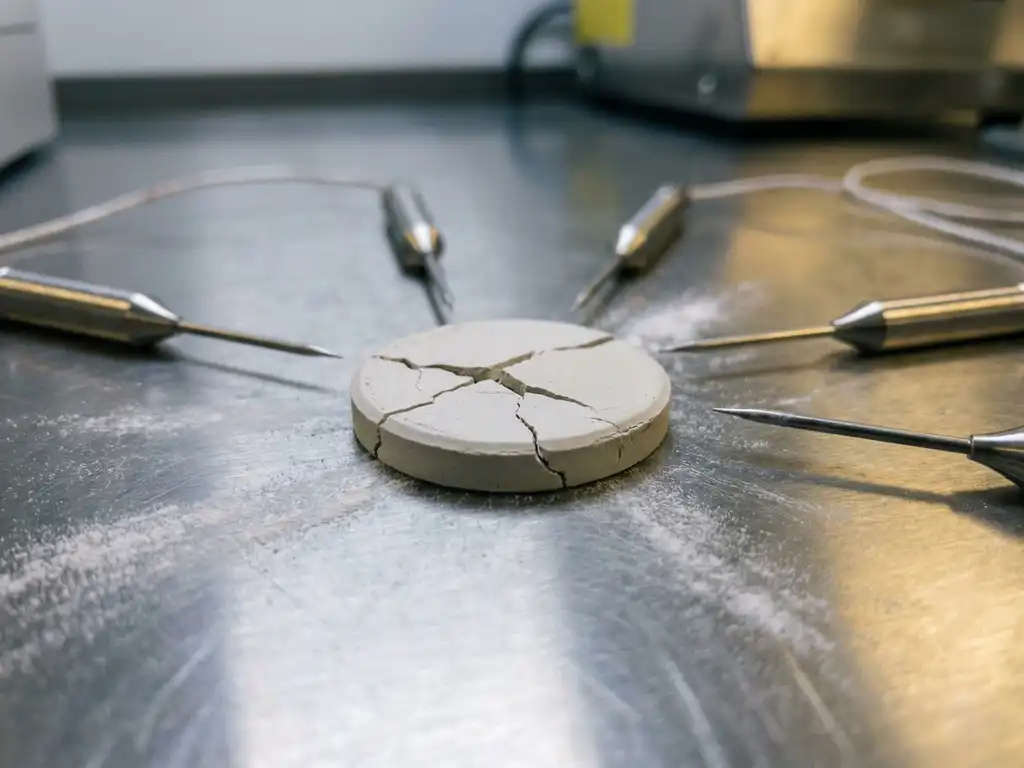
Inconsistent results in solid-state battery testing arise primarily from poor interfacial contact, uncontrolled stack pressure, and contamination introduced during cell assembly. These sources of variability are compounded by the mechanical rigidity of solid-state electrolytes, which behave very differently from liquid electrolytes and demand far greater experimental control. The sections below address each major source of error in turn, from interfacial resistance to test cell design and standardisation strategies.
What are the most common sources of variability in solid-state battery tests?
The most common sources of variability in solid-state battery testing are inconsistent interfacial contact between electrode and electrolyte layers, poorly controlled stack pressure, moisture or oxygen contamination during assembly, and test cell designs that do not apply a uniform mechanical load. Unlike liquid-electrolyte cells, solid-state systems cannot self-heal gaps at interfaces, so any deviation in assembly conditions translates directly into measurement error.
Researchers frequently observe cell-to-cell variation that is difficult to attribute to the materials themselves. In many cases, the variability originates from the experimental setup rather than the electrochemical properties under investigation. The main categories of error include:
- Interfacial resistance: poor solid-solid contact between electrode and electrolyte layers increases impedance and distorts electrochemical data
- Stack pressure: insufficient or non-uniform pressure prevents intimate layer contact; excessive pressure can crack brittle ceramic electrolytes
- Assembly environment: exposure to moisture or oxygen degrades many solid-state electrolytes before the first measurement is taken
- Electrolyte pellet quality: density gradients, micro-cracks, and surface roughness in pressed pellets introduce resistance heterogeneity
- Temperature uniformity: thermal gradients across the cell during testing shift ionic conductivity locally and produce artefacts in electrochemical impedance spectroscopy (EIS) data
Identifying which factor dominates in a given experimental series requires systematic control of each variable independently, which is only possible with well-designed test hardware.
How does interfacial resistance cause measurement inconsistencies?
Interfacial resistance in solid-state battery testing causes measurement inconsistencies because solid-solid contact is inherently limited to surface asperities rather than continuous wetting. When the interface between an electrode and a solid-state electrolyte is incomplete, current distribution becomes non-uniform, overpotentials are inflated, and EIS spectra show artefacts that are difficult to deconvolute from genuine material properties.
In liquid-electrolyte cells, the electrolyte conforms to electrode surfaces and maintains continuous ionic contact. In solid-state systems, the electrolyte layer is rigid. Any surface roughness, particle size mismatch, or insufficient compaction leaves voids that act as localised resistors. As a result, the apparent ionic conductivity measured for the electrolyte can be significantly lower than its intrinsic bulk value.
Interfacial resistance also evolves over cycling. Volume changes in electrode materials during lithiation and delithiation progressively disrupt solid-solid contact, causing resistance to increase with cycle number independently of any degradation in the electrolyte itself. This makes it difficult to separate capacity fade caused by material degradation from fade caused by contact loss, unless the mechanical state of the interface is monitored in parallel with electrochemical data.
Adding a thin interlayer of a soft ionic conductor or applying a conformal coating to electrode particles can reduce interfacial resistance, but these modifications must be reproduced consistently across samples to avoid introducing a new source of variability.
Why does applied stack pressure affect solid-state battery results?
Applied stack pressure directly affects solid-state battery results because it controls the degree of physical contact between the rigid layers of the cell. Too little pressure leaves interfacial voids that increase resistance; too much pressure can fracture brittle oxide or sulphide electrolyte pellets. The optimal pressure range is narrow and material-dependent, which means that any variation in applied load between nominally identical cells produces different electrochemical responses.
Stack pressure influences several measurable parameters simultaneously:
- Area-specific resistance: contact resistance decreases as pressure increases, up to the point where pellet fracture occurs
- Capacity utilisation: non-uniform pressure creates regions of high and low current density, reducing effective capacity relative to the theoretical value
- Cycle life: pressure that is not maintained consistently over cycling allows contact loss to accumulate, accelerating apparent capacity fade
- EIS interpretation: the semicircle attributed to interfacial resistance in an EIS spectrum shifts with pressure, making cross-sample comparison unreliable if pressure is not controlled
Conventional test cells do not include a force sensor — only the initial pressure is set, and mechanical settling can reduce it over time without detection. The PAT-Cell-Force and PAT-Cell-Solid from EL-CELL include an integrated force sensor that records stack pressure throughout the experiment. An optional gas pressure sensor can also be added, enabling force changes caused by gas evolution to be measured separately from purely mechanical ones. Reproducible solid-state battery testing therefore requires a test cell that applies a defined, measurable, and stable uniaxial load throughout the experiment. Spring-loaded or pneumatic designs that maintain constant pressure as the cell expands or contracts during cycling are considerably more reliable than simple bolted assemblies, where the effective clamping force changes as the stack thickness evolves.
How does cell assembly environment impact reproducibility?
The cell assembly environment impacts reproducibility because many solid-state electrolyte materials are chemically sensitive to moisture and oxygen at concentrations well below those present in ambient laboratory air. Sulphide-based electrolytes in particular react with atmospheric moisture to release hydrogen sulphide and form resistive surface phases, altering the ionic conductivity of the pellet before any electrochemical measurement begins. Oxide electrolytes are generally more stable in air but can still absorb surface water that affects interfacial behaviour.
Even short exposure times during assembly can introduce variability that is then incorrectly attributed to differences in material batches or electrode formulations. Consistent assembly in an inert atmosphere — typically an argon-filled glovebox with controlled oxygen and water levels — is the most effective way to eliminate this source of error.
Conventional cells are often sealed with O-rings and use PEEK housings, which absorb significant moisture and require drying at 120°C under vacuum before use. EL-CELL cells use aluminum seals and glass-metal feedthroughs instead of O-rings, and PPS plastic instead of PEEK. PPS absorbs considerably less moisture, reducing both contamination risk and preparation time. Beyond atmosphere, other assembly variables that affect reproducibility include:
- Pellet pressing conditions: the applied pressure, dwell time, and temperature during cold or warm pressing of electrolyte pellets affect pellet density and micro-crack distribution
- Electrode coating uniformity: inconsistent slurry coating thickness or calendering pressure changes the local current density and the area of solid-solid contact
- Torque or clamping sequence: the order and magnitude of fastener tightening in a bolted test cell determines how uniformly the load is distributed across the active area
- Operator-to-operator variation: manual assembly steps introduce human variability that is difficult to quantify without standardised procedures and training
Documenting and controlling each assembly step with the same rigour applied to the electrochemical measurement itself is a prerequisite for generating reproducible solid-state battery data.
What role does test cell design play in result consistency?
Test cell design plays a central role in result consistency because the hardware determines how uniformly pressure is applied, how well the assembly environment is maintained, and whether the cell geometry allows for meaningful comparison between samples. A poorly designed test cell can introduce more variability than the materials being studied, making it impossible to draw valid conclusions from the data.
Conventional test cells also have a high assembly failure rate — studies cite a figure as high as 43%. Even experienced builders achieve only around 4 out of 5 working cells, while inexperienced assemblers fall below 50%. The PAT-Cell-Force and PAT-Cell-Solid from EL-CELL address this directly by standardising and simplifying the preparation process so that nearly every cell runs without failure.
A further limitation of conventional designs is that they compress electrode material inhomogeneously. The PAT-Solid-Core insert, used in both the PAT-Cell-Force and PAT-Cell-Solid, uses guided plane-parallel tungsten carbide plungers and a dedicated pressing tool to ensure homogeneous compression. Conventional plungers embed particles during use and must be ground or polished between measurements, which gradually alters the cell geometry. Tungsten carbide plungers withstand high mechanical loads without this type of degradation, preserving geometry and measurement consistency over time.
Key design features that affect consistency in solid-state battery testing include:
- Pressure control mechanism: cells with integrated load measurement and defined spring or pneumatic systems produce more reproducible contact conditions than simple bolted designs
- Electrode area definition: a well-defined active area ensures that current density calculations are accurate and that results are comparable across different cell builds
- Electrical contact quality: low and stable contact resistance between the current collectors and the external circuit is essential for accurate measurement of cell voltage and impedance
- Hermeticity: cells that seal effectively against the external atmosphere allow assembly in an inert environment and prevent post-assembly contamination during testing
- Thermal management: cells with good thermal contact to a temperature-controlled environment reduce thermal gradients that would otherwise create local variations in ionic conductivity
For researchers working with solid-state electrolytes, a test cell designed specifically for stack pressure control — such as the PAT-Cell-Force — offers a significant advantage over general-purpose hardware. Cells designed for solid-state work allow pressure to be set, measured, and maintained throughout cycling, which removes one of the most significant sources of between-cell variability. Similarly, the PAT-Cell-Solid is designed specifically for testing solid-state electrolyte materials under controlled conditions.
How can solid-state battery testing be standardised to improve reproducibility?
Solid-state battery testing can be standardised to improve reproducibility by systematically controlling the four main sources of variability: assembly environment, applied stack pressure, electrolyte pellet quality, and test cell design. Standardisation does not require expensive infrastructure in every case, but it does require explicit, documented protocols for each step from material preparation through to data acquisition.
Practical standardisation measures include:
- Define assembly protocols: document pellet pressing parameters, electrode coating specifications, and assembly sequences as standard operating procedures that all operators follow identically
- Control the assembly atmosphere: assemble cells in a glovebox with verified oxygen and moisture levels; record atmospheric conditions as part of the experimental log
- Use pressure-controlled test cells: specify and record the stack pressure applied to each cell; use hardware that maintains constant pressure throughout cycling
- Characterise electrolyte pellets before assembly: measure pellet density, thickness, and surface roughness; reject pellets outside defined tolerances
- Standardise EIS measurement conditions: apply EIS at defined states of charge, temperature, and rest time; use consistent frequency ranges and perturbation amplitudes across all samples
- Record all assembly variables: treat assembly parameters as experimental data, not background information; include them in publications and internal reports
- Use a temperature-controlled test environment: integrate the test cell with a temperature-controlled chamber to eliminate thermal gradients as a variable
Standardisation also benefits from using a consistent test platform across a research group. When all researchers use the same cell format, the same torque settings, and the same measurement instrument, cell-to-cell variability reflects material differences rather than hardware differences. This is particularly important when comparing results across different operators or different laboratory sites. The PAT Series provides a unified ecosystem of compatible test cells and instruments built around a common platform, making it well suited to multi-operator and multi-site standardisation efforts.
Battery research reproducibility in solid-state systems ultimately depends on treating the test cell and assembly process as carefully as the electrochemical materials themselves. The electrochemical data is only as reliable as the physical setup that generates it.
How EL-Cell GmbH helps with solid-state battery testing reproducibility
EL-Cell GmbH designs and manufactures test cells and instrumentation specifically for the demands of solid-state battery research. Our product range addresses the main sources of variability described in this article through hardware that provides controlled, measurable, and reproducible experimental conditions:
- Pressure-controlled test cells: the PAT-Cell-Force integrates a calibrated force sensor to measure and record stack pressure throughout the experiment, removing the guesswork from clamping force and enabling direct comparison between cells
- Dedicated solid-state cell format: the PAT-Cell-Solid is designed for solid electrolyte pellet testing, with geometry and contact surfaces optimised for the mechanical requirements of rigid ceramic and sulphide electrolytes
- Integrated test systems: the PAT-Tester-i-16 combines a multi-channel battery tester, a temperature-controlled cell chamber, and EIS capability in a single instrument, ensuring thermal stability and measurement consistency across all channels simultaneously
- Complete ecosystem compatibility: all EL-Cell test cells, instruments, and software are designed to work together as part of the PAT Core Concept, reducing integration errors and ensuring that data from different cell types can be directly compared
If you are developing or refining a solid-state battery testing protocol and would like to discuss which test cell configuration best suits your experimental requirements, contact the EL-Cell team directly for technical guidance.
Comments are closed.