


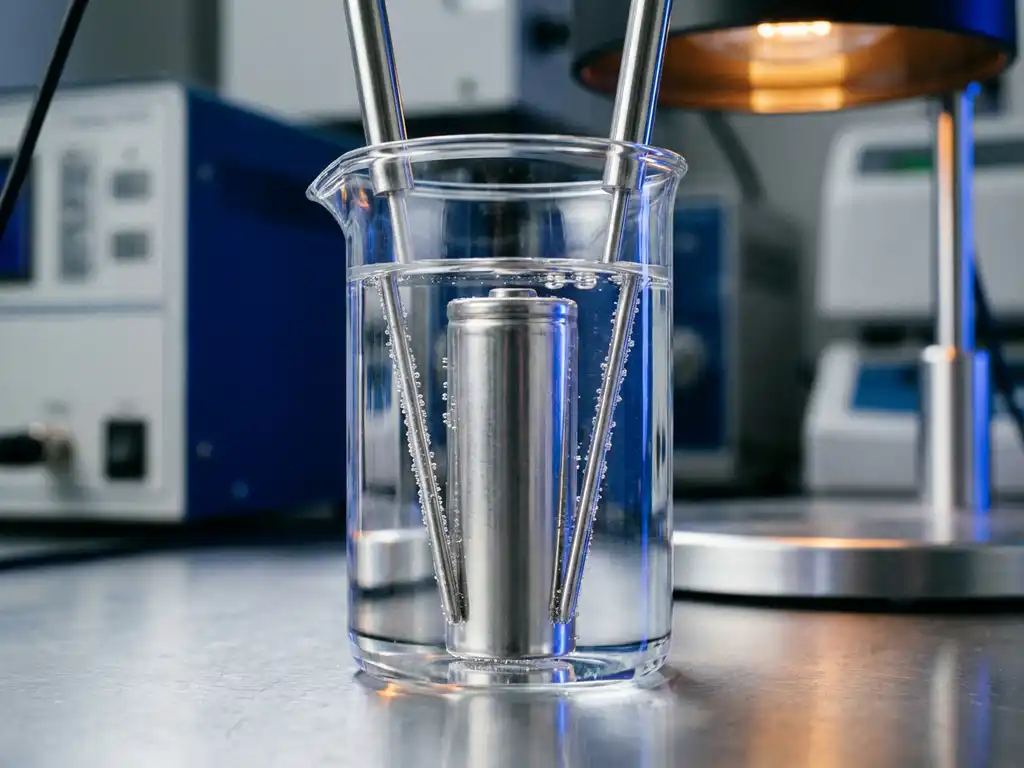
PAT-Tester-i-16: integrates a potentiostat/galvanostat, EIS capability, a temperature-controlled cell chamber, and a docking station for up to 16 channels in a single instrument.
ECD-4-nano: electrochemical dilatometer measures electrode thickness changes with a resolution better than 1 nanometre.
PAT-Cell-Press: support solid-state battery research under defined mechanical pressure (not mentioned alongside PAT-Cell-Solid for solid-state; PAT-Cell-Press is a gas analysis test cell).
PAT-Cell-Solid: supports solid-state battery research under defined mechanical pressure.
Electrochemistry is the branch of physical chemistry that studies the relationship between electrical energy and chemical reactions. For battery researchers, it forms the theoretical and experimental foundation of almost everything that happens inside a cell—from the first charge cycle to long-term degradation. Understanding electrochemical principles is not optional for serious battery research; it is the starting point.
This article addresses the most common foundational questions about electrochemistry as it applies to battery research. It is structured to provide direct answers followed by supporting context. Whether you are beginning a PhD or designing a new experimental protocol, these answers should help clarify both the concepts and the practical tools involved.
What is electrochemistry and how does it work?
Electrochemistry is the study of chemical processes that involve the transfer of electrons between substances, typically at the interface between an electrode and an electrolyte. These electron-transfer reactions, known as redox reactions, either release electrical energy (as in a discharging battery) or consume it (as in charging). The field encompasses both the thermodynamics and kinetics of these interfacial processes.
At its core, electrochemistry works by separating the oxidation and reduction half-reactions of a redox process into two distinct electrodes. Electrons travel through an external circuit, producing measurable current, while ions migrate through the electrolyte to maintain charge balance. The driving force for this process is the difference in electrochemical potential between the two electrodes, which determines the cell voltage.
Electrochemical reactions are governed by several key principles:
- Faraday’s laws of electrolysis — the amount of substance transformed at an electrode is directly proportional to the charge passed
- The Nernst equation — describes how electrode potential varies with the concentration of electroactive species
- Butler-Volmer kinetics — describes the relationship between current density and overpotential at an electrode surface
These principles apply directly to battery electrodes, making electrochemical theory an essential framework for interpreting experimental data.
Why does electrochemistry matter for battery research?
Electrochemistry matters for battery research because every performance metric of a battery—capacity, voltage, rate capability, cycle life, and efficiency—is determined by electrochemical processes. Without a rigorous understanding of electrode kinetics, interfacial chemistry, and ion transport, it is not possible to design better electrode materials, optimise electrolyte formulations, or diagnose degradation mechanisms.
Battery research is fundamentally applied electrochemistry. When a researcher measures the specific capacity of a new anode material in mAh/g, they are quantifying the charge stored per unit mass through electrochemical reactions. When they observe capacity fade over repeated cycles, they are observing the cumulative result of parasitic electrochemical side reactions, structural changes, and electrolyte decomposition.
Electrochemical understanding also enables researchers to distinguish between different failure modes. A drop in capacity can result from loss of active lithium, impedance growth, or structural degradation of the electrode—and only electrochemical analysis can reliably differentiate between these mechanisms.
What are the key electrochemical processes inside a battery?
The key electrochemical processes inside a lithium-ion battery are lithium-ion intercalation and deintercalation at the electrodes, electrolyte decomposition and solid electrolyte interphase (SEI) formation, and ion transport through the electrolyte and separator. Each of these processes directly influences battery performance and long-term stability.
Intercalation and deintercalation
During charging, lithium ions deintercalate from the cathode material and intercalate into the anode. During discharge, the reverse occurs. This reversible process is the primary energy storage mechanism in lithium-ion batteries. The specific capacity of an electrode material depends on how many lithium ions it can accommodate per unit mass or volume.
SEI layer formation
During the first charge cycle, the electrolyte partially decomposes at the anode surface, forming the SEI layer (solid electrolyte interphase). This layer is ionically conductive but electronically insulating, which prevents further electrolyte decomposition while allowing lithium-ion transport. The quality and stability of the SEI layer significantly affect coulombic efficiency and cycle life. Irreversible lithium consumption during SEI formation is one reason first-cycle coulombic efficiency is always lower than in subsequent cycles.
Overpotential and polarisation
Overpotential is the difference between the thermodynamic equilibrium potential of an electrode and its actual potential under current flow. It arises from kinetic limitations, ohmic resistance, and mass transport constraints. High overpotential reduces energy efficiency and can trigger unwanted side reactions, including lithium plating on graphite anodes at high charge rates.
How do researchers measure electrochemical performance in the lab?
Researchers measure electrochemical performance using a combination of galvanostatic cycling, potentiostatic techniques, and electrochemical impedance spectroscopy (EIS). These methods, applied using a potentiostat or galvanostat, provide quantitative data on capacity, voltage profiles, rate capability, coulombic efficiency, and internal resistance.
Galvanostatic cycling applies a constant current (expressed as a C-rate relative to the electrode’s theoretical capacity) and records the resulting voltage as a function of time or charge passed. This produces charge-discharge curves that reveal the specific capacity in mAh/g, voltage plateau characteristics, and capacity retention over many cycles.
EIS applies a small sinusoidal voltage perturbation across a range of frequencies and measures the impedance response. The resulting Nyquist or Bode plot can be fitted to an equivalent circuit model to separate contributions from ohmic resistance, charge-transfer resistance, and diffusion-related processes. EIS is particularly useful for tracking impedance evolution during ageing or for characterising the SEI layer.
Additional techniques include:
- Cyclic voltammetry (CV) — scans voltage at a defined rate to identify redox peaks and reaction reversibility
- Chronoamperometry — applies a potential step and measures the current response over time
- Rate capability testing — cycles cells at progressively higher C-rates to assess power performance
What is the difference between a half-cell and a full-cell test?
A half-cell test evaluates a single electrode (the working electrode) against a reference electrode, typically lithium metal, in a three-electrode or two-electrode configuration. A full-cell test pairs a cathode and an anode in a complete electrochemical cell. The key distinction is that half-cell testing isolates the behaviour of one electrode, while full-cell testing reflects the combined performance of both electrodes under realistic operating conditions.
Half-cell testing is the standard approach for characterising new electrode materials in academic research. By using a lithium metal counter and reference electrode, researchers can measure the absolute potential of the working electrode versus Li/Li+, obtain accurate specific capacity values in mAh/g, and identify material-level degradation mechanisms without interference from the counter electrode.
Full-cell testing is necessary to assess practical performance. Parameters such as capacity matching between cathode and anode (the N/P ratio), lithium inventory loss, and cross-talk between electrodes only become apparent in a full-cell configuration. Coulombic efficiency values measured in half-cells can be misleading because the lithium metal counter electrode provides an effectively unlimited lithium source, masking irreversible lithium consumption that would cause capacity fade in a real cell.
Most research programmes begin with half-cell screening of individual electrode materials before progressing to full-cell validation.
What tools and equipment are used in electrochemical battery research?
Electrochemical battery research requires a potentiostat or galvanostat for electrical measurements, electrochemical test cells to house the electrode assembly, and supporting lab tools for electrode preparation and cell assembly. The quality and design of the test cell directly affect the reproducibility of results.
The core instrumentation includes:
- Potentiostat/galvanostat — applies and measures voltage and current; must support EIS for full characterisation
- Electrochemical test cells — standardised cells that hold the electrode stack, electrolyte, and separator under controlled conditions
- Temperature-controlled cell chambers — maintain stable thermal conditions to reduce measurement variability
- Electrode coating and calendering equipment — for preparing reproducible electrode films from slurries
- Gloveboxes — for handling air- and moisture-sensitive materials such as lithium metal and many electrolytes
Specialised test cells extend the range of measurable parameters. Dilatometric cells quantify electrode thickness changes during cycling, which correlate with lithium insertion and structural changes. Optical cells allow in situ observation of electrode surfaces. Pressure-controlled cells apply defined mechanical loads to the electrode stack, which is relevant for solid-state battery research, where stack pressure significantly affects ionic contact.
Data acquisition software that integrates with the potentiostat is also essential. It must support automated cycling protocols, real-time monitoring, and export formats compatible with standard analysis tools.
How EL-Cell GmbH supports electrochemical battery research
EL-Cell GmbH designs and manufactures electrochemical test equipment specifically for laboratory-scale battery materials research. Our product ecosystem is built around the PAT Series, which integrates test cells, measurement instruments, and software into a coherent, interoperable platform.
Our portfolio addresses the full range of experimental needs described in this article:
- The PAT-Cell and PAT-Cell-Force provide standardised, reproducible test cells for half-cell and full-cell cycling, with defined electrode geometry and controlled stack pressure
- The PAT-Tester-i-16 integrates a potentiostat/galvanostat, EIS capability, a temperature-controlled cell chamber, and a docking station for up to 16 channels in a single instrument
- The ECD-4-nano electrochemical dilatometer measures electrode thickness changes with a resolution better than 1 nanometre, enabling direct observation of volume changes during cycling
- The PAT-Cell-Solid and PAT-Cell-Press support solid-state battery research under defined mechanical pressure
- EL-Software provides integrated test control, data acquisition, and analysis across the PAT Series platform
All EL-Cell test cells are designed for reproducibility and ease of assembly, which is particularly important in academic environments with frequent staff turnover. Detailed documentation and application notes support the onboarding of new researchers.
If you are setting up a battery research lab or looking to standardise your electrochemical test protocols, contact EL-Cell GmbH to discuss your experimental requirements. You can also learn more about our approach to battery research instrumentation on the EL-Cell about page.
Comments are closed.