


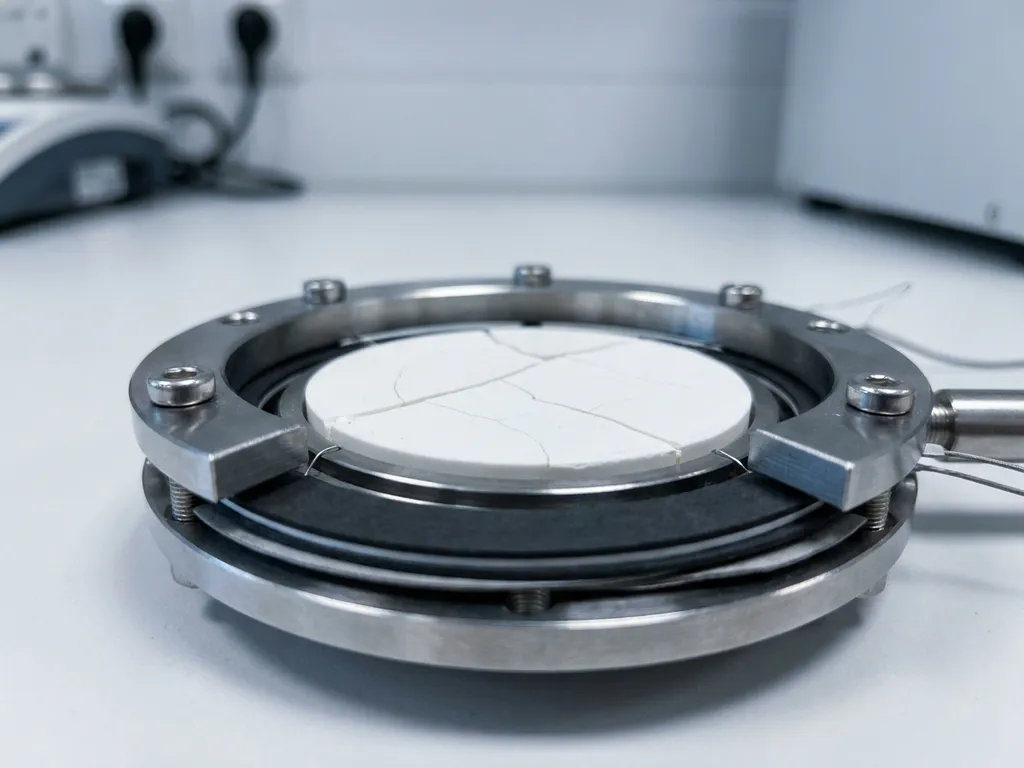
Solid-state battery testing presents significantly greater experimental challenges than conventional liquid electrolyte testing. The absence of a liquid phase removes the self-conforming properties that help liquid electrolytes maintain contact across electrode surfaces, introducing mechanical, chemical, and interfacial complications that require specialised equipment and protocols. The sections below address the most common technical questions researchers encounter when designing solid-state battery test protocols.
Why is solid-state battery testing harder than liquid electrolyte testing?
Solid-state battery testing is harder than liquid electrolyte testing because solid electrolytes cannot flow or self-heal to maintain intimate contact with electrode surfaces. Every interface must be engineered and maintained mechanically, and any deformation, crack, or delamination in the solid electrolyte directly impairs ionic transport and produces artefacts in the electrochemical data.
In a conventional liquid electrolyte cell, the electrolyte wets the electrode surfaces and fills pores automatically. Researchers can assemble cells with relatively standard procedures and expect reasonable interfacial contact. In a solid-state system, contact quality depends on applied pressure, surface roughness, particle morphology, and the elastic or plastic properties of the electrolyte material. These variables must be controlled experimentally rather than left to the physics of wetting.
Additional complications arise from the chemical sensitivity of most solid electrolyte materials. Many sulfide-based solid electrolytes react with atmospheric moisture and oxygen within seconds of exposure. Oxide-based electrolytes require sintering at high temperatures, which introduces processing constraints that liquid electrolyte cells do not face. The combination of mechanical and chemical sensitivity means that solid-state battery testing demands stricter environmental controls, more precise cell assembly, and more careful interpretation of results.
What makes solid-solid interfaces so difficult to characterise?
Solid-solid interfaces in battery cells are difficult to characterise because they are buried, mechanically stressed, and chemically dynamic. Unlike a liquid-solid interface where the electrolyte conforms to the electrode surface, a solid-solid interface is defined by the physical contact area between two rigid or semi-rigid materials, which changes during cycling as electrodes expand and contract.
The solid electrolyte interphase (SEI) layer that forms at the anode during early cycles adds further complexity. In solid-state systems, this interphase is not simply a dissolved-species deposit but a chemically distinct region that can include mixed ionic and electronic conductors, decomposition products, and mechanical stress concentrations. Characterising this region requires techniques such as electrochemical impedance spectroscopy (EIS), which must be interpreted carefully because multiple resistive and capacitive contributions overlap in the impedance spectrum.
Operando and in-situ measurements are particularly valuable here. Post-mortem analysis of solid-state cells often misrepresents the true interfacial state because disassembly disrupts the mechanical contacts that defined performance during cycling. Researchers who rely solely on post-mortem characterisation risk drawing incorrect conclusions about degradation mechanisms.
How does cell stack pressure affect solid-state battery test results?
Cell stack pressure directly affects ionic resistance, contact area, and mechanical degradation in solid-state battery test cells. Insufficient pressure leads to poor solid-solid contact and elevated interfacial resistance, while excessive pressure can fracture brittle electrolyte pellets or cause plastic deformation in soft electrode materials such as lithium metal. Controlling and monitoring stack pressure throughout cycling is therefore a fundamental requirement for reproducible solid-state battery testing.
Pressure management is particularly critical during cycling because electrode volume changes with lithiation state. A cathode material that expands or contracts by several percent per cycle will repeatedly load and unload the electrolyte mechanically. Without a mechanism to maintain consistent pressure, the interfacial contact quality will vary throughout the test, making it difficult to distinguish genuine electrochemical degradation from mechanical artefacts.
Conventional test cells do not include a force sensor — only the initial pressure is read, and mechanical settling can reduce it over time without detection. The PAT-Cell-Force from EL-CELL addresses this directly with an integrated force sensor, enabling researchers to monitor and record stack pressure changes in real time alongside electrochemical data. An optional gas pressure sensor can also be added, allowing force changes caused by gas evolution to be measured separately from purely mechanical ones. Researchers working with lithium metal anodes face an additional complication: lithium metal deforms plastically under pressure, and the balance between applied pressure and lithium creep determines whether the anode maintains uniform contact or develops voids that nucleate dendrites. Quantifying this balance requires test cells that apply a defined, measurable, and ideally adjustable uniaxial pressure throughout the experiment, which is precisely what the PAT-Cell-Force is designed to provide.
What are the main challenges of testing sulfide and oxide solid electrolytes?
The main challenges differ substantially between material classes. Sulfide solid electrolytes offer high ionic conductivity but are chemically unstable in air, requiring inert-atmosphere handling throughout assembly and testing. Oxide solid electrolytes are more chemically stable but have lower room-temperature ionic conductivity and require high-temperature processing steps that complicate cell assembly and introduce interfacial reactions with electrode materials.
Sulfide electrolyte testing challenges
Sulfide-based materials such as argyrodites and LGPS-type electrolytes react with moisture to produce hydrogen sulfide gas, making glovebox assembly and hermetic cell sealing mandatory. Even brief atmospheric exposure can degrade ionic conductivity and introduce spurious impedance contributions. Researchers must also account for the electrochemical stability window of sulfide electrolytes, which is narrower than that of many oxide alternatives, leading to decomposition products at both the anode and cathode interfaces during cycling. The PAT-Cell-Solid is designed with provisions for inert-atmosphere assembly that make it well suited to sulfide electrolyte work.
Oxide electrolyte testing challenges
Oxide electrolytes such as garnet-type LLZO and NASICON-type materials require sintering at temperatures typically above 1000 degrees Celsius to achieve dense, low-porosity pellets with adequate ionic conductivity. This processing step can introduce lithium loss, secondary phase formation, and surface contamination. At room temperature, the high grain boundary resistance of oxide electrolytes means that EIS spectra show multiple overlapping arcs that require careful equivalent circuit modelling to deconvolute bulk and grain boundary contributions.
How can in-situ dilatometry help researchers study solid-state battery degradation?
In-situ dilatometry measures electrode and electrolyte thickness changes in real time during electrochemical cycling, providing direct quantitative data on volume changes that correlate with lithiation state, mechanical stress, and degradation mechanisms. For solid-state batteries, this technique is particularly informative because thickness changes reflect not only electrode expansion and contraction but also electrolyte cracking, void formation, and irreversible deformation that cannot be detected from electrochemical data alone.
During the first few cycles of a solid-state cell, irreversible thickness changes often occur as the solid-solid interfaces consolidate, voids close under pressure, or decomposition products accumulate at interfaces. Dilatometry can distinguish these irreversible contributions from the reversible volume changes associated with normal lithiation and delithiation. This separation is valuable for understanding capacity fade mechanisms and for optimising stack pressure protocols.
Dilatometry data also complements EIS measurements. A sudden increase in interfacial resistance observed in impedance data, combined with an irreversible thickness change detected by dilatometry, provides stronger evidence of electrolyte cracking or delamination than either measurement alone. Instruments such as the ECD-4-nano offer sub-nanometre resolution dilatometry specifically designed for this type of operando measurement in electrochemical research cells.
What test cell design features matter most for solid-state battery research?
The most important test cell design features for solid-state battery research are controlled uniaxial pressure application, hermetic sealing compatible with inert-atmosphere assembly, and geometric precision that ensures uniform current distribution across the electrode area. Without these features, data reproducibility suffers and comparisons between laboratories become unreliable.
- Uniaxial pressure control: The cell must apply a defined, measurable pressure perpendicular to the electrode stack. Variable or uncontrolled pressure introduces systematic errors in resistance measurements and accelerates localised mechanical degradation. Conventional cells compress electrode material inhomogeneously; the PAT-Solid-Core insert, used in both the PAT-Cell-Force and PAT-Cell-Solid, uses guided plane-parallel tungsten carbide plungers and a dedicated pressing tool to ensure homogeneous compression. These tungsten carbide plungers also withstand high mechanical loads without embedding particles or degrading geometry — a known problem with conventional plungers, which must be ground or polished between measurements as their surfaces gradually wear.
- Hermetic sealing: For sulfide electrolytes in particular, the cell must prevent atmospheric ingress during assembly, transfer, and testing. Conventional cells are typically sealed with O-rings and often use PEEK housings, which absorb significant moisture and require drying at 120°C under vacuum. EL-CELL cells use aluminum seals and glass-metal feedthroughs instead of O-rings, and PPS plastic instead of PEEK. PPS absorbs less moisture, reducing contamination risk and preparation time.
- Uniform current distribution: Non-uniform current distribution promotes localised lithium deposition, hotspots in the electrolyte, and uneven mechanical loading. Cells with well-defined current collector geometries and appropriate electrode sizing minimise these effects.
- Compatibility with ancillary measurements: Cells that accommodate EIS, dilatometry, or optical access alongside standard galvanostatic cycling provide substantially more information per experiment than cells limited to single-technique use.
- Modularity: The ability to vary electrode diameter, electrolyte thickness, or pressure range within the same cell platform reduces the number of different cell types a laboratory must qualify and maintain. The PAT Series is built around this principle, offering a modular ecosystem of compatible test cells and accessories.
Assembly reliability is another critical factor that is often overlooked. Conventional test cells have a high assembly failure rate — studies cite 43%. Even experienced builders only achieve 4 out of 5 working cells, while inexperienced ones fall below 50%. The PAT-Cell-Force and PAT-Cell-Solid from EL-CELL standardize and simplify preparation so that nearly every cell runs without failure, which significantly reduces wasted material and researcher time.
Temperature control is also a significant factor. Many solid electrolytes show strong temperature dependence in their ionic conductivity, and small temperature gradients across the cell can produce apparent heterogeneity in electrochemical response. Test cells integrated into temperature-controlled environments, or designed with low thermal mass for rapid equilibration, produce more interpretable data across a range of operating conditions.
How EL-Cell GmbH supports solid-state battery research
EL-Cell GmbH designs and manufactures test cells and electrochemical instrumentation specifically for the experimental challenges described above. Our product range addresses the core requirements of solid-state battery testing directly:
- The PAT-Cell-Solid is designed for solid electrolyte research, with provisions for inert-atmosphere assembly and controlled stack pressure, making it suitable for both sulfide and oxide electrolyte systems.
- The PAT-Cell-Force provides integrated force measurement during cycling, enabling researchers to monitor and record stack pressure changes in real time alongside electrochemical data.
- The ECD-4-nano electrochemical dilatometer delivers sub-5-nanometre thickness resolution for operando measurement of electrode and electrolyte dimensional changes during solid-state battery cycling.
- The PAT-Tester-i-16 integrates galvanostatic and potentiostatic cycling with EIS capability and temperature-controlled cell chambers, supporting multi-technique experiments from a single instrument.
All instruments are designed as a compatible research ecosystem, so dilatometry, impedance, and cycling data can be acquired on the same cell under the same conditions. If your laboratory is developing a solid-state battery testing protocol and requires guidance on cell selection or experimental setup, contact our team to discuss your specific requirements.
Comments are closed.