


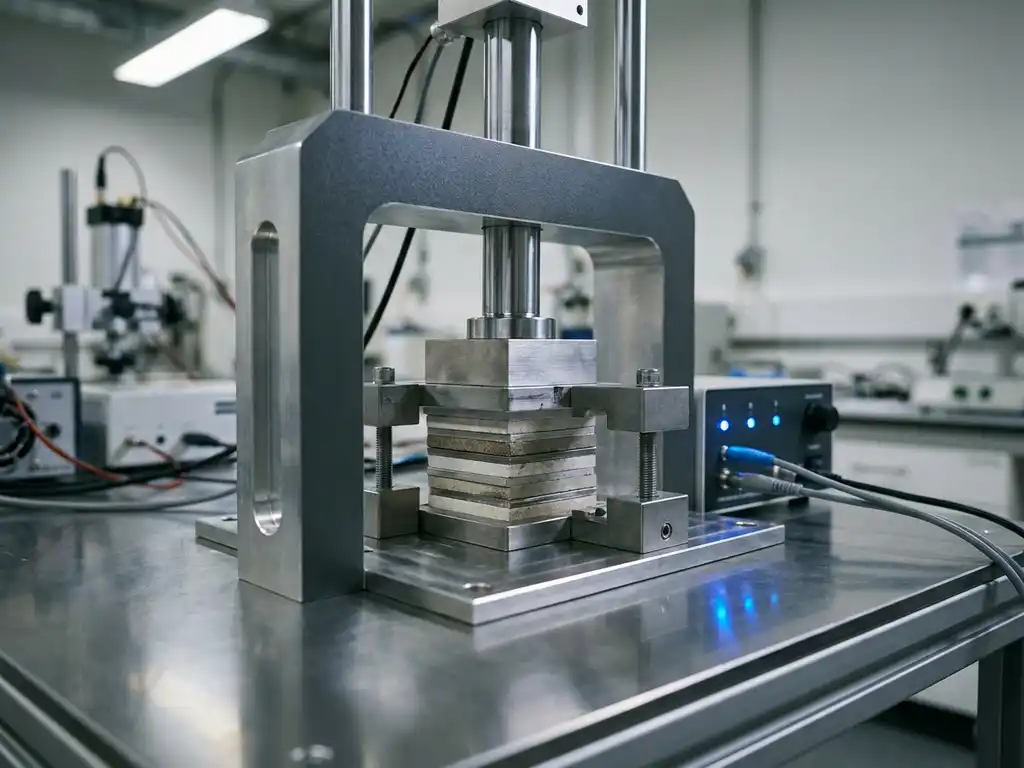
Solid-state battery testing at scale demands a fundamentally different approach to force application compared to conventional liquid-electrolyte cells. Unlike cells with a liquid or gel electrolyte that can conform to electrode surfaces, solid-state cells rely on intimate physical contact between rigid or semi-rigid layers — and that contact is governed almost entirely by applied mechanical pressure. As research programmes move from coin-cell screening to pouch-format or multi-layer stack configurations, the methods used to apply, monitor, and control that pressure must evolve accordingly.
This article works through the core principles of force application in solid-state battery testing, from the electrochemical reasons pressure matters to the practical decisions researchers face when scaling up their test protocols.
What makes force application different in solid-state batteries?
In a conventional liquid-electrolyte cell, the electrolyte fills gaps between electrode particles and the separator, maintaining ionic contact even when electrode geometry changes during cycling. In a solid-state cell, the electrolyte is a rigid or semi-rigid solid — a ceramic, glass-ceramic, or polymer material — and ionic transport depends on direct physical contact between layers.
This distinction has a direct consequence: if the applied stack pressure is insufficient, contact resistance at the electrode-electrolyte interface increases, and electrochemical performance degrades. If pressure is excessive, brittle solid electrolytes can crack, creating internal short circuits or mechanical failure.
For example, oxide-based solid electrolytes such as LLZO (lithium lanthanum zirconium oxide) are particularly sensitive to this balance. They require meaningful stack pressure to achieve acceptable interfacial contact, yet they fracture at relatively modest loads compared to polymer electrolytes. This narrow operating window is one reason why force application in solid-state testing cannot be treated as a secondary concern.
How stack pressure affects electrochemical performance
Stack pressure influences several measurable electrochemical parameters simultaneously, which makes it a critical experimental variable rather than a passive mechanical condition.
The most direct effect is on interfacial impedance. Electrochemical impedance spectroscopy (EIS) measurements on solid-state cells routinely show that the interfacial resistance component — visible as a semicircle in the Nyquist plot — decreases as contact pressure increases, up to a threshold. Beyond that threshold, further pressure yields diminishing returns or introduces mechanical damage.
Pressure also affects:
- Coulombic efficiency: Poor interfacial contact promotes uneven current distribution, which can accelerate lithium dendrite formation and reduce cycle-to-cycle charge recovery.
- Capacity retention: Delamination caused by electrode volume changes during cycling is suppressed by adequate stack pressure, helping maintain specific capacity (mAh/g) over extended cycling.
- Rate capability: At higher C-rates, the impact of interfacial resistance becomes more pronounced, meaning that pressure-related contact losses are amplified under fast charge or discharge conditions.
Understanding these relationships at the laboratory scale is a prerequisite for translating results to any larger format — and it is precisely why force test cells such as the PAT-Cell-Force have become standard equipment in solid-state battery research.
Why scaling up solid-state testing breaks conventional approaches
Building on the electrochemical sensitivity described above, the challenge intensifies when researchers move beyond small-format cells. At the coin-cell scale, a simple spring or fixed screw torque can provide approximately uniform pressure across a small electrode area. At larger electrode areas, the same approach introduces significant pressure gradients.
Conventional spring-loaded or torque-controlled cell housings were designed primarily for liquid-electrolyte systems, where pressure uniformity is less critical. In solid-state cells, a pressure gradient across the electrode face produces a corresponding gradient in interfacial resistance — meaning that different regions of the electrode cycle at different effective rates. This undermines the reproducibility that research data requires.
There is also a dynamic dimension to the problem. Solid electrodes expand and contract during lithiation and delithiation, and in a fixed-displacement cell housing, this volume change translates directly into changes in stack pressure. A cell that begins a test at the correct pressure may be operating well outside the optimal range by the end of a charge or discharge cycle. Tracking this with an electrochemical dilatometer or force-sensing test cell reveals how substantially pressure can shift within a single cycle.
Limitations of conventional test cells for solid-state research
Beyond pressure gradients and dynamic force drift, conventional test cells present several additional challenges that are worth understanding before selecting equipment for a solid-state testing programme.
High assembly failure rates. Studies cite an assembly failure rate of around 43% for conventional test cells. Even experienced builders achieve only 4 out of 5 working cells, while inexperienced assemblers fall below 50%. The PAT-Cell-Force and PAT-Cell-Solid from EL-CELL address this directly by standardizing and simplifying cell preparation, so that nearly every assembled cell runs without failure.
No integrated force sensing. Conventional cells do not include a force sensor. Only the initial pressure is set, and mechanical settling can reduce it over time without any detection. EL-CELL cells include an integrated force sensor, so force evolution is tracked continuously throughout cycling. An optional gas pressure sensor can also be added, allowing researchers to distinguish force changes caused by gas evolution from those caused by mechanical settling.
Inhomogeneous compression of electrode material. Conventional cells compress electrode material inhomogeneously. The PAT-Solid-Core insert, used in both the PAT-Cell-Force and PAT-Cell-Solid, uses guided plane-parallel tungsten carbide plungers and a dedicated pressing tool to ensure homogeneous compression across the electrode stack.
Moisture absorption from housing materials. Conventional cells are typically sealed with O-rings and often use PEEK housings, which absorb significant moisture and require drying at 120°C under vacuum. EL-CELL cells use aluminum seals and glass-metal feedthroughs instead of O-rings, and PPS plastic instead of PEEK. PPS absorbs considerably less moisture, reducing contamination risk and shortening preparation time.
Plunger degradation over time. Conventional plungers embed particles during use and must be ground or polished between measurements, gradually altering cell geometry and compromising reproducibility. EL-CELL uses tungsten carbide plungers that withstand high mechanical loads without this type of surface degradation.
Key force application methods used in solid-state test cells
Researchers working with solid-state battery testing have developed several approaches to applying and controlling stack pressure, each with distinct advantages depending on the experimental context.
Fixed-displacement (rigid) clamping
The simplest approach uses a rigid housing with a fixed screw torque to set an initial displacement. This method is reproducible in the sense that the same torque produces the same initial geometry, but it does not maintain constant force as the cell expands or contracts. It is most appropriate for electrolytes and electrode combinations with low volume change and high mechanical compliance.
Spring-loaded clamping
Incorporating calibrated springs into the cell housing allows the applied force to vary within a defined range as electrode thickness changes. The spring constant determines how sensitive the force is to displacement: a stiff spring maintains more constant force, while a soft spring accommodates larger volume changes with less force variation. This is a practical middle ground for many research applications.
Pneumatic and hydraulic pressure application
For precise, adjustable, and continuously controlled stack pressure, pneumatic or hydraulic systems apply a defined force independent of cell thickness changes. This approach is particularly valuable when studying pressure-dependent phenomena or when comparing results across different electrolyte compositions, because the pressure variable can be held truly constant or programmatically varied.
Instrumented force sensing
Integrating a load cell directly into the test cell assembly allows real-time measurement of stack force throughout cycling. When combined with displacement measurement, this enables simultaneous tracking of both mechanical and electrochemical data — an approach directly relevant to operando studies of electrode mechanics.
Matching force control to your testing goals
The appropriate force application method depends on what the experiment is designed to measure. Choosing the wrong approach does not simply introduce noise — it can systematically bias results in ways that are difficult to detect without dedicated force measurement.
Consider the following decision points:
- Screening studies: When comparing many electrolyte or electrode compositions at low throughput, spring-loaded cells offer acceptable reproducibility with minimal setup complexity.
- Pressure-dependent characterisation: When the research question involves how performance varies with stack pressure, pneumatic or hydraulic control is necessary to isolate pressure as an independent variable.
- Operando mechanical studies: When electrode volume change or stress evolution is the primary measurement target, instrumented force sensing with simultaneous displacement tracking is the appropriate tool.
- Protocol development for scale-up: When the goal is to establish pressure parameters that will inform larger-format cell design, quantitative force data from instrumented cells is essential.
A common misconception is that any consistent assembly procedure produces comparable results. In solid-state testing, consistency of assembly torque does not guarantee consistency of applied force — particularly across different electrolyte thicknesses, electrode densities, or temperature conditions.
Building a reproducible solid-state testing workflow
Reproducibility in solid-state battery testing requires treating force application as a controlled experimental parameter from the outset, not as a fixed assembly step.
A reliable workflow typically includes the following elements:
- Define the target pressure range based on the electrolyte material class and electrode system, using literature values or preliminary characterisation data as a starting point.
- Select a force application method matched to the precision required by the research question, as outlined in the section above.
- Record force and displacement data at minimum at the start and end of each test, and ideally continuously throughout cycling, to detect pressure drift and correlate it with electrochemical changes.
- Control temperature independently of the mechanical assembly, since thermal expansion of cell components can introduce pressure changes that confound mechanical measurements.
- Report force conditions in publications with the same rigour applied to electrochemical parameters — stack pressure, spring constant or system compliance, and any observed force evolution during cycling.
Applying these steps consistently transforms force application from an uncontrolled variable into a documented experimental condition, which is a prerequisite for generating data that other groups can replicate or build upon.
How EL-Cell GmbH supports solid-state battery testing
EL-Cell GmbH designs test cells and instrumentation specifically for the kind of controlled, quantitative solid-state battery testing described in this article. Our product range addresses the full range of force application requirements discussed above:
- The PAT-Cell-Force is a force test cell designed for solid-state and other pressure-sensitive battery systems, enabling defined and reproducible stack pressure application with integrated force measurement.
- The PAT-Cell-Solid is purpose-built for solid-state electrolyte testing, accommodating the mechanical and geometric requirements of ceramic and polymer solid electrolyte assemblies.
- The ECD-4-nano electrochemical dilatometer provides sub-5 nm resolution displacement measurement, allowing researchers to quantify electrode thickness changes and correlate them with force and electrochemical data in the same experiment.
- The PAT-Tester-i-16 integrates galvanostatic and potentiostatic cycling with EIS capability and temperature control, providing a complete measurement environment for solid-state cell characterisation.
These instruments are designed to work together as a compatible system, so force, displacement, electrochemical, and thermal data can be collected under consistent, well-defined conditions. If you are establishing or scaling a solid-state testing programme, contact us to discuss which combination of test cells and instrumentation best fits your experimental requirements.
Comments are closed.