


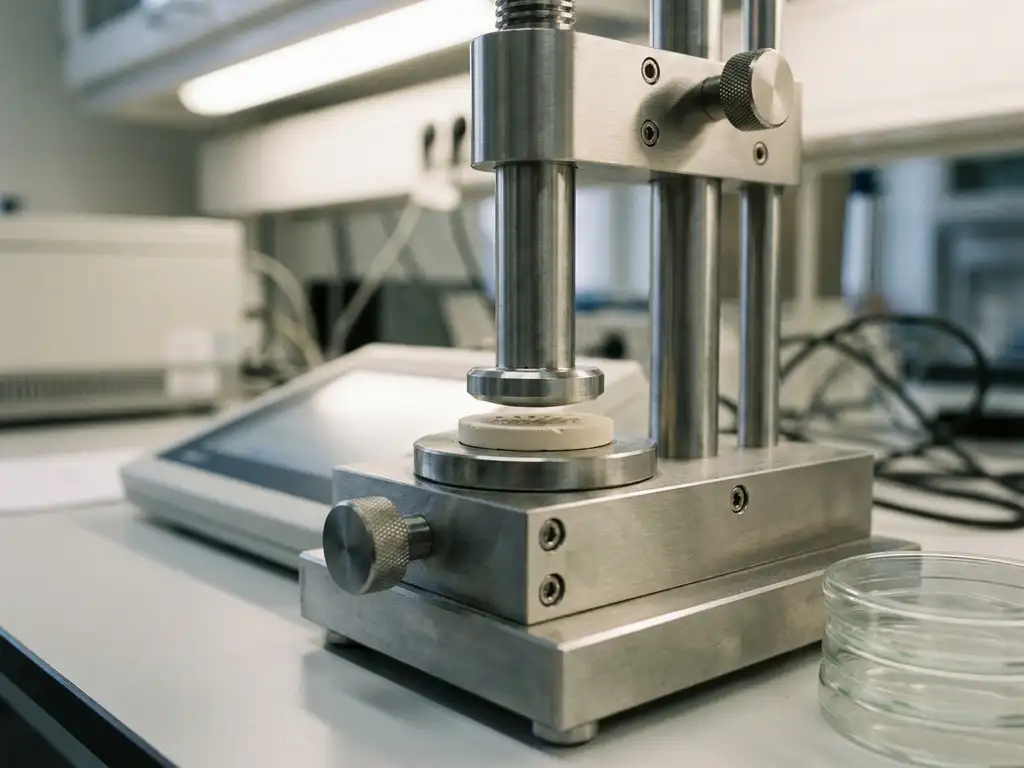
Creep and relaxation in solid electrolytes introduce systematic mechanical artefacts into force measurements that, if unaccounted for, can lead to misinterpretation of electrochemical data. Solid state battery testing depends on accurate force readings to monitor stack pressure, electrode expansion, and electrolyte integrity — yet the viscoelastic nature of many solid electrolyte materials means that the forces recorded by a test cell are not always a direct reflection of the electrochemical processes occurring within it. Understanding the mechanical behaviour of these materials is therefore a prerequisite for generating reliable, reproducible data.
This article builds from foundational definitions through to practical experimental design, giving researchers a framework for identifying, accounting for, and minimising the influence of creep and relaxation in force test cell measurements.
What are creep and relaxation in solid electrolytes?
Creep and relaxation are two manifestations of viscoelastic behaviour — the tendency of a material to exhibit both elastic (spring-like) and viscous (flow-like) responses to mechanical stress over time.
Creep describes the progressive deformation of a material under a constant applied stress. Rather than deforming instantaneously to a fixed strain and remaining there, a viscoelastic material continues to deform slowly as time passes, even when the applied load does not change. Relaxation is the complementary phenomenon: when a material is held at a constant strain, the internal stress it exerts decreases over time as the material redistributes load internally.
For solid electrolytes — including oxide ceramics, sulphide glasses, and polymer-based systems — both behaviours are well established. A sulphide electrolyte pellet held under a fixed stack pressure will gradually thin over hours or days (creep), while a pellet compressed to a fixed thickness will exert progressively less force on the current collectors (relaxation). The rate and magnitude of these effects depend strongly on material composition, temperature, and the magnitude of the applied stress.
How solid electrolyte mechanics influence force readings
In a force test cell, a load sensor monitors the mechanical force exerted by the electrode stack. The intention is to use this signal as a proxy for physical changes within the cell — electrode swelling during lithiation, for example, or electrolyte densification under pressure.
Viscoelastic behaviour complicates this interpretation in two distinct ways:
- Apparent force drift: When a cell is assembled and brought to a target pressure, the force reading will decline over time even in the absence of any electrochemical activity. This is relaxation. A researcher who does not allow sufficient equilibration time before beginning a measurement will record a baseline that is still evolving, making it impossible to isolate electrochemically driven force changes.
- Irreversible deformation: Creep can permanently alter the geometry of the electrolyte pellet or separator, changing the effective stack dimensions. This affects the calibration relationship between force and pressure, and can introduce cumulative errors across long-term cycling experiments.
For example, consider a cell assembled with a sulphide electrolyte at 50 MPa stack pressure. If the electrolyte creeps by even a few micrometres over the first hour, the force sensor will record a drop in load that has nothing to do with the electrochemistry. Without awareness of this effect, a researcher might incorrectly attribute the force decrease to an electrochemical event such as initial lithiation of the anode.
It is also worth noting that conventional test cells do not include a force sensor at all — only the initial pressure applied during assembly is known, and mechanical settling can reduce it over time without any means of detection. This makes it impossible to distinguish a genuine electrochemical force change from a slow mechanical drift. The PAT-Cell-Force from EL-CELL addresses this directly with an integrated force sensor. An optional gas pressure sensor can also be added, enabling researchers to measure force changes caused by gas evolution separately from purely mechanical ones — a critical capability when these two contributions would otherwise be conflated.
Key variables that amplify or dampen these effects
Building on the distinction between creep and relaxation established above, it is useful to identify which experimental variables have the greatest influence on the magnitude of these effects. This allows researchers to design protocols that either minimise viscoelastic artefacts or at least keep them consistent across experiments.
Material class
Polymer electrolytes are the most susceptible to both creep and relaxation, given their inherently viscoelastic nature at room temperature. Sulphide electrolytes exhibit moderate creep, particularly at elevated temperatures or high pressures. Oxide ceramics (such as garnet-type materials) are comparatively rigid, though they are not immune — especially when used in composite form with polymer binders.
Temperature
Elevated temperature accelerates both creep and relaxation. For experiments conducted above ambient temperature — which is common when testing materials with limited ionic conductivity at room temperature — the time-dependent force drift will be more pronounced and must be factored into the measurement protocol.
Applied stress magnitude
Higher stack pressures generally accelerate creep. There is often a threshold below which creep is negligible for a given material; operating near this threshold, where electrochemical performance remains acceptable, can reduce the mechanical artefact without compromising the measurement.
Dwell time and loading rate
The rate at which pressure is applied during cell assembly influences the initial stress state of the electrolyte. Rapid loading can introduce a larger initial elastic component that then relaxes quickly, producing a steep early force drop. Slow, controlled loading allows the material to distribute stress more evenly, resulting in a more stable baseline.
Interpreting force test cell data with creep in mind
Accurate interpretation of force test cell data requires separating mechanical artefacts from electrochemically driven signals. The key principle is that any force change observed in the cell is the sum of contributions from electrochemical processes and time-dependent mechanical behaviour.
A practical approach is to record a baseline force trace under open-circuit conditions before beginning any electrochemical protocol. If the force is still drifting during this period, the electrolyte has not yet reached mechanical equilibrium. Attempting to measure small force changes due to, for example, a partial lithiation step against an unstable baseline will produce data that cannot be meaningfully interpreted.
When the baseline has stabilised, subsequent force changes can be attributed with greater confidence to electrochemical events. Even so, it is good practice to compare the rate and direction of force change with what is physically expected. A force increase during lithiation of a graphite anode, for instance, is consistent with known volume expansion behaviour. An unexpected force decrease during the same process warrants further investigation before drawing conclusions.
Common measurement errors and how to avoid them
Several recurring errors arise specifically from insufficient attention to viscoelastic behaviour in solid state battery testing. Recognising these patterns is the first step towards eliminating them.
- Insufficient equilibration time: Assembling a cell and immediately beginning an electrochemical measurement is one of the most common sources of artefactual force data. Allow the assembled cell to equilibrate at the target temperature and pressure until the force reading is stable — this may take anywhere from minutes to several hours depending on the electrolyte material.
- Attributing baseline drift to electrochemistry: A slow, monotonic force decrease that continues across multiple cycles is more likely to reflect ongoing creep than a reversible electrochemical process. Compare the drift rate during rest periods with that during active cycling to distinguish the two.
- Neglecting temperature stabilisation: Force sensors and electrolyte materials both respond to temperature changes. If the cell has not reached thermal equilibrium with its environment, thermally driven dimensional changes will be superimposed on both the mechanical and electrochemical signals.
- Using inconsistent assembly torque or pressure: Variability in assembly procedures introduces variability in the initial stress state of the electrolyte, making it difficult to compare results across experiments or between cells. Standardising assembly with a defined loading protocol is essential for reproducibility.
- Overlooking cumulative creep in long-term cycling: Over hundreds of cycles, even modest creep rates can produce significant changes in stack geometry. Periodic checks of the force baseline during rest periods can help identify whether cumulative deformation is occurring.
A further source of error that is easy to overlook is inhomogeneous compression of the electrode material. Conventional test cells compress electrode stacks unevenly, introducing local pressure gradients that distort both mechanical and electrochemical data. The PAT-Cell-Force and PAT-Cell-Solid from EL-CELL address this through the PAT-Solid-Core insert, which uses guided plane-parallel tungsten carbide plungers and a dedicated pressing tool to ensure homogeneous compression across the electrode area. These tungsten carbide plungers also withstand high mechanical loads without embedding particles or degrading — a problem that affects conventional plungers, which must be ground or polished between measurements and gradually change cell geometry as a result.
Designing experiments that account for viscoelastic behaviour
With the error sources identified above in mind, it is possible to design experimental protocols that systematically account for viscoelastic behaviour rather than treating it as an uncontrolled nuisance.
Pre-measurement conditioning
Subject the assembled cell to a defined conditioning period at the target temperature and pressure before recording any data. For polymer electrolytes, this may involve a controlled temperature ramp followed by an isothermal hold. For sulphide electrolytes, a fixed-pressure dwell period is typically sufficient. The conditioning period should be long enough that the rate of force change falls below a defined threshold — for example, less than a specified force per unit time over a defined window.
Reference measurements and controls
Include a control cell assembled under identical conditions but held at open circuit throughout the experiment. The force trace from this control represents the purely mechanical contribution to the signal. Subtracting this from the force trace of the electrochemically active cell provides a cleaner estimate of the electrochemically driven force changes.
Separating timescales
Viscoelastic relaxation typically operates on timescales of minutes to hours, while many electrochemical processes — particularly at low C-rates — operate on similar timescales. Where possible, design protocols that either operate faster than the mechanical relaxation timescale (to treat the mechanical response as approximately constant) or much slower (to allow full mechanical equilibration between steps). Intermediate timescales are the most difficult to interpret cleanly.
Documenting assembly and loading conditions
Record the applied pressure, loading rate, assembly temperature, and equilibration time for every experiment. This information is essential for identifying the source of anomalous force data after the fact, and for ensuring that results from different experiments or different operators can be meaningfully compared.
How EL-Cell GmbH supports force measurements in solid state battery research
EL-Cell GmbH designs test cells and instruments specifically for the kind of mechanically sensitive measurements described in this article. For researchers working with solid electrolytes, the following products are directly relevant:
- The PAT-Cell-Force is a test cell with an integrated force sensor, designed to monitor stack pressure continuously during electrochemical cycling. It is compatible with solid electrolyte configurations and provides the stable, calibrated force baseline that controlled viscoelastic studies require. An optional gas pressure sensor can be added to separate force contributions from gas evolution from those arising purely from mechanical changes — an important distinction when both phenomena are present simultaneously.
- The PAT-Cell-Solid is configured specifically for solid state battery testing, with geometry and component tolerances suited to the assembly pressures typical of sulphide and oxide electrolyte systems. Both the PAT-Cell-Force and PAT-Cell-Solid use the PAT-Solid-Core insert with guided plane-parallel tungsten carbide plungers and a dedicated pressing tool, ensuring homogeneous compression of electrode material and maintaining consistent cell geometry across measurements.
- The PAT-Tester-i-16 provides multi-channel potentiostat and galvanostat functionality with integrated temperature control, enabling the kind of thermally stabilised, long-term cycling protocols that minimise thermally driven force artefacts.
Reliable solid state battery testing also depends on cell assembly quality. Conventional test cells have a high assembly failure rate — studies cite a figure as high as 43%, and even experienced builders typically achieve only four out of five working cells, while less experienced ones fall below 50%. The PAT-Cell-Force and PAT-Cell-Solid are designed to standardise and simplify preparation so that nearly every cell runs without failure. Part of this reliability comes from the sealing approach: EL-CELL cells use aluminum seals and glass-metal feedthroughs rather than O-rings, and PPS plastic rather than PEEK. PEEK housings, which are common in conventional designs, absorb significant moisture and require drying at 120°C under vacuum. PPS absorbs considerably less moisture, reducing contamination risk and cutting preparation time.
All products are part of the PAT Series — a single, interoperable research ecosystem built around the PAT Core Concept — which means force, electrochemical, and thermal data can be recorded and analysed within a consistent framework. Researchers who need to discuss experimental design for solid electrolyte force measurements are welcome to contact us directly — we can advise on cell selection, assembly protocols, and measurement strategies suited to specific material systems.
Comments are closed.