


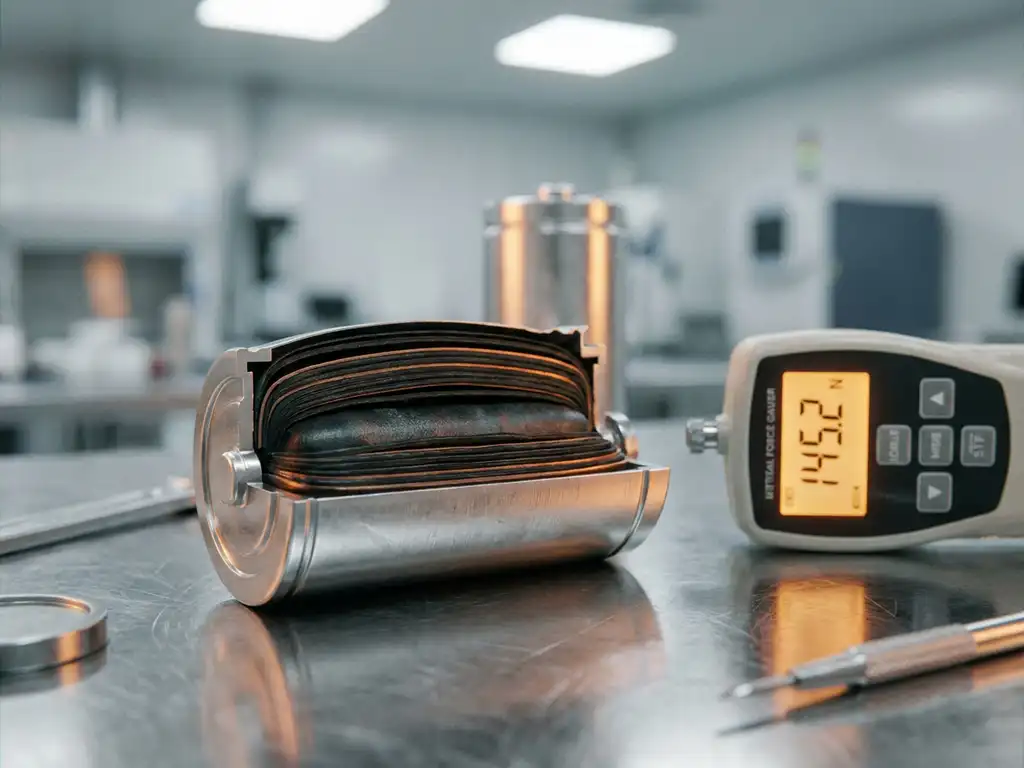
Cell swelling is a measurable, mechanically significant phenomenon that directly affects how lithium-ion and solid-state battery materials behave under cycling conditions. Understanding swelling dynamics is not merely an academic exercise – it has direct consequences for how force test cells are configured, what measurements are meaningful, and whether experimental results reflect real material behaviour or artefacts of poor setup design.
This article builds progressively from the electrochemical origins of swelling through to practical guidance on experimental design. Whether you are configuring a force test cell for the first time or refining an existing protocol, the concepts covered here will help you make more deliberate and defensible choices.
What is cell swelling and why does it occur in lithium-ion batteries?
Cell swelling refers to the volumetric expansion of electrode materials that occurs during lithium intercalation and de-intercalation. When lithium ions insert into a host material – graphite during charge, for example – the crystal lattice expands to accommodate them. When they leave, the lattice contracts. This is a reversible, thermodynamically driven process, but its magnitude and rate vary considerably depending on the material chemistry involved.
In graphite anodes, volumetric expansion can reach approximately 10% at full lithiation, while silicon-based anodes are well known for expansions exceeding 300% at full lithiation. On the cathode side, layered oxide materials such as NMC also undergo lattice-level strain during cycling, though typically at lower absolute magnitudes. These changes are not merely structural curiosities – they generate internal stresses that influence capacity retention, Solid Electrolyte Interphase (SEI) layer stability, and long-term cell performance.
For researchers, the key insight is that swelling is not a single event but a dynamic process. The rate, direction, and magnitude of dimensional change shift across different states of charge, C-rates, and temperatures. Treating swelling as a static quantity will lead to experimental designs that miss the most mechanistically informative regions of the charge-discharge cycle.
How swelling dynamics change under mechanical constraint
When an electrode is free to expand, swelling proceeds according to its intrinsic material properties. When it is constrained – as it is inside a force test cell – the situation becomes more complex. Mechanical constraint converts dimensional change into internal stress, and that stress feeds back into the electrochemical behaviour of the cell.
Under constraint, several important effects emerge:
- Lithium diffusion kinetics can slow as compressive stress opposes ion insertion into the lattice.
- Contact resistance between electrode layers and current collectors changes as the stack is compressed or relaxed at different states of charge.
- Electrolyte distribution within the porous electrode structure shifts as mechanical pressure redistributes the liquid or solid electrolyte phase.
- In solid-state battery testing, stack pressure is critical for maintaining ionic contact across the solid electrolyte interface – loss of contact due to swelling or shrinkage can produce apparent capacity fade that is purely mechanical in origin.
This feedback between mechanical state and electrochemical response is precisely why force test cells are valuable. They allow researchers to apply and monitor defined mechanical boundary conditions, making it possible to separate intrinsic material behaviour from artefacts of unconstrained or poorly controlled setups.
Key parameters that define force test cell behaviour
A force test cell is characterised by several interdependent parameters, each of which must be understood before designing a meaningful experiment.
Applied force and pressure distribution
The initial stack pressure applied at assembly defines the mechanical starting condition. In solid-state battery testing, this is particularly important because insufficient pressure can prevent adequate contact across the solid electrolyte layer. Too much pressure can cause fractures in brittle electrolyte materials. The target pressure range depends on the specific electrolyte chemistry and electrode morphology under investigation.
Conventional test cells compress electrode material inhomogeneously. The PAT-Solid-Core insert, used in both the PAT-Cell-Force and PAT-Cell-Solid, addresses this directly by using guided plane-parallel tungsten carbide plungers and a dedicated pressing tool to ensure homogeneous compression across the electrode stack.
Force resolution and dynamic range
Swelling-induced forces evolve continuously during cycling. A load cell with insufficient resolution will miss small but mechanistically significant force changes, particularly in early-cycle SEI formation events where dimensional changes are subtle. The dynamic range must accommodate both the initial assembly force and the peak forces generated at full lithiation.
Conventional test cells do not include a force sensor — only the initial pressure is read at assembly, and mechanical settling can reduce it over time without detection. The PAT-Cell-Force and PAT-Cell-Solid from EL-CELL include an integrated force sensor that monitors force continuously throughout cycling. An optional gas pressure sensor can also be added, enabling force changes caused by gas evolution to be measured separately from those of mechanical origin — a distinction that is otherwise impossible to make.
Thermal coupling
Temperature affects both the rate of swelling and the mechanical properties of the electrode stack. Experiments conducted without temperature control conflate thermal expansion with electrochemically driven dimensional change, making it impossible to isolate the contribution of each. A temperature-controlled cell environment is therefore not optional for quantitative swelling studies.
Matching experimental design to research objectives
Building on the parameters described above, the next step is to align the experimental configuration with the specific research question being addressed. Different objectives require different measurement priorities.
For studies focused on material characterisation, the primary goal is to measure swelling as a function of state of charge with minimal interference from the test setup itself. This calls for a well-defined, reproducible initial pressure, a load cell with high resolution, and a stable temperature environment. The electrode geometry should be standardised to allow comparison across samples.
For studies aimed at understanding degradation mechanisms, the experimental design must capture how swelling behaviour evolves across many cycles. This means logging force data continuously alongside electrochemical parameters such as coulombic efficiency and differential capacity. Changes in the force profile over cycles can indicate SEI growth, lithium plating, or delamination before these effects become visible in the capacity data.
For solid-state battery testing, maintaining a defined stack pressure throughout the measurement is the central challenge. Unlike liquid electrolyte cells, where the electrolyte can redistribute to accommodate dimensional changes, solid electrolyte cells require the mechanical boundary condition to remain within a specified range at all states of charge. This often means designing the experiment around the swelling envelope of the specific electrode-electrolyte combination, not applying a generic protocol.
Common measurement errors caused by overlooking swelling dynamics
Several reproducible classes of error arise when swelling dynamics are not properly accounted for in force test cell experiments.
- Pressure drift during cycling: If the cell is assembled at a fixed displacement rather than a fixed force, the internal pressure will change as the electrode stack swells and contracts. This introduces a variable mechanical boundary condition that is rarely reported but significantly affects the electrochemical data.
- Irreversible capacity attributed to chemistry: In solid-state cells, a drop in apparent capacity may reflect loss of interfacial contact due to swelling-induced delamination rather than any electrochemical degradation. Without force monitoring, these two causes are indistinguishable.
- Inconsistent results across laboratories: Differences in assembly torque, spring preload, or cell housing compliance between laboratories can produce different mechanical boundary conditions even when the same nominal protocol is followed. This is a common source of inter-laboratory variability that is rarely discussed in published methods sections.
- Artefacts at the beginning and end of charge: Rapid force changes occur at the onset of phase transitions in the electrode material. If the data acquisition rate for force is lower than for electrochemical parameters, these transient events are missed, and the correlation between force and electrochemical state becomes misleading.
Integrating swelling data into a complete experimental workflow
Swelling data becomes most informative when it is treated as a co-primary measurement rather than an ancillary output. This means synchronising force and displacement data with the electrochemical data stream from the outset of experimental design, not adding it retrospectively.
A coherent workflow typically involves the following steps:
- Pre-characterisation: Before cycling, measure the initial thickness and compliance of the electrode stack at the target assembly pressure. This establishes a baseline against which all subsequent dimensional changes are referenced.
- Synchronised data acquisition: Configure the potentiostat or galvanostat to log force, displacement, voltage, and current on a common time axis. Misaligned timestamps between instruments are a frequent source of errors in post-processing.
- State-of-charge resolved analysis: Plot force as a function of state of charge rather than time alone. This reveals the pressure envelope across the full charge-discharge cycle and identifies the states of charge at which mechanical stress is highest.
- Cycle-resolved tracking: Extract force metrics – such as peak force, minimum force, and hysteresis – on a per-cycle basis. Progressive changes in these values are often the earliest indicators of mechanical degradation within the cell.
- Cross-correlation with electrochemical impedance spectroscopy (EIS): Periodic EIS measurements taken at defined force states can reveal how interfacial resistance evolves with mechanical condition. This is particularly valuable in solid-state battery testing, where ionic contact resistance is directly linked to stack pressure.
When swelling data is integrated in this way, it transforms from a secondary observation into a diagnostic tool that can distinguish between electrochemical, mechanical, and coupled failure modes with considerably greater precision.
How EL-Cell GmbH supports force test cell research
EL-Cell GmbH designs test cells and instrumentation specifically for the kind of mechanically resolved electrochemical research described in this article. A key advantage of the EL-CELL approach is reliability: conventional test cells carry a high assembly failure rate — studies cite figures as high as 43%. Even experienced builders typically achieve only 4 out of 5 working cells, while inexperienced ones fall below 50%. The PAT-Cell-Force and PAT-Cell-Solid standardise and simplify preparation so that nearly every cell runs without failure.
Material choices also matter for data quality. Conventional cells are typically sealed with O-rings and often use PEEK housings, which absorb significant moisture and require drying at 120°C under vacuum. EL-CELL cells use aluminum seals and glass-metal feedthroughs instead of O-rings, and PPS plastic instead of PEEK. PPS absorbs less moisture, reducing contamination risk and cutting preparation time. Conventional plungers embed particles during use and must be ground or polished between measurements, gradually altering cell geometry. EL-CELL uses tungsten carbide plungers that withstand high mechanical loads without this degradation, preserving cell geometry across the full lifetime of the hardware.
Our product range addresses the full measurement chain required for rigorous swelling studies:
- The PAT-Cell-Force is a spring-loaded test cell that applies a defined, reproducible force to the electrode stack throughout cycling, eliminating pressure drift caused by fixed-displacement assembly.
- The PAT-Cell-Solid is designed for solid-state battery testing under controlled stack pressure, with the mechanical boundary conditions needed for reliable ionic contact across solid electrolyte layers.
- The ECD-4-nano dilatometer provides sub-5 nm resolution thickness measurements, enabling quantitative tracking of electrode dimensional changes across the full state-of-charge range.
- The PAT-Tester-i-16 integrates galvanostatic and potentiostatic cycling with EIS capability and a temperature-controlled cell chamber, allowing synchronised electrochemical and mechanical data acquisition from a single instrument.
All instruments are designed to work together within the PAT Series ecosystem, so force, displacement, electrochemical, and impedance data share a common time axis without requiring custom integration work. If you are designing or refining a force test cell experiment, contact us to discuss your specific electrode chemistry and measurement requirements.
Comments are closed.