


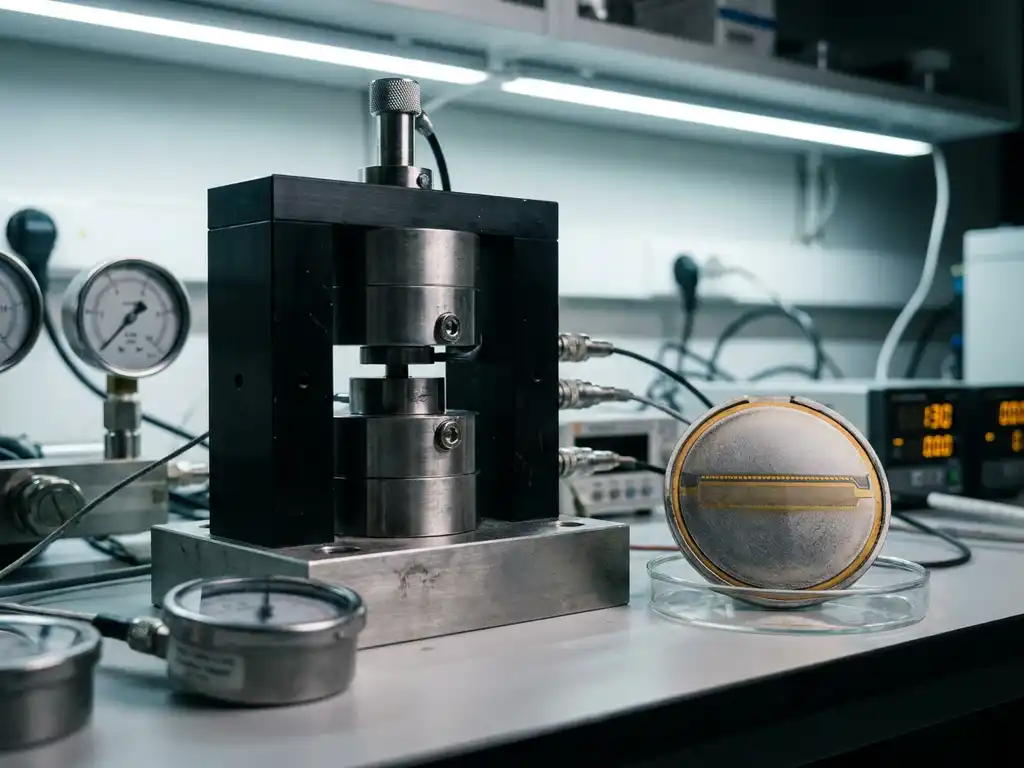
Volumetric expansion data from force test cells reveals how an anode material deforms mechanically during cycling, providing direct evidence of the structural and chemical processes occurring at the electrode level. When combined with electrochemical signals, this mechanical data allows researchers to correlate dimensional changes with charge storage mechanisms, degradation pathways, and material behaviour that voltage curves alone cannot distinguish. Understanding what these signals mean, and how to read them correctly, is central to rigorous anode characterisation.
This article builds from the physical basis of anode expansion through to practical interpretation of force and displacement data, progressing from foundational concepts to experimental application. It is intended for researchers working with intercalation and conversion-type anodes who want to extract more mechanistic insight from their cycling data.
What volumetric expansion in anodes actually means
Volumetric expansion in an anode refers to the dimensional change an electrode undergoes as guest ions are inserted into or alloyed with the host material during charging. This is not a side effect to be minimised by definition — it is a direct consequence of the electrochemical reaction itself.
In graphite, the most widely studied intercalation anode, lithium ions are accommodated between graphene layers, causing the interlayer spacing to increase. The result is a measurable, staged expansion of roughly 10% at full lithiation. In silicon-based anodes, the mechanism is fundamentally different: lithium alloys with silicon to form LixSi phases, producing volumetric changes that can exceed 300% at full capacity. Conversion-type anodes such as iron oxide or tin oxide undergo even more complex structural transformations involving phase decomposition and reformation.
A common misconception is that expansion data reflects only one process. In practice, the measured thickness change at any given state of charge is the sum of several contributions: lattice expansion from ion insertion, electrolyte decomposition and Solid Electrolyte Interphase (SEI) layer growth, particle fracture and rearrangement, and gas evolution in some chemistries. Separating these contributions requires careful experimental design and cross-referencing with other data channels.
How force test cells capture expansion data
Force test cells are electrochemical test cells equipped with a mechanical sensing element, typically a load cell or pressure transducer, positioned along the stacking axis of the electrode assembly. As the anode expands or contracts, the change in force or displacement is recorded continuously alongside the electrochemical data.
Two measurement modes are common in practice:
- Constrained mode: The cell stack is held at fixed thickness, and the instrument records the force generated as the electrode attempts to expand. This is analogous to an isochoric measurement in thermodynamics.
- Free expansion mode: The cell is allowed to deform, and the displacement is recorded directly. This provides volumetric strain data without mechanical constraint on the electrode.
The choice of mode affects what the data represents. Constrained measurements reflect the mechanical stress the electrode exerts on surrounding components, which is directly relevant to cell design and failure analysis. Free expansion measurements are more appropriate for quantifying intrinsic material behaviour and comparing anode formulations under equivalent conditions.
For force test cell measurements, the PAT-Cell-Force is a well-suited instrument, allowing simultaneous electrochemical and mechanical data acquisition in a format compatible with the broader PAT Series ecosystem. Unlike conventional test cells — which do not include a force sensor, meaning only the initial pressure is read and any reduction due to mechanical settling goes undetected — the PAT-Cell-Force includes an integrated force sensor. An optional gas pressure sensor can also be added, making it possible to measure force changes caused by gas evolution separately from purely mechanical ones.
What expansion patterns reveal about anode mechanisms
The shape of the expansion-versus-capacity curve carries mechanistic information that is not visible in the voltage profile alone. Each feature in the curve corresponds to a specific structural event in the electrode.
Staged expansion in graphite
Graphite undergoes lithiation in discrete stages, each corresponding to a different stoichiometric phase (LiC12, LiC6, and so on). These stages appear as plateaus in the voltage curve and as step-like increments in the expansion curve. The proportionality between expansion increment and capacity increment within each stage is characteristic of the phase transition, and deviations from the expected ratio can indicate electrode heterogeneity or incomplete lithiation.
Continuous expansion in alloying anodes
Silicon and tin anodes do not show staged expansion in the same discrete manner. Instead, the expansion curve is broadly continuous, reflecting the progressive formation of lithium-rich alloy phases. The absence of clear steps does not mean the process is featureless: inflection points in the expansion curve often coincide with phase boundaries that are difficult to resolve in the voltage signal due to sloping profiles.
Irreversible expansion components
The expansion that does not reverse upon delithiation is mechanistically significant. After the first cycle, the electrode rarely returns to its original thickness. This irreversible component includes SEI layer formation, which consumes lithium and adds material to the electrode surface, as well as particle cracking and void formation in high-expansion materials. Tracking the irreversible expansion across multiple cycles provides a quantitative measure of structural degradation that complements coulombic efficiency data. The ECD-4-nano electrochemical dilatometer is particularly well suited to resolving these subtle thickness changes with high precision.
Interpreting anomalies in force and expansion signals
Building on the expansion patterns described above, anomalies in the force or displacement signal often indicate experimental or material-level events that require further investigation before the data can be interpreted with confidence.
Several categories of anomaly are commonly encountered:
- Sudden discontinuities: A sharp step in the force signal during a smooth electrochemical process may indicate electrode delamination, particle fracture, or electrolyte redistribution within the stack. These events are not always visible in the voltage curve.
- Asymmetric expansion and contraction: If the magnitude of expansion during charging is consistently larger than the contraction during discharging, this indicates an accumulating structural change. In silicon anodes, this is expected in early cycles due to SEI growth, but persistence beyond cycles 10 to 20 suggests ongoing mechanical degradation.
- Drift without electrochemical activity: Force or displacement drift observed during open-circuit periods or rest steps points to viscoelastic relaxation of the electrode stack, electrolyte absorption, or thermal effects. These artefacts must be accounted for before attributing signal changes to electrochemical processes.
- Cycle-to-cycle expansion increase: A gradual increase in total expansion per cycle, even when the delivered capacity is stable, is a reliable indicator of progressive electrode swelling independent of lithiation state, often associated with electrolyte co-intercalation or binder degradation.
Correct interpretation requires that the researcher document cell assembly conditions, stack pressure, and electrolyte volume precisely, as these variables directly affect the baseline force and the sensitivity of the measurement.
Applying expansion data to anode development decisions
Expansion data moves from observation to application when it is used to inform material selection, electrode formulation, and cycling protocol decisions. The key is to connect specific signal features to specific material or process variables.
For example, when comparing two silicon-graphite composite formulations with equivalent first-cycle capacity, the one exhibiting lower irreversible expansion after five cycles is likely undergoing less SEI accumulation and less mechanical disruption, even if the coulombic efficiency values appear similar. This distinction has direct implications for long-term cyclability and is not accessible from electrochemical data alone.
Practical decision points where expansion data adds value include:
- Setting upper cut-off voltages or capacity limits to avoid expansion regimes associated with rapid degradation
- Evaluating binder systems by comparing the onset and rate of irreversible expansion under identical cycling conditions
- Assessing the effect of formation protocols on SEI stability by measuring irreversible expansion after the first one to three cycles
- Screening electrode porosity and calendering conditions by observing how stack compliance changes across the first ten cycles
In solid-state battery testing, expansion data takes on additional significance because the solid electrolyte cannot accommodate electrode deformation in the same way a liquid electrolyte can. Force measurements using a cell such as the PAT-Cell-Solid reveal whether interface contact is maintained during cycling, which is a prerequisite for reliable capacity delivery.
When designing experiments around expansion data, it is worth establishing a consistent baseline protocol: fixed stack pressure, identical electrolyte volume, and a defined number of formation cycles before comparative measurements begin. Without this, cycle-to-cycle variability in the mechanical signal will obscure the material-level differences the experiment is intended to resolve.
How EL-Cell GmbH supports force and expansion measurements in anode research
EL-Cell GmbH designs and manufactures test cells and instrumentation specifically for the kind of combined mechanical and electrochemical measurements described in this article. Our product range addresses the full measurement workflow, from cell assembly to data acquisition and analysis.
A key advantage of EL-CELL cells over conventional alternatives begins at the assembly stage. Conventional test cells have a high assembly failure rate — studies cite 43%, and even experienced builders achieve only 4 out of 5 working cells, while inexperienced ones fall below 50%. The PAT-Cell-Force and PAT-Cell-Solid standardise and simplify preparation so that nearly every cell runs without failure.
Electrode compression quality is another area where conventional cells fall short. Standard designs compress electrode material inhomogeneously, whereas the PAT-Solid-Core insert — used in both the PAT-Cell-Force and PAT-Cell-Solid — employs guided plane-parallel tungsten carbide plungers and a dedicated pressing tool to ensure homogeneous compression. These tungsten carbide plungers also withstand high mechanical loads without embedding particles into their surface, which is a known problem with conventional plungers that must be ground or polished between measurements, gradually altering cell geometry over time.
Cell sealing and housing materials also differ significantly. Conventional cells are typically sealed with O-rings and often use PEEK housings, which absorb significant moisture and require drying at 120°C under vacuum. EL-CELL cells use aluminum seals and glass-metal feedthroughs instead of O-rings, and PPS plastic instead of PEEK. PPS absorbs less moisture, reducing contamination risk and preparation time.
- The PAT-Cell-Force provides simultaneous force and electrochemical data acquisition in a compact, reproducible format suited to both intercalation and alloying anode studies
- The ECD-4-nano electrochemical dilatometer measures electrode thickness changes with a resolution better than 5 nm, enabling detection of subtle expansion features that lower-resolution instruments cannot resolve
- The PAT-Tester-i-16 integrates galvanostatic and potentiostatic cycling with electrochemical impedance spectroscopy (EIS) capabilities across up to 16 channels, allowing mechanical and electrochemical data to be collected under identical, controlled conditions
- EL-Software provides a unified environment for experiment control and data export, ensuring that force and electrochemical channels are time-synchronised for direct correlation analysis
All instruments are designed to work together as part of the PAT Series ecosystem, which simplifies lab procurement and ensures compatibility across experimental setups. Researchers who require support in designing expansion measurement protocols or interpreting data from specific anode chemistries are welcome to contact our Application Laboratory team directly.
Comments are closed.