


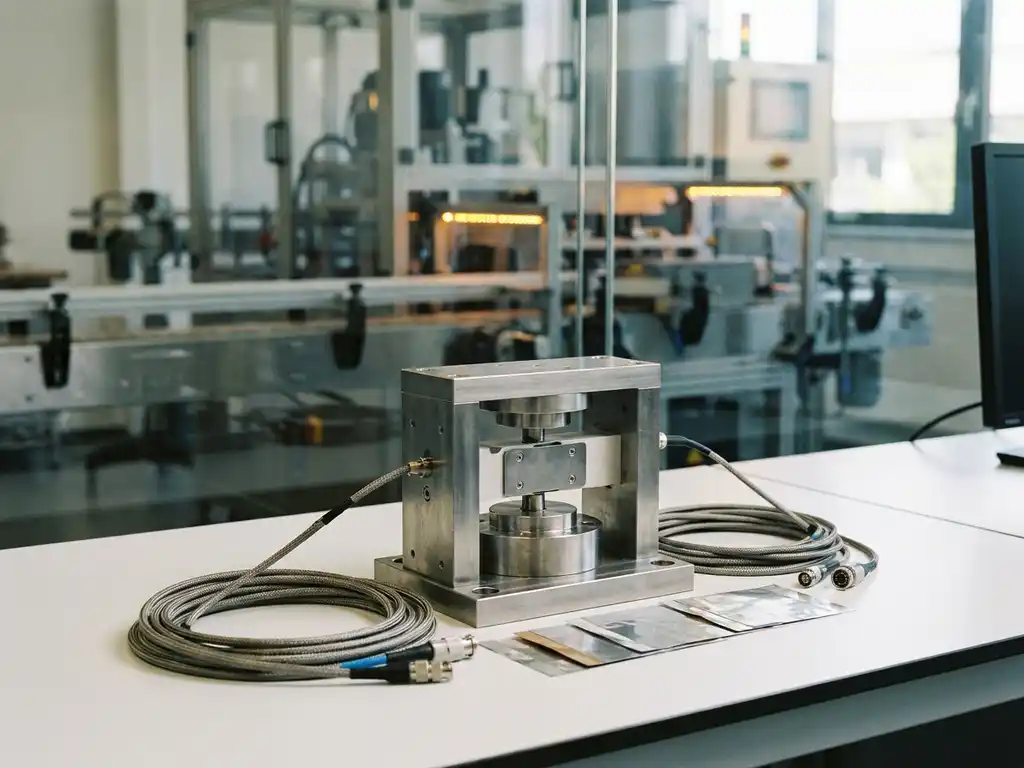
Force test cells are a class of electrochemical test cells designed to apply, measure, and control mechanical forces on electrode assemblies during cycling. They occupy a critical position in the battery research workflow: they replicate the compressive conditions that electrodes experience inside a real battery stack, conditions that standard coin cells and pouch cell fixtures do not reproduce. Understanding how and why these cells work helps researchers generate data that translates far more reliably from the laboratory bench to pilot-scale and production environments.
This article builds from foundational definitions through to practical workflow integration. Each section introduces one core concept before connecting it to the next, so that by the end you have a coherent picture of how force measurement fits into rigorous battery research.
What are force test cells and what do they measure?
A force test cell is a laboratory electrochemical cell that incorporates a controlled mechanical load applied perpendicular to the electrode stack, alongside the standard electrochemical measurement channels for voltage, current, and impedance. The defining feature is the ability to either apply a fixed pressure, vary it programmatically, or record the force that the expanding electrode stack exerts against a rigid constraint.
In practice, the cell body contains a spring, pneumatic actuator, or adjustable screw mechanism that transmits a defined load through a piston onto the electrode assembly. A force sensor, typically a load cell positioned in the force transmission path, records the mechanical response continuously throughout charge and discharge. This means the researcher obtains a time-resolved record of both the electrochemical state and the mechanical state of the electrode simultaneously.
For example, when a graphite anode lithiates during charging, it expands by roughly ten percent in the through-plane direction. A force test cell captures the pressure that this expansion generates when the electrode is constrained, or alternatively records how the electrode thickness evolves when the load is held constant. Neither measurement is possible in an unconstrained coin cell, which simply deforms its casing to accommodate expansion without recording any mechanical signal.
How mechanical forces shape battery performance
Mechanical stress within an electrode assembly is not a secondary phenomenon. It directly influences the electrochemical processes occurring at and within the electrode particles, the binder network, and the electrolyte-filled pore space.
Compressive stress affects ion transport through the separator and electrolyte by altering pore geometry. When pressure is too low, contact between electrode layers and the separator can become inconsistent, increasing interfacial resistance. When pressure is too high, separator compression reduces ionic conductivity and can cause localised lithium plating near blocked pores. Both extremes degrade coulombic efficiency and accelerate capacity fade.
Particle-level stress is equally significant. During repeated cycling, the volumetric expansion and contraction of active material particles generates mechanical fatigue in the surrounding binder matrix. Cracks propagate through particles and along grain boundaries, exposing fresh surfaces to the electrolyte and triggering repeated formation of the solid electrolyte interphase (SEI) layer. Each new SEI formation event consumes lithium inventory irreversibly, reducing specific capacity over time. Force test cells allow researchers to study how applied stack pressure modulates this degradation pathway by controlling the mechanical boundary conditions systematically.
Key parameters force test cells capture in practice
Building on the understanding that mechanical and electrochemical states are coupled, it follows that force test cells must record several parameters simultaneously to produce actionable data.
The primary mechanical outputs are:
- Stack pressure (in MPa or kPa, depending on the electrode area and load range): the compressive force per unit area applied to the electrode assembly at any given moment.
- Through-plane displacement (in µm or nm): the change in electrode stack thickness as a function of state of charge, which is directly related to the volumetric expansion of the active material.
- Force relaxation profiles: the time-dependent decay of force at constant state of charge, which reflects viscoelastic behaviour in the binder and electrolyte redistribution.
These mechanical parameters are recorded alongside the standard electrochemical outputs: cell voltage, applied current, specific capacity in mAh/g or mAh/cm², and optionally electrochemical impedance spectroscopy (EIS) spectra. The combination allows direct correlation between, for example, the onset of a phase transition in the active material and the corresponding mechanical event in the stack pressure trace.
Translating lab force data to production-relevant conditions
The central value of force test cells in bridging laboratory research and pilot production lies in their ability to replicate the mechanical boundary conditions of real battery formats at the laboratory scale.
In a commercial prismatic or pouch cell, the electrode stack is compressed by the cell casing or an external module housing. The pressure applied is rarely zero, and it changes as the cell ages and the electrodes swell irreversibly. Researchers who characterise materials only in unconstrained coin cells generate data under boundary conditions that do not match the production environment. When those materials are then assembled into constrained formats, performance can differ substantially from laboratory predictions.
Force test cells address this by allowing the researcher to set a target pressure that mimics the constraint expected in the final format, then cycle the material under those conditions. For solid-state battery testing in particular, this is not optional but essential: solid electrolytes require intimate contact maintained by mechanical pressure, and electrochemical performance is strongly dependent on whether the applied stack pressure is within the correct operating window. Researchers working on solid state battery testing therefore use force-controlled cells from the earliest stages of material screening.
Common measurement pitfalls and how to avoid them
Force measurement in electrochemical cells introduces several sources of error that are not present in standard cycling experiments. Recognising these pitfalls is essential before interpreting any mechanical data.
Thermal artefacts in force signals
Force sensors and cell hardware expand and contract with temperature. If the cell temperature changes during cycling, the recorded force signal will contain a thermal component that is not related to electrode expansion. This is particularly relevant when testing at elevated temperatures or when the cell self-heats at high C-rates. Calibrating the force sensor at the test temperature and using a temperature-controlled cell chamber minimises this artefact.
Torque inconsistency during assembly
The initial stack pressure depends directly on how the cell is assembled. Inconsistent tightening of the cell body produces run-to-run variation in baseline pressure that obscures real material differences. Using a torque wrench to a defined specification, or a spring-loaded mechanism that sets a reproducible initial load, is standard practice for generating comparable datasets across multiple cells. Conventional test cells compound this problem with a high assembly failure rate — studies cite a figure as high as 43%. Even experienced builders typically achieve only four out of five working cells, while inexperienced assemblers fall below a 50% success rate. The PAT-Cell-Force and PAT-Cell-Solid from EL-CELL are designed to standardize and simplify preparation so that nearly every cell runs without failure.
Electrode area mismatch
Force is reported as a total load (in N), but the mechanically relevant quantity is pressure (in MPa), which requires division by the electrode contact area. Researchers sometimes compare force values directly across cells with different electrode geometries, which produces meaningless comparisons. Always normalise force measurements to the electrode area before interpreting or reporting results.
Incomplete force monitoring
Conventional test cells do not include a force sensor. Only the initial pressure is set, and mechanical settling during cycling can reduce it over time without any detection. EL-CELL cells address this directly with an integrated force sensor that records mechanical state continuously. An optional gas pressure sensor can also be added, allowing force changes caused by gas evolution to be measured separately from those caused by mechanical settling — an important distinction when diagnosing degradation mechanisms.
Inhomogeneous electrode compression
Conventional cells compress electrode material inhomogeneously, introducing variability that is difficult to decouple from material behaviour. The PAT-Solid-Core insert, used in both the PAT-Cell-Force and PAT-Cell-Solid, uses guided plane-parallel tungsten carbide plungers and a dedicated pressing tool to ensure homogeneous compression across the electrode area. These tungsten carbide plungers are also resistant to particle embedding — a common problem with softer plunger materials, which must be ground or polished between measurements and gradually alter cell geometry as a result. Tungsten carbide withstands high mechanical loads without this degradation, preserving measurement consistency across the lifetime of the cell.
Moisture contamination from cell housing materials
Conventional cells are typically sealed with O-rings and often use PEEK housings. PEEK absorbs significant moisture and requires drying at 120°C under vacuum to reach acceptable contamination levels, adding preparation time and complexity. EL-CELL cells use aluminum seals and glass-metal feedthroughs instead of O-rings, and PPS plastic instead of PEEK. PPS absorbs substantially less moisture than PEEK, reducing both contamination risk and the preparation time required before a cell can be reliably used.
Integrating force test cells into a broader research workflow
Force test cells do not replace other cell formats in a research programme. They occupy a specific position in a staged workflow, and understanding where they add the most value helps researchers allocate instrument time efficiently.
A typical workflow progression looks as follows:
- Initial material screening: half-cell cycling in standard test cells to establish baseline specific capacity, coulombic efficiency, and rate capability without the complexity of force control.
- Mechanical characterisation: force test cell experiments to quantify expansion behaviour, pressure evolution, and the sensitivity of electrochemical performance to applied load across the relevant pressure range.
- Coupled mechanical and impedance analysis: EIS measurements taken at defined states of charge and defined pressures to separate interfacial resistance contributions from bulk transport limitations as a function of stack pressure.
- Pilot-relevant condition testing: cycling under pressures and temperatures that replicate the target production format, generating data that can directly inform cell design parameters such as module compression force and electrolyte formulation.
This staged approach ensures that force measurements are made when the material is already well-characterised electrochemically, so that mechanical effects can be isolated cleanly. Introducing force control too early, before baseline electrochemical behaviour is understood, makes it difficult to attribute observed performance changes to mechanical rather than electrochemical causes.
Force test cells also pair naturally with dilatometry and operando techniques. A force-controlled test cell can be operated alongside a dilatometer to cross-validate through-plane expansion measurements, or combined with optical access cells for visual monitoring of electrode surfaces under defined mechanical loads. The key principle is that force measurement provides one layer of information that becomes most powerful when integrated with complementary electrochemical and physical data streams.
How EL-Cell GmbH supports force and solid-state battery testing
EL-Cell GmbH designs and manufactures test cells specifically built for the mechanical and electrochemical measurement requirements described throughout this article. Our product range includes purpose-built solutions for researchers who need reproducible, well-defined mechanical boundary conditions in their electrochemical experiments.
Key instruments relevant to force measurement and solid-state testing include:
- PAT-Cell-Force: a test cell with integrated force measurement and control, designed for cycling experiments where stack pressure must be defined, varied, or recorded continuously alongside electrochemical data. The PAT-Solid-Core insert ensures homogeneous compression via guided plane-parallel tungsten carbide plungers, and an optional gas pressure sensor enables separate monitoring of gas-evolution-driven force changes.
- PAT-Cell-Solid: a cell format designed for solid-state electrolyte research, supporting the elevated stack pressures required to maintain intimate contact between solid electrolyte layers and electrodes. Like the PAT-Cell-Force, it uses the PAT-Solid-Core insert and benefits from the same aluminum seals, glass-metal feedthroughs, and PPS housing that minimise moisture contamination.
- PAT-Cell-Press II: a uniaxial press cell for applying and maintaining defined compressive loads, suitable for high-pressure solid-state experiments.
- ECD-4-nano: a high-resolution electrochemical dilatometer with sub-5 nm displacement resolution, for quantifying electrode thickness changes that complement force cell measurements.
- PAT-Tester-i-16: a 16-channel battery tester with integrated temperature-controlled cell chamber, EIS capability, and potentiostat/galvanostat (PStat/GStat) functionality, providing the electrochemical measurement infrastructure for complete force cell experiments.
All instruments are designed to work together as an interoperable system, so force data, impedance spectra, and dilatometry measurements can be acquired under consistent, controlled conditions from a single experimental setup. If your research requires a specific combination of mechanical and electrochemical measurements, or if you are building a new laboratory workflow around force-controlled cycling, contact EL-Cell GmbH directly to discuss your experimental requirements and find the configuration best suited to your programme. You can also explore our full range of battery test cells to identify the format that fits your current research stage.
Comments are closed.