


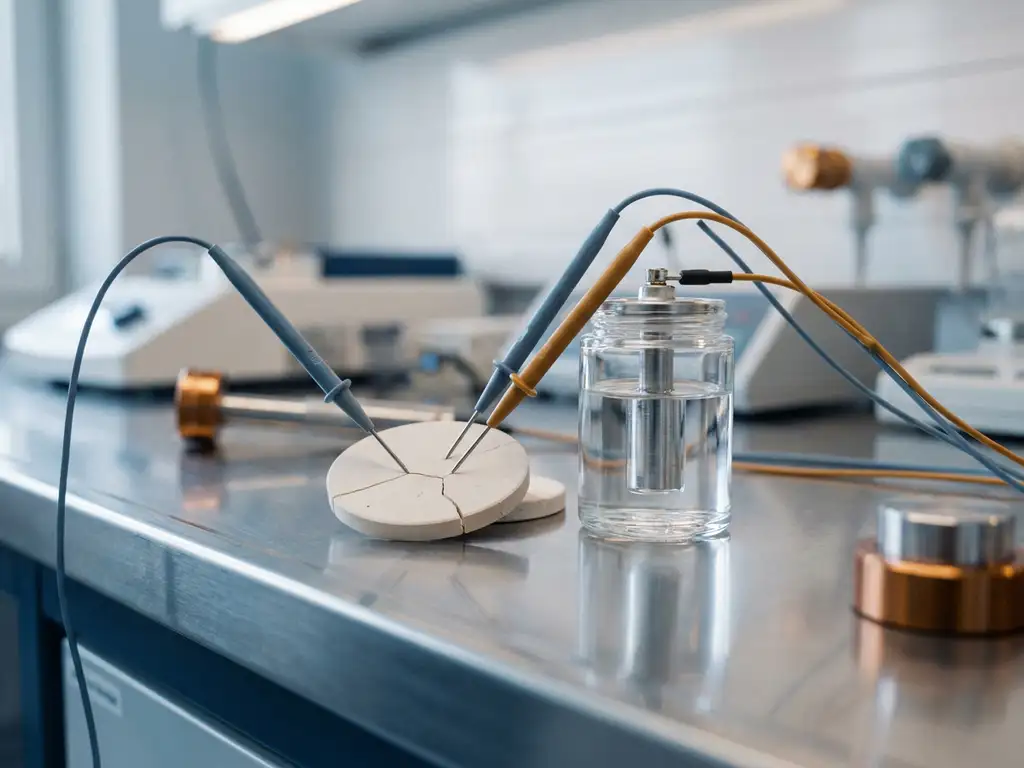
Solid-state batteries cannot be tested in exactly the same way as liquid electrolyte batteries. The absence of a liquid phase introduces mechanical, interfacial, and ionic transport constraints that require adapted experimental protocols and, in many cases, specialised test cell hardware. The sections below address the most common questions researchers encounter when moving from conventional liquid electrolyte cells to solid-state systems.
What makes solid-state batteries fundamentally different to test?
The defining difference is the replacement of a liquid or gel electrolyte with a solid ionic conductor. Liquid electrolytes conform to electrode surfaces and distribute ionic current uniformly; solid electrolytes do not. Every aspect of cell assembly, conditioning, and measurement is affected by this substitution, from the torque applied during cell assembly to the frequency range used in electrochemical impedance spectroscopy (EIS).
Three properties of solid electrolytes drive most of the testing challenges:
- Mechanical rigidity: Solid electrolytes cannot wet electrode surfaces. Intimate contact must be engineered through pressure, co-sintering, or thin-film deposition, and any loss of contact during cycling creates resistive interfaces that are difficult to distinguish from true electrochemical degradation.
- Ionic conductivity range: Solid electrolytes span several orders of magnitude in ionic conductivity depending on material class (oxides, sulfides, polymers). This directly affects the current densities that are experimentally accessible and the overpotentials observed during cycling.
- Chemical and electrochemical stability windows: Many solid electrolytes react with electrode materials at the interface, forming interphases analogous to the Solid Electrolyte Interphase (SEI) layer in liquid systems but often less well-defined and harder to characterise.
Which standard battery testing methods still apply to solid-state cells?
Galvanostatic cycling, rate capability testing, and electrochemical impedance spectroscopy (EIS) all remain applicable to solid-state batteries. The underlying electrochemical principles are unchanged: capacity is still measured in mAh/g or mAh/cm², coulombic efficiency still quantifies charge losses per cycle, and impedance spectra still resolve resistive and capacitive contributions from different cell components.
The following standard protocols transfer directly, with adjustments to parameters rather than fundamental methodology:
- Galvanostatic cycling: C-rate selection must account for the lower ionic conductivity of many solid electrolytes. Rates that are routine for liquid cells (1C or above) may be inaccessible without significant polarisation losses in solid-state systems.
- EIS: Impedance spectroscopy remains one of the most informative techniques for solid-state cells. Grain boundary resistance, bulk electrolyte resistance, and interfacial impedance appear as distinct features in the Nyquist plot, though deconvolution requires careful equivalent circuit modelling.
- Open-circuit voltage measurement: Thermodynamic quantities such as equilibrium potential and state-of-charge estimation are unaffected by the electrolyte phase.
What new challenges arise when testing solid-state batteries?
Solid-state battery testing introduces challenges that have no direct equivalent in liquid electrolyte work. The most significant are interfacial contact loss, lithium dendrite penetration through the solid electrolyte, and the sensitivity of sulfide-based electrolytes to moisture and oxygen during cell assembly.
Interfacial contact and stack pressure
Electrode volume changes during cycling cause the solid electrolyte to lose intimate contact with the active material. This manifests as rising interfacial impedance and capacity fade that is not related to intrinsic material degradation. Maintaining controlled uniaxial pressure throughout the experiment is therefore a technical requirement, not an optional refinement. The applied pressure must be high enough to preserve contact but not so high as to fracture brittle ceramic electrolytes.
Dendrite formation and short-circuit risk
Contrary to early expectations, solid electrolytes do not fully suppress lithium dendrite growth. At current densities above a material-dependent threshold, lithium metal can propagate through grain boundaries or pre-existing flaws in the electrolyte, leading to internal short circuits. Detecting the onset of dendrite penetration during testing requires continuous monitoring of voltage profiles and, ideally, complementary diagnostic techniques.
How does cell design affect solid-state battery test results?
Cell design has a direct and measurable impact on solid-state battery test results. Stack pressure, electrode geometry, current collector contact, and the method of electrolyte integration all influence the impedance, capacity, and cycling stability observed in the laboratory. Results obtained in one cell format are not automatically transferable to another.
Key design variables and their effects include:
- Applied stack pressure: Insufficient pressure increases interfacial resistance and accelerates capacity fade. Excessive pressure can fracture oxide electrolyte pellets or cause electrolyte extrusion in polymer systems.
- Electrode thickness and porosity: Composite cathodes in solid-state cells typically contain solid electrolyte particles mixed with active material. The ratio, particle size distribution, and compaction pressure all affect ionic and electronic percolation through the electrode.
- Current collector geometry: Non-uniform current distribution across the electrode area leads to localised lithium plating and stripping, which is particularly problematic when using lithium metal anodes.
- Electrolyte pellet preparation: Cold-pressing versus hot-pressing versus tape-casting produces electrolyte layers with different densities, grain boundary densities, and surface roughness — all of which affect the measured ionic conductivity and interfacial resistance.
Can in-situ and operando techniques be used with solid-state batteries?
Yes, in-situ and operando techniques are applicable to solid-state batteries and are particularly valuable given the difficulty of post-mortem analysis in these systems. Techniques including operando X-ray diffraction, operando dilatometry, and in-situ EIS can be implemented with appropriate cell hardware, though the rigid cell geometry imposes constraints on probe access that do not apply to pouch or liquid electrolyte coin cells.
PAT-series test cells designed for in-situ measurements are well suited to solid-state research because they allow controlled stack pressure while accommodating optical, X-ray, or mechanical probes. Operando dilatometry is especially informative for solid-state cells: measuring electrode thickness changes with nanometre resolution allows researchers to correlate volume expansion and contraction with electrochemical events, identify contact loss events, and quantify irreversible deformation over extended cycling.
In-situ EIS during cycling is another established approach. Tracking impedance as a function of state of charge and cycle number allows the evolution of grain boundary resistance, interfacial resistance, and bulk electrolyte resistance to be separated and monitored without disassembling the cell.
What equipment do researchers need for solid-state battery testing?
Solid-state battery testing requires a battery cycler with EIS capability, a test cell that applies and maintains controlled uniaxial pressure, and an inert assembly environment (typically an argon-filled glovebox for sulfide and lithium metal systems). Beyond this baseline, the specific experimental questions determine which additional instrumentation is needed.
A practical equipment list for a solid-state battery research programme includes:
- Pressure-controlled test cell: A cell capable of applying defined and reproducible stack pressure is essential. Cells designed for soft-matter electrodes are not suitable without modification.
- Potentiostat/galvanostat with EIS: Full impedance spectroscopy capability across a wide frequency range is necessary to characterise grain boundary and interfacial contributions.
- Electrochemical dilatometer: For quantifying electrode thickness changes during cycling with sufficient resolution to detect sub-micrometre events.
- Temperature-controlled environment: Many solid electrolytes show strong temperature dependence in ionic conductivity. Isothermal testing conditions are required for reproducible results.
- Glovebox or dry room access: Sulfide electrolytes react with moisture to produce toxic hydrogen sulfide gas. Oxide electrolytes are more tolerant but still benefit from controlled assembly conditions.
How EL-Cell GmbH supports solid-state battery testing
EL-Cell GmbH designs and manufactures test equipment specifically for the demands of advanced battery research, including solid-state battery testing. Our product range addresses the core requirements described throughout this article:
- The PAT-Cell-Press applies defined uniaxial pressure to the cell stack, maintaining consistent electrode-electrolyte contact throughout cycling and enabling reproducible results across experiments.
- The PAT-Cell-Solid is designed specifically for solid electrolyte systems, accommodating the rigid geometry and pressure requirements of pellet-based and thin-film solid-state cells. Together with the PAT-Cell-Force, it uses the PAT-Solid-Core insert, which features guided plane-parallel tungsten carbide plungers and a dedicated pressing tool to ensure homogeneous compression of electrode material — an advantage over conventional cells, where compression is typically inhomogeneous. The tungsten carbide plungers withstand high mechanical loads without embedding particles or degrading over time, unlike conventional plungers that must be ground or polished between measurements, gradually altering cell geometry.
- The ECD-4-nano electrochemical dilatometer measures electrode thickness changes with a resolution better than 5 nm, making it well suited to operando monitoring of solid-state electrode deformation.
- The PAT-Tester-i-16 integrates a battery cycler, EIS capability, and a temperature-controlled cell chamber into a single instrument, providing the isothermal and impedance measurement conditions that solid-state research requires.
The PAT-Cell-Force and PAT-Cell-Solid also address a persistent problem with conventional test cell designs: high assembly failure rates. Studies report a 43% failure rate for conventional cells, and even experienced builders achieve only around 4 out of 5 working cells, while less experienced researchers fall below 50%. The standardised preparation approach used in EL-CELL cells reduces this significantly, so that nearly every assembled cell runs without failure.
Conventional test cells present additional measurement limitations. They do not include a force sensor, meaning only the initial stack pressure is recorded; mechanical settling can reduce it over time without any indication. EL-CELL cells include an integrated force sensor that tracks pressure continuously throughout the experiment. An optional gas pressure sensor can also be added, allowing force changes caused by gas evolution to be measured separately from those caused by mechanical settling — a distinction that is not possible with conventional designs.
Cell sealing is another area where conventional designs introduce risk. Standard cells typically rely on O-rings and PEEK housings; PEEK absorbs significant moisture and requires drying at 120°C under vacuum before use. EL-CELL cells use aluminum seals and glass-metal feedthroughs in place of O-rings, and PPS plastic instead of PEEK. PPS absorbs considerably less moisture, reducing both contamination risk and preparation time.
All instruments are designed as an interoperable research ecosystem, so cell hardware, cycler, and software work together without compatibility issues. If you are setting up a solid-state battery research programme or adapting an existing workflow, contact our team to discuss which configuration best fits your experimental requirements.
Comments are closed.