


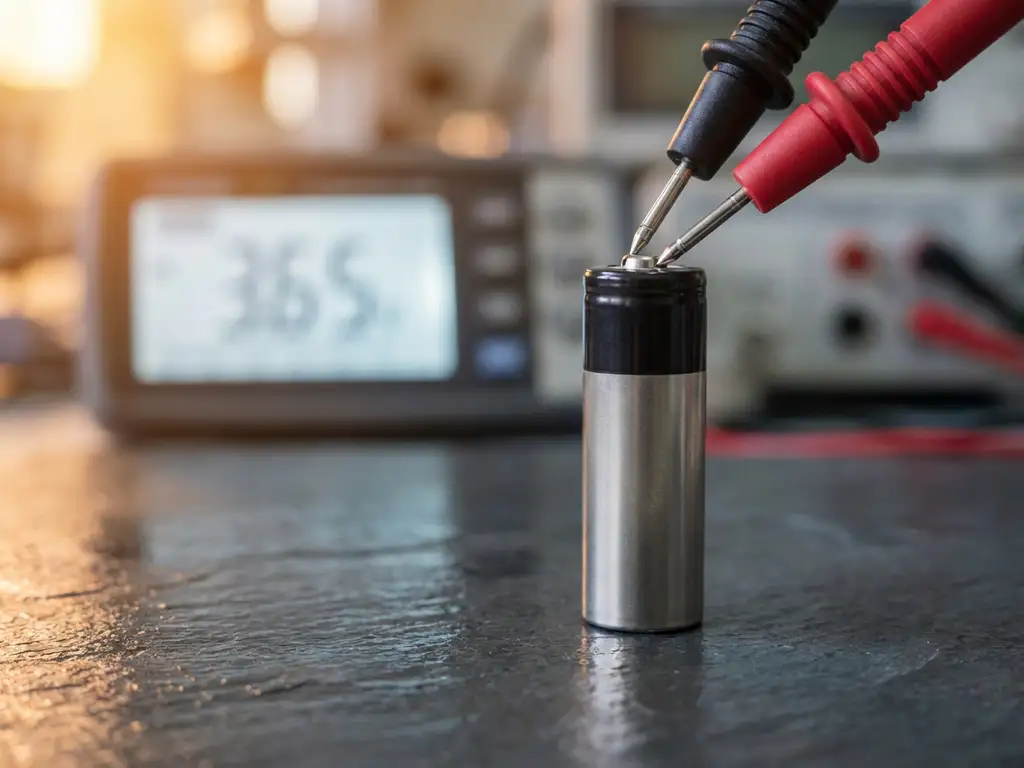
The open-circuit voltage (OCV) of a lithium-ion battery is the cell voltage measured when no current flows through the circuit. It reflects the thermodynamic state of the electrochemical system and provides a direct indication of the electrode potentials at a given state of charge. Understanding OCV is fundamental to battery materials research, from electrode characterisation to full-cell diagnostics.
For researchers working with half-cells and full cells in the laboratory, OCV measurements serve as a baseline reference for electrochemical behaviour. The sections below address the most common questions surrounding battery OCV, progressing from core definitions to practical measurement considerations.
What is the open-circuit voltage of a lithium-ion battery?
The open-circuit voltage of a lithium-ion battery is the potential difference between the positive and negative electrodes when the cell is at electrical rest, meaning no current is applied or drawn. For a typical lithium-ion full cell, OCV values fall in the range of approximately 2.5 V to 4.2 V, depending on electrode chemistry and state of charge. It is a thermodynamic quantity directly related to the Gibbs free energy of the cell reaction.
OCV is distinct from the terminal voltage measured under load. When current flows, overpotential and ohmic resistance cause the measured voltage to deviate from the true thermodynamic value. The open-circuit condition eliminates these contributions, making OCV a cleaner representation of the electrochemical state of the cell.
In half-cell configurations, OCV reflects the potential of a single electrode relative to a reference electrode, most commonly lithium metal in lithium-ion research. This allows researchers to characterise the thermodynamic behaviour of individual electrode materials in isolation.
Why does open-circuit voltage matter in battery research?
Open-circuit voltage matters in battery research because it provides direct thermodynamic information about electrode materials, state of charge, and cell health without the interference of kinetic or resistive effects. It is used to assess electrode equilibrium potentials, validate electrochemical models, and establish reference points for cycling protocols.
Researchers rely on OCV measurements for several practical purposes:
- Determining the state of charge (SoC) of a cell before and after cycling experiments
- Identifying phase transitions in electrode materials through characteristic voltage plateaux
- Detecting self-discharge over time by monitoring OCV decay at rest
- Validating thermodynamic models and entropy measurements
- Checking cell integrity after assembly before the first electrochemical cycle
In academic research, OCV data frequently appears in publications as a quality indicator. A stable, reproducible OCV after assembly and prior to cycling indicates that the cell has been correctly assembled and that no short circuits or parasitic reactions are occurring. Poorly reproducible OCV values across nominally identical cells often signal inconsistencies in electrode preparation or cell assembly.
How does open-circuit voltage change with state of charge?
Open-circuit voltage increases with state of charge in a lithium-ion battery. As lithium ions are extracted from the negative electrode during charging, the electrode potential rises, increasing the overall cell voltage. The relationship between OCV and SoC is non-linear and is characteristic of the specific electrode chemistry used.
The OCV versus SoC curve, often referred to as the equilibrium discharge curve or pseudo-OCV curve, reflects the thermodynamic properties of the electrode materials. Key features include:
- Voltage plateaux: Flat regions in the OCV curve correspond to two-phase coexistence regions in the electrode material, such as the well-known plateau in graphite at approximately 0.1 V versus Li/Li⁺
- Sloping regions: Gradual voltage changes indicate solid-solution behaviour, where lithium is inserted continuously into the host lattice
- Hysteresis: The OCV curve measured during lithiation often differs from that measured during delithiation, a phenomenon particularly prominent in conversion-type electrode materials
Obtaining an accurate OCV versus SoC curve requires very slow cycling or intermittent relaxation steps to allow the cell to approach thermodynamic equilibrium at each point. The galvanostatic intermittent titration technique (GITT) is a standard method used for this purpose in research settings.
What factors affect the open-circuit voltage of a lithium-ion battery?
The open-circuit voltage of a lithium-ion battery is affected by state of charge, electrode chemistry, temperature, and the degree of thermodynamic equilibration. Each factor influences the measured OCV independently, and in practice several act simultaneously.
Electrode chemistry
The choice of active materials defines the thermodynamic voltage window of the cell. Cathode materials such as lithium iron phosphate (LFP) exhibit a flat OCV plateau near 3.4 V versus Li/Li⁺, while layered oxides such as NMC (lithium nickel manganese cobalt oxide) show a sloping profile reaching above 4.0 V. The anode material similarly determines its contribution to the full-cell OCV.
Temperature
OCV has a measurable temperature dependence governed by the entropy of the cell reaction. The temperature coefficient of OCV (dOCV/dT) varies with SoC and electrode chemistry. In research contexts, temperature-dependent OCV measurements are used to extract entropic contributions to the Gibbs free energy, providing thermodynamic data that is difficult to obtain by other means.
Relaxation time
A cell that has recently been charged or discharged will not immediately reach its true equilibrium OCV. Concentration gradients within the electrodes and electrolyte require time to dissipate. Insufficient relaxation time before measurement leads to an apparent OCV that does not reflect the true thermodynamic state, which can introduce systematic errors in SoC estimation and model validation.
Ageing and degradation
As a cell ages, changes in the OCV curve can indicate capacity-loss mechanisms. Shifts in the relative positions of the anode and cathode OCV curves, known as electrode slippage, alter the shape of the full-cell OCV profile and can be used diagnostically to identify the dominant degradation mode.
How is open-circuit voltage measured in a laboratory setting?
In a laboratory setting, open-circuit voltage is measured using a potentiostat or battery tester connected to the cell terminals, with no current applied. The instrument records the voltage at rest over a defined period to confirm that the cell has reached a stable value. Measurement duration depends on the electrode chemistry and the cell’s recent electrochemical history.
Standard laboratory practice for OCV measurement involves the following steps:
- Assemble the electrochemical test cell under controlled conditions, typically in an inert-atmosphere glove box
- Connect the cell to the measurement instrument and allow a defined rest period, commonly between 30 minutes and several hours, depending on the system
- Record the OCV at the end of the rest period, or log the OCV continuously to observe the relaxation profile
- Repeat the measurement at multiple SoC points if a full OCV versus SoC curve is required, using GITT or slow-rate cycling protocols
The accuracy and reproducibility of OCV measurements depend heavily on the quality of the test cell. Parasitic reactions, electrolyte leakage, or poor electrical contact can all introduce artefacts. Standardised test cells with well-defined geometry and controlled assembly conditions are therefore important for generating reliable OCV data.
What is the difference between OCV and equilibrium potential?
Open-circuit voltage and equilibrium potential are closely related but not identical. The equilibrium potential is the thermodynamically defined electrode potential when the electrochemical system is at complete equilibrium, with no net reaction occurring and all concentration gradients fully relaxed. OCV is the measured cell voltage under open-circuit conditions, which approximates the equilibrium potential but may differ if the cell has not fully relaxed.
In practice, a cell at open circuit is often in a quasi-equilibrium state rather than true thermodynamic equilibrium. Slow processes such as lithium diffusion within electrode particles, electrolyte concentration gradients, and ongoing side reactions mean that a perfectly stable OCV may take hours or even days to achieve in some systems. Researchers therefore distinguish between the measured OCV after a given rest period and the true equilibrium potential derived from thermodynamic analysis.
The equilibrium potential for a given electrode reaction is described by the Nernst equation, which relates potential to the activities of the electroactive species. In intercalation electrodes, the activity terms reflect the lithium chemical potential within the host material, which changes continuously with lithium content. This is why the OCV of a lithium-ion cell varies with SoC rather than remaining constant, as it would for a simple redox couple with well-defined activity terms.
How EL-Cell GmbH supports open-circuit voltage measurements
Accurate OCV measurements depend on reproducible cell assembly and reliable instrumentation. EL-Cell GmbH designs and manufactures electrochemical test cells and measurement systems specifically for battery materials research, addressing the practical requirements that underpin high-quality OCV data.
Our products relevant to OCV characterisation include:
- PAT-Cell: A versatile electrochemical test cell for half-cell and full-cell measurements, offering well-defined geometry and consistent contact pressure for reproducible results across experimental series
- PAT-Tester-i-16: A multi-channel battery tester with an integrated temperature-controlled cell chamber, enabling OCV measurements and GITT protocols across up to 16 channels simultaneously, with potentiostat and galvanostat capabilities
If you are developing OCV measurement protocols or need test cells that minimise assembly artefacts, contact us to discuss how our product range can be configured to meet your specific research requirements.
Comments are closed.