


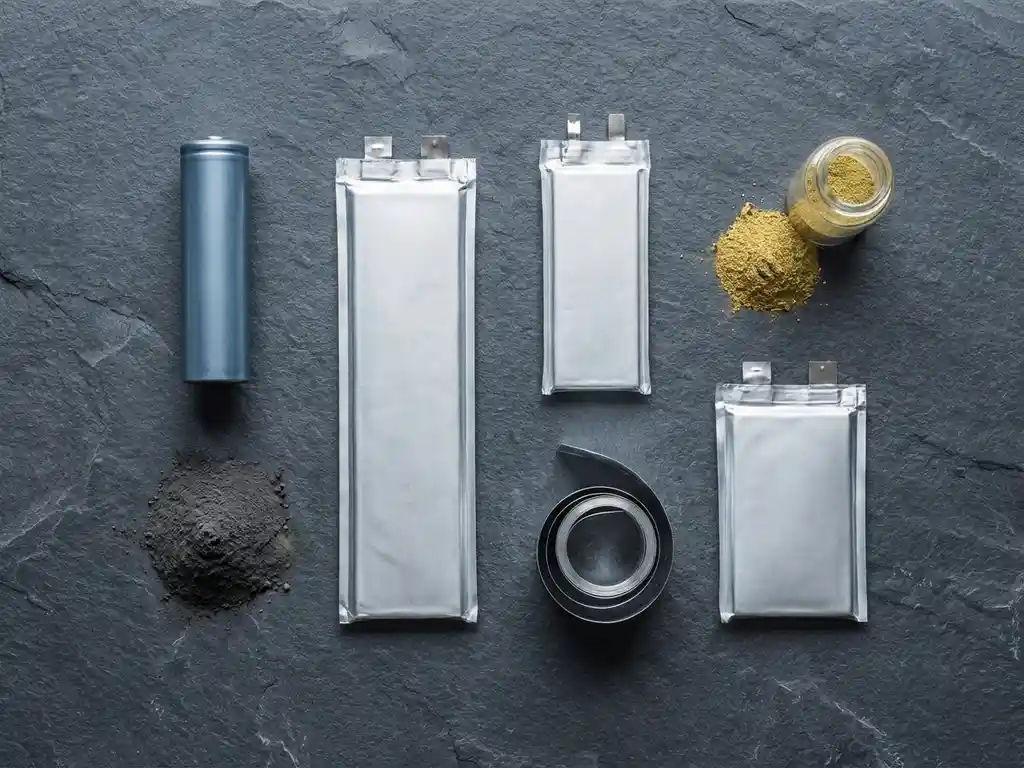
The most common battery chemistries used in research today are lithium-ion variants, including nickel manganese cobalt (NMC), nickel cobalt aluminium (NCA), and lithium iron phosphate (LFP) cathode systems, alongside emerging next-generation chemistries such as solid-state, lithium-sulfur, and sodium-ion. Understanding which chemistries dominate the research landscape, and why, helps laboratories make informed decisions about experimental design and equipment selection.
This article addresses the key questions battery materials researchers encounter when navigating the field, from foundational chemistry comparisons to practical guidance on test cell selection and measurement protocols.
Why is lithium-ion still the most researched battery chemistry?
Lithium-ion battery chemistry remains the most researched because it offers a well-understood electrochemical framework, a broad existing industrial base, and significant headroom for improvement in specific capacity (mAh/g), cycle life, and safety. Decades of published data make it the reference point against which all alternative chemistries are benchmarked.
Research into lithium-ion systems continues at high intensity for several reasons. First, incremental gains in cathode and anode materials, electrolyte formulations, and electrode architecture directly translate into commercially relevant improvements. Second, the solid electrolyte interphase (SEI) layer that forms on the anode during early cycles remains an active area of investigation, as its composition and stability govern both coulombic efficiency and long-term capacity retention. Third, lithium-ion provides a mature experimental platform: standardised half-cell and full-cell test protocols, well-characterised reference electrodes, and a large body of literature make it easier to contextualise new findings.
For researchers entering the field, lithium-ion also offers practical advantages. Electrode materials are commercially available, electrolyte formulations are well documented, and test results can be directly compared with published benchmarks. This reproducibility is essential for publication-quality data.
What are the key differences between NMC, NCA, and LFP cathode chemistries?
NMC (LiNiMnCoO2), NCA (LiNiCoAlO2), and LFP (LiFePO4) differ primarily in their electrochemical potential, specific capacity, thermal stability, and cycle life. NMC and NCA offer higher specific capacity and energy density, while LFP provides superior thermal stability and cycle life at a lower operating voltage.
NMC cathodes
NMC cathodes are defined by the ratio of nickel, manganese, and cobalt in the layered oxide structure. Higher nickel content, as in NMC811, increases specific capacity but reduces structural stability and raises safety concerns at high states of charge. Manganese contributes structural stability, while cobalt supports electronic conductivity. Researchers studying NMC materials frequently investigate capacity fade mechanisms, cation mixing, and surface coating strategies to extend cycle life.
NCA cathodes
NCA cathodes substitute aluminium for manganese, which improves structural integrity at elevated temperatures and under high charge rates. NCA delivers high specific capacity and is widely used in high-energy applications. Research challenges include surface reactivity with liquid electrolytes and sensitivity to moisture during electrode preparation, both of which require careful experimental controls.
LFP cathodes
LFP operates via a two-phase reaction mechanism, producing a characteristic flat voltage plateau during charge and discharge. Its specific capacity is lower than NMC or NCA, but its olivine structure provides exceptional thermal and chemical stability. Research into LFP focuses on improving rate capability, which is limited by low electronic conductivity, often through carbon coating and particle size reduction. LFP is also increasingly studied in the context of sodium-ion analogues, given the structural similarities.
Which next-generation battery chemistries are gaining the most research momentum?
The next-generation battery chemistries attracting the greatest research attention are solid-state batteries, lithium-sulfur (Li-S) batteries, sodium-ion batteries, and lithium-metal anodes. Each addresses specific limitations of conventional lithium-ion systems, though each also presents distinct technical challenges that remain active areas of investigation.
- Solid-state batteries: Replace liquid electrolytes with solid ionic conductors, eliminating liquid electrolyte decomposition and enabling lithium-metal anodes. Research challenges include interfacial resistance between the solid electrolyte and electrodes, mechanical stress during cycling, and scalable manufacturing of thin electrolyte layers.
- Lithium-sulfur batteries: Offer theoretical specific capacity far exceeding that of conventional cathodes, but suffer from polysulfide dissolution into liquid electrolytes, volume changes in the sulfur electrode, and low coulombic efficiency in early cycles.
- Sodium-ion batteries: Use sodium rather than lithium as the charge carrier, drawing on more abundant raw materials. Electrode materials and electrolyte formulations differ from lithium-ion, requiring dedicated research into sodiation mechanisms, SEI chemistry, and suitable anode materials.
- Lithium-metal anodes: Offer high specific capacity but are prone to dendrite formation, which poses both safety and cycle life concerns. Research focuses on electrolyte additives, solid electrolyte interlayers, and stack pressure management to suppress dendrite growth.
Each of these chemistries requires adapted experimental approaches, and in many cases, specialised test cells that can accommodate solid electrolytes, elevated pressures, or operando measurement techniques.
How do researchers choose the right battery chemistry for their experiments?
Researchers select a battery chemistry based on the specific scientific question being addressed, the availability of electrode materials and electrolytes, the required electrochemical metrics, and compatibility with the measurement techniques planned. There is no universal choice; the chemistry must match the experimental objective.
Several practical factors guide the decision:
- Research objective: Fundamental mechanistic studies often use model systems such as lithium iron phosphate due to its well-defined two-phase behaviour. Studies targeting high-energy applications typically use NMC or NCA cathodes paired with graphite or silicon-graphite composite anodes.
- Electrochemical metrics of interest: If the focus is on specific capacity (mAh/g) or rate capability, the cathode chemistry must be selected accordingly. If the study concerns interfacial phenomena, the anode and electrolyte combination may be the primary variable.
- Measurement compatibility: Certain chemistries require specific conditions. Solid-state electrolytes require elevated stack pressure for good interfacial contact. Lithium-sulfur cells may require gas management to handle polysulfide volatility. Operando techniques such as electrochemical dilatometry or optical monitoring impose additional constraints on cell geometry.
- Half-cell versus full-cell configuration: Half-cells against a lithium-metal reference are common for initial material screening, but full-cell measurements are necessary to assess practical performance, including capacity matching and voltage-window optimisation.
Choosing the correct test cell format is as important as selecting the chemistry itself, since cell geometry, electrode area, and pressure control all influence the quality and reproducibility of the data obtained.
What test equipment is needed to study different battery chemistries in the lab?
Studying different battery chemistries in the lab requires a combination of electrochemical test cells matched to the chemistry and experimental objective, a potentiostat or battery tester capable of the required current and voltage ranges, and, where applicable, specialised measurement accessories for operando techniques such as dilatometry, gas analysis, or optical monitoring.
Test cells
The choice of test cell depends on the chemistry and the measurement type. Standard lithium-ion chemistries in half-cell or full-cell configurations are well served by versatile coin-cell-format or spring-loaded test cells. Solid-state electrolytes require cells that apply and maintain defined uniaxial stack pressure, since interfacial contact between solid layers is pressure dependent. Electrode expansion studies, relevant to silicon anodes and lithium-metal systems, require a dilatometer capable of resolving nanometre-scale thickness changes during cycling. Gas-evolving chemistries require cells with integrated gas management or analysis ports.
Potentiostats and battery testers
A potentiostat/galvanostat (PStat/GStat) with electrochemical impedance spectroscopy (EIS) capability is standard for characterising interfacial resistance, SEI development, and ionic conductivity in both liquid and solid electrolyte systems. Multi-channel instruments allow parallel testing across multiple cells, which is important for statistical validation and high-throughput material screening. The current range must be matched to the electrode area and C-rate requirements of the chemistry under study.
Operando and in-situ accessories
Many next-generation battery chemistries require measurement techniques beyond standard galvanostatic cycling. Dilatometry quantifies electrode strain during charge and discharge, which is particularly relevant for high-capacity anodes such as silicon or lithium metal. Optical cells allow visual or spectroscopic observation of electrode surfaces during cycling. Gas analysis cells support differential electrochemical mass spectrometry (DEMS) for detecting and quantifying evolved gases, which is relevant to electrolyte decomposition studies and sulfur cathode research.
How EL-Cell GmbH supports battery chemistry research
EL-Cell GmbH designs and manufactures electrochemical test equipment specifically for battery materials researchers working across the full range of chemistries described in this article. Our product portfolio is structured to support experiments from initial material screening through to advanced operando characterisation, with all instruments designed to work together as a compatible research ecosystem.
Key instruments relevant to battery chemistry research include:
- The PAT-Cell, a versatile spring-loaded test cell suitable for standard lithium-ion half-cell and full-cell experiments across NMC, NCA, LFP, and other chemistries.
- The PAT-Cell-Solid, designed for solid-state electrolyte research with defined and controllable uniaxial stack pressure.
- The ECD-4-nano, a high-resolution electrochemical dilatometer that resolves thickness changes to better than 5 nm, suited to silicon anodes, lithium-metal systems, and any chemistry where electrode volume change is a research variable.
- The PAT-Tester-i-16, a multi-channel potentiostat/galvanostat with EIS capability and an integrated temperature-controlled cell chamber, supporting up to 16 parallel test channels.
- The ECC-Opto-10 for optical in-situ measurements, and the PAT-Cell-Press II for gas analysis applications.
For research groups that require electrochemical testing without the immediate capacity to perform it in-house, our Application Laboratory offers contract testing services. Clients send electrode materials or electrolytes, and our laboratory team handles cell assembly, protocol design, and data evaluation using our high-throughput PAT-Tester instrumentation. If you would like to discuss which test cells or instruments are appropriate for your specific chemistry and experimental objectives, contact our technical team directly.
Comments are closed.