


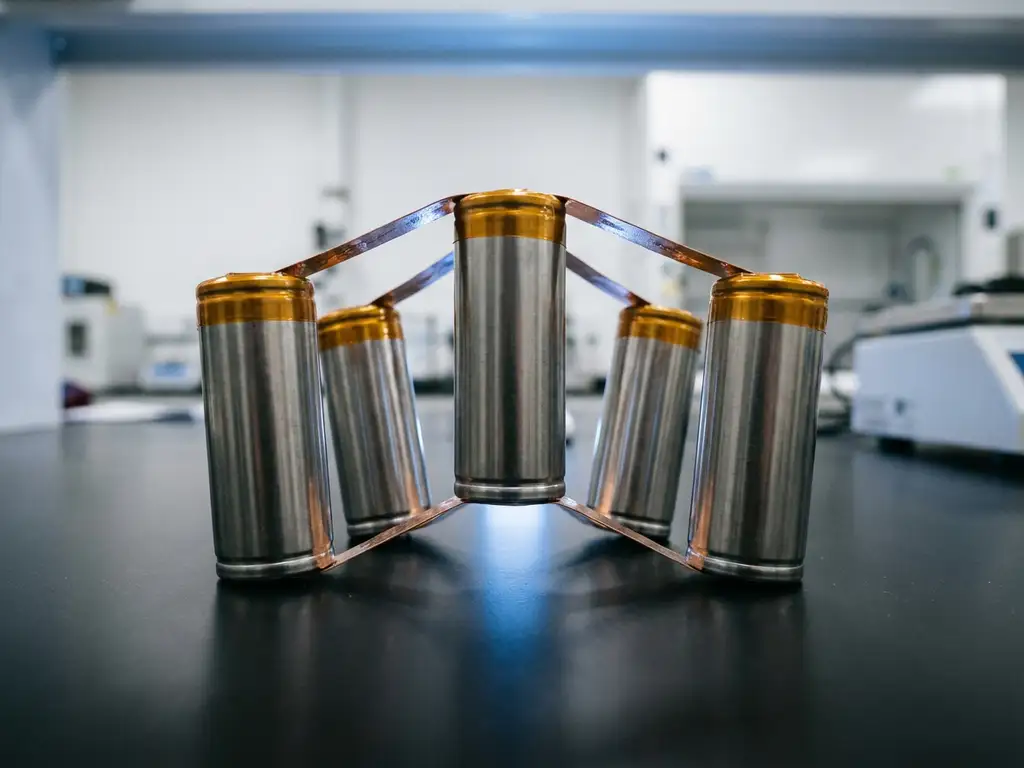
Balancing cells in a lithium-ion battery pack is a fundamental requirement for safe, efficient, and long-lasting operation. Without it, individual cells drift apart in state of charge, leading to premature capacity loss and potential safety risks. This article explains the mechanisms behind cell imbalance, the methods used to correct it, and how researchers study balancing behavior in the laboratory.
What does it mean to balance cells in a lithium-ion battery pack?
Cell balancing in a lithium-ion battery pack is the process of equalizing the state of charge (SoC) across all individual cells connected in series or parallel. Because no two cells are perfectly identical, differences in capacity, internal resistance, and self-discharge rate cause cells to reach full charge or full discharge at different times, reducing the usable capacity of the entire pack.
Balancing ensures that every cell operates within its safe voltage window. A pack is only as strong as its weakest cell: if one cell reaches its upper voltage limit before the others during charging, the charger must stop early to protect it, leaving the remaining cells undercharged. The same logic applies during discharge. Cell balancing corrects this mismatch, allowing the full energy of the pack to be accessed reliably.
Why does cell imbalance happen in the first place?
Cell imbalance in a lithium-ion battery pack arises from manufacturing tolerances and diverging aging behavior. Even cells produced on the same production line exhibit small differences in specific capacity (mAh/g), internal resistance, and self-discharge rate. Over time, these small differences amplify as cells age at different rates under real operating conditions.
Manufacturing variation
Variations in electrode coating thickness, electrolyte distribution, and separator uniformity introduce differences in cell capacity and resistance from the outset. These are unavoidable at the manufacturing scale and represent the baseline level of imbalance in any new pack.
Differential aging
As cells cycle, the solid electrolyte interphase (SEI) layer on the anode grows at different rates depending on local temperature, current distribution, and usage history. Cells positioned at the edges of a module may experience different thermal conditions than those at the center, accelerating capacity fade unevenly. Self-discharge rates also diverge with age, causing SoC to drift between cells even during storage.
What are the main methods used to balance battery cells?
The two principal methods for cell balancing in a lithium-ion battery pack are passive balancing and active balancing. Passive balancing dissipates excess energy as heat, while active balancing redistributes energy between cells. A battery management system (BMS) implements one or both approaches depending on the application requirements.
- Passive balancing: Resistors bleed off charge from higher-SoC cells until they match the lowest cell in the pack.
- Active balancing: Energy transfer circuits move charge from higher-SoC cells to lower-SoC cells, preserving usable energy.
- Top balancing: Cells are equalized at the top of their charge window, ensuring a uniform full charge.
- Bottom balancing: Cells are equalized at the bottom of their discharge window, ensuring a uniform full discharge.
Top balancing is the more common approach in applications where cells are regularly charged to their upper voltage limit. Bottom balancing is used in specific contexts where full discharge is the critical operating point.
What’s the difference between passive and active cell balancing?
The key distinction between passive and active cell balancing is energy efficiency. Passive balancing wastes excess charge as heat through a bleed resistor, making it simple and low-cost but thermally inefficient. Active balancing transfers charge between cells using inductors, capacitors, or DC-DC converters, recovering energy that would otherwise be lost.
Passive balancing
In passive balancing, a resistor is connected in parallel with each cell. When a cell reaches a higher SoC than its neighbors, the resistor dissipates the excess charge until all cells reach the same voltage. The circuit is straightforward and reliable, but all the redistributed energy is converted to heat. This creates thermal management challenges and reduces overall pack efficiency.
Active balancing
Active balancing circuits are more complex and more expensive, but they preserve energy by moving it from overcharged cells to undercharged ones. Common topologies include capacitor-based shuttling, inductor-based transfer, and transformer-coupled converters. Active balancing is particularly valuable in large-format packs where the energy losses from passive dissipation would be significant and where thermal management is already a constraint.
The choice between passive and active balancing involves trade-offs between cost, complexity, thermal load, and efficiency requirements. Research-scale work often prioritizes understanding these trade-offs before committing to a pack design.
How does a battery management system control cell balancing?
A battery management system (BMS) controls cell balancing by continuously monitoring the voltage of each individual cell and activating balancing circuits when the spread between cells exceeds a defined threshold. The BMS measures cell voltages, estimates SoC, and triggers either passive dissipation or active energy transfer to bring cells back into alignment.
The BMS typically performs balancing during charging, when cells approach their upper voltage limit and differences are most apparent. Some systems also balance during rest periods to correct for self-discharge drift. More sophisticated BMS designs incorporate temperature monitoring and coulombic efficiency tracking to adjust balancing strategies based on the actual aging state of individual cells.
The accuracy of SoC estimation is critical to effective balancing. If the BMS misreads the SoC of a cell due to measurement noise or model error, it may apply balancing current unnecessarily or fail to correct a genuine imbalance. Researchers studying BMS algorithms therefore invest considerable effort in validating SoC estimation methods against measured electrochemical data.
How is cell balancing studied and validated in battery research?
Cell balancing is studied in battery research by characterizing the electrochemical properties of individual cells under controlled conditions, then modeling how those properties interact at the pack level. Researchers measure capacity, internal resistance, and self-discharge rate for each cell to quantify the degree of initial mismatch, and then track how these parameters evolve over cycling.
Electrochemical impedance spectroscopy (EIS) is a widely used technique for characterizing the internal resistance and interfacial properties of individual cells. By measuring impedance spectra at different states of charge and temperatures, researchers can build equivalent circuit models that predict how cells will behave under balancing currents. Dilatometry is also used to track volume changes in electrodes during cycling, which correlate with capacity fade and can reveal differential aging between cells.
Controlled cycling experiments on matched sets of cells, deliberately aged to different degrees, allow researchers to test balancing algorithms under realistic conditions of imbalance. This kind of validation work requires test cells that deliver reproducible, artifact-free electrochemical data, so that observed differences in cell behavior reflect genuine material properties rather than experimental noise.
How EL-Cell GmbH supports cell balancing research
Studying the electrochemical origins of cell imbalance requires test hardware that delivers consistent, reproducible data at the individual cell level. EL-Cell GmbH provides the instruments and test cells needed to characterize electrode materials and cell components before they are assembled into packs. Our product ecosystem is designed to give battery researchers precise control over experimental conditions and reliable data at every stage of investigation.
- The PAT-Tester-i-16 offers up to 16 independent test channels with potentiostat/galvanostat (PStat/GStat) and EIS capabilities, enabling parallel characterization of multiple cells under identical conditions.
- The ECD-4-nano electrochemical dilatometer resolves electrode thickness changes to better than 5 nm, supporting the study of differential volume changes that underlie capacity fade and imbalance.
- The PAT-Cell series provides standardized, leak-tight test cells for half-cell and full-cell measurements, ensuring that electrochemical data is free from hardware-introduced artifacts.
If you are investigating the electrochemical factors that drive cell-to-cell variation or validating materials intended for use in balanced battery packs, contact us to discuss which combination of test cells and instrumentation best fits your experimental requirements.
Comments are closed.