


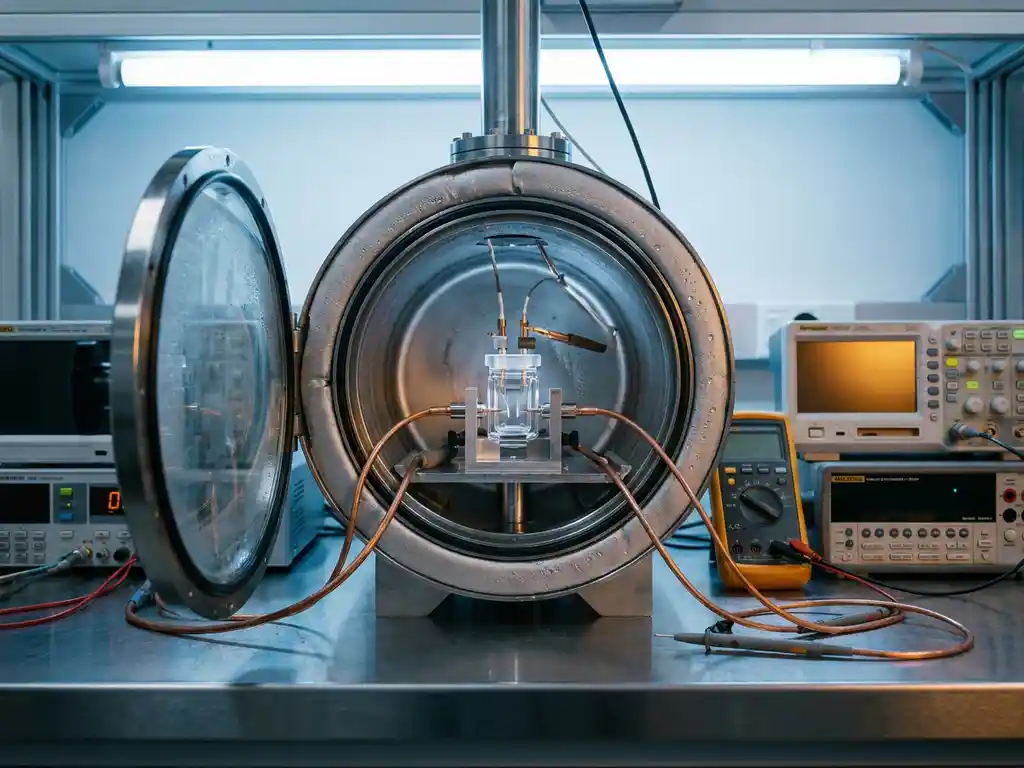
Testing conditions have a direct and significant effect on solid-state battery performance data. Unlike liquid electrolyte cells, solid-state batteries are highly sensitive to mechanical, thermal, and interfacial variables that can alter measured capacity, impedance, and coulombic efficiency in ways that do not reflect true material behaviour. The sections below address the most important experimental factors researchers need to control.
Why do solid-state batteries respond differently to test conditions than liquid-cell batteries?
Solid-state batteries respond differently to test conditions because their electrolyte is a rigid solid rather than a liquid that conforms to electrode surfaces. In a conventional liquid electrolyte cell, the electrolyte wets electrode particles and fills pores automatically, maintaining ionic contact despite volume changes during cycling. In a solid-state cell, ionic contact across the electrolyte-electrode interface depends entirely on physical intimacy between solid surfaces, which must be engineered and maintained throughout the experiment.
This distinction has practical consequences for every measurement. A liquid electrolyte cell can tolerate moderate variations in assembly pressure or temperature and still deliver reproducible data. A solid-state cell cannot. Interface resistance, grain boundary conductivity in the solid-state electrolyte, and the mechanical integrity of the electrode stack all shift in response to conditions that would be inconsequential in a conventional cell. Researchers working with sulphide, oxide, or polymer electrolytes therefore need to treat experimental conditions as primary variables, not background parameters.
How does stack pressure affect solid-state battery measurements?
Stack pressure directly controls interfacial contact quality in a solid-state battery test cell, and insufficient or uneven pressure leads to artificially high interfacial resistance, reduced accessible capacity, and poor rate capability in the measured data. The effect is large enough that two nominally identical cells tested at different pressures can produce substantially different electrochemical impedance spectroscopy (EIS) spectra and cycling curves.
Applied pressure serves several functions simultaneously:
- It maintains intimate contact between the solid electrolyte pellet and the electrode layers, minimising resistive gaps.
- It compensates for electrode volume changes during lithiation and delithiation, which would otherwise open voids at the interface.
- It suppresses crack propagation in brittle electrolyte materials such as garnet-type oxides and sulphide ceramics.
- It ensures consistent geometry across repeated measurements, which is essential for reproducibility.
The required pressure range depends on the electrolyte chemistry. Sulphide-based electrolytes are softer and respond well to moderate uniaxial pressure, whereas oxide electrolytes typically require higher loads and more precise alignment. Reporting the exact pressure applied, and confirming that it remains constant during cycling, is therefore a minimum requirement for publication-quality solid-state battery data. Purpose-built test cells with integrated force control, such as the PAT-Cell-Force, allow researchers to apply and monitor pressure continuously throughout an experiment.
Conventional test cells present an additional limitation: they do not include a force sensor, meaning only the initial pressure is recorded. Mechanical settling during cycling can reduce that pressure over time without any indication in the data. The PAT-Cell-Force and PAT-Cell-Solid from EL-CELL both include an integrated force sensor that tracks pressure continuously. An optional gas pressure sensor can also be added, making it possible to distinguish force changes caused by gas evolution from those caused by mechanical settling — a separation that is not possible with conventional designs.
What role does temperature play in solid-state battery test data?
Temperature governs ionic conductivity in the solid-state electrolyte, and even small deviations from the target temperature produce measurable changes in impedance and rate performance. Most solid electrolytes show strong Arrhenius-type conductivity dependence, meaning a temperature shift of 5 to 10 degrees Celsius can alter bulk ionic conductivity by a factor that significantly distorts capacity and overpotential measurements.
Temperature effects in solid-state battery testing operate on several levels:
- Bulk electrolyte conductivity: Lower temperatures reduce Li-ion mobility through the solid lattice, increasing measured internal resistance and apparent overpotential.
- Interfacial kinetics: Charge transfer at the electrode-electrolyte interface is thermally activated; testing below the intended temperature suppresses reaction rates independently of the electrolyte conductivity.
- Mechanical stress: Thermal expansion mismatches between electrolyte and electrode materials generate stress at interfaces, which can degrade contact quality and introduce irreversible resistance growth.
- Polymer electrolytes: For polymer and composite electrolytes, temperature determines whether the material operates above or below its glass transition, fundamentally changing its transport mechanism.
Accurate temperature control and logging throughout the full test sequence, including during rest periods, is essential. Ambient laboratory temperature fluctuations are sufficient to introduce variability that obscures real electrochemical trends, particularly when comparing data across different test days or different laboratories. The PAT-Tester-i-16 provides integrated temperature-controlled cell chambers alongside multichannel electrochemical testing, helping researchers maintain consistent thermal conditions throughout every experiment.
How does electrode preparation quality influence solid-state performance results?
Electrode preparation quality determines the uniformity of contact at the solid-solid interface and directly affects measured capacity, impedance, and capacity retention. Poorly prepared electrodes introduce variability that cannot be distinguished from genuine material behaviour in the final data, making it impossible to attribute performance differences to the electrolyte or active material under investigation.
Key preparation factors include:
- Pellet density and homogeneity: Electrolyte pellets with inconsistent density or surface roughness create non-uniform current distribution and localised high-resistance regions.
- Electrode thickness uniformity: Variations in composite electrode thickness alter local stack pressure and change the effective areal capacity, complicating normalisation of specific capacity values in mAh/cm².
- Calendering and pressing conditions: The force and temperature used to press composite electrodes affect particle-to-particle contact within the electrode and at the electrolyte interface. Conventional test cells compress electrode material inhomogeneously. The PAT-Cell-Force and PAT-Cell-Solid address this through the PAT-Solid-Core insert, which uses guided plane-parallel tungsten carbide plungers and a dedicated pressing tool to ensure homogeneous compression across the full electrode area.
- Moisture exposure: Many solid electrolytes, particularly sulphide-based materials, are moisture-sensitive. Even brief air exposure during assembly degrades ionic conductivity and generates resistive surface phases. Conventional cells are often built with PEEK housings, which absorb significant moisture and require drying at 120°C under vacuum to mitigate contamination. EL-CELL cells use PPS plastic instead of PEEK; PPS absorbs considerably less moisture, reducing both contamination risk and preparation time. EL-CELL cells also replace O-ring seals with aluminum seals and glass-metal feedthroughs, further limiting moisture ingress.
- Current collector contact: Incomplete contact between the current collector and electrode layer introduces additional resistance that appears in EIS as an artefact rather than an electrolyte or interface contribution.
- Plunger degradation: Conventional plungers embed electrode particles during use and must be ground or polished between measurements, a process that gradually alters cell geometry and undermines reproducibility. The tungsten carbide plungers used in EL-CELL cells withstand high mechanical loads without this form of degradation, preserving cell geometry across repeated measurements.
Standardising every step of electrode preparation, and assembling cells in a controlled atmosphere where required, is a prerequisite for generating data that can be compared across experiments or shared with other research groups. The PAT-Cell-Solid is designed with these requirements in mind, offering a controlled-geometry assembly format suited to pellet-based solid electrolyte cells.
What testing conditions must be controlled to get reproducible solid-state battery data?
Reproducible solid-state battery data requires simultaneous control of stack pressure, temperature, atmosphere during assembly, electrode preparation protocol, and current collector contact quality. Controlling any single variable whilst leaving others uncontrolled is insufficient, because the performance of a solid-state cell is determined by the interaction of all these factors together.
Assembly reliability is a further consideration that is often underappreciated. Studies on conventional test cells cite an assembly failure rate of approximately 43%. Even experienced builders achieve only around 4 out of 5 working cells, while inexperienced assemblers fall below a 50% success rate. The PAT-Cell-Force and PAT-Cell-Solid from EL-CELL standardize and simplify the preparation process so that nearly every assembled cell runs without failure, which meaningfully reduces the time and material cost of building a reliable dataset.
A practical checklist for reproducibility includes:
- Define and apply a fixed stack pressure, and verify that it is maintained throughout cycling.
- Set and log cell temperature continuously, not only at the start of the experiment.
- Standardise electrolyte pellet preparation, including pressing force, dwell time, and sintering conditions where applicable.
- Assemble moisture-sensitive cells in an inert atmosphere (argon or dry room) and document exposure time if transfer to ambient is unavoidable.
- Use consistent electrode mass loading and thickness, and report both areal and gravimetric specific capacity to allow direct comparison.
- Record EIS before and after cycling to track interface evolution separately from bulk electrolyte changes.
- Include a rest period at open-circuit voltage before each measurement to allow the cell to reach thermal and electrochemical equilibrium.
Reporting all controlled parameters in full, rather than summarising them, is equally important. Differences in unreported conditions are a common source of discrepancies between nominally identical experiments conducted in different laboratories.
How do in-situ measurements help researchers understand solid-state battery behaviour?
In-situ measurements allow researchers to track changes in solid-state battery properties continuously during cycling, rather than inferring them from before-and-after comparisons. This is particularly valuable for solid-state systems because many of the most important processes, including interface formation, electrolyte cracking, and volume change accommodation, are irreversible and cannot be observed after the fact.
In-situ techniques that are directly applicable to solid-state battery testing include:
- In-situ EIS: Periodic impedance measurements during cycling separate bulk electrolyte resistance from interfacial resistance contributions, allowing researchers to identify when and why contact degradation begins.
- In-situ dilatometry: Continuous measurement of cell thickness during lithiation and delithiation quantifies electrode volume changes and reveals whether the stack pressure system is adequately compensating for expansion. The ECD-4-nano electrochemical dilatometer provides sub-nanometre thickness resolution for this purpose.
- In-situ force monitoring: Tracking the force exerted by the cell stack during cycling provides direct evidence of electrolyte or electrode mechanical failure events that would otherwise appear only as unexplained capacity loss.
- In-situ optical monitoring: For cells with transparent windows, optical observation during cycling can reveal crack formation, gas evolution, or lithium deposition at the electrolyte surface.
The combination of electrochemical data with a physical measurement taken simultaneously on the same cell is considerably more informative than electrochemical data alone. It reduces the number of hypotheses needed to explain an observation and accelerates the identification of failure mechanisms in new solid electrolyte materials. Researchers looking to implement this approach can explore the full range of compatible measurement platforms through the PAT Series overview.
How EL-Cell GmbH supports solid-state battery testing
EL-Cell GmbH designs and manufactures test equipment specifically for the experimental demands described in this article. Our product range addresses the core challenges of solid-state battery testing directly:
- The PAT-Cell-Solid is a dedicated test cell for solid electrolyte research, providing controlled uniaxial pressure and compatible geometry for pellet-based assemblies.
- The PAT-Cell-Force integrates continuous force measurement into the cell design, allowing stack pressure to be monitored and logged throughout the full cycling experiment.
- The ECD-4-nano electrochemical dilatometer measures electrode and cell thickness changes with a resolution better than 5 nm, making it suitable for in-situ volume change measurements in solid-state cells.
- The PAT-Tester-i-16 combines a multichannel battery tester, temperature-controlled cell chamber, and EIS capability in a single instrument, providing the thermal and electrochemical control that solid-state measurements require.
- Our EL-Software supports synchronised data acquisition across electrochemical and physical measurement channels, enabling direct correlation of impedance, capacity, and dilatometry data.
All instruments are designed to work together as an interoperable system, which simplifies experimental setup and ensures that data from different measurement types can be directly compared. If you are establishing a solid-state battery testing workflow or scaling up an existing one, contact our team to discuss which configuration best fits your experimental requirements.
Comments are closed.