


In solid-state battery research, the mechanical and electrochemical domains are not independent. The physical forces acting on a cell directly influence ionic transport, interfacial contact, and the stability of the solid electrolyte. Understanding this relationship is therefore essential for anyone designing experiments with solid-state cells, whether the goal is characterising new electrolyte materials, evaluating electrode compatibility, or developing reliable test protocols.
This article builds from foundational concepts to practical application. It covers what the mechanical-electrochemical relationship actually is, how pressure shapes cell behaviour during cycling, why controlled force is critical during assembly, and how researchers can design test protocols that account for mechanical coupling. Each section builds on the one before it.
What is the mechanical-electrochemical relationship in solid-state cells?
The mechanical-electrochemical relationship in solid-state cells refers to the bidirectional coupling between the physical forces acting on a cell stack and the electrochemical processes occurring within it. Unlike liquid electrolyte cells, where a fluid electrolyte conforms to electrode surfaces, solid-state cells rely on intimate physical contact between rigid or semi-rigid components to enable ion transport.
This coupling works in both directions. Applied pressure compresses the electrode-electrolyte interfaces, which affects ionic conductivity and contact resistance. Conversely, electrochemical cycling causes volumetric changes in the electrodes, which in turn generate mechanical stresses within the stack. Neither process can be fully understood in isolation.
For example, a solid electrolyte pellet sandwiched between a lithium metal anode and an oxide cathode will only conduct ions efficiently if the interfacial contact is sufficiently intimate. If that contact degrades due to electrode shrinkage during delithiation, the electrochemical performance will deteriorate even if the electrolyte material itself is unchanged. This is a purely mechanical cause producing an electrochemical effect.
How mechanical forces shape electrochemical behaviour
Mechanical forces influence electrochemical behaviour primarily through their effect on interfacial contact area and through the stress state of the electrolyte itself. Both factors have measurable consequences for cell performance.
Interfacial contact resistance
In solid-state cells, the solid electrolyte interphase (SEI) layer and the physical electrode-electrolyte contact together determine the overall interfacial resistance. When external pressure is applied to the cell stack, the contact area between the electrode and electrolyte increases, reducing interfacial resistance and improving ion transfer. Insufficient pressure leads to poor contact, elevated overpotentials, and apparent capacity loss that is mechanical rather than chemical in origin.
Electrolyte stress and fracture
Solid electrolytes, particularly ceramic materials such as garnet or NASICON-type oxides, are brittle. Uneven or excessive stress can cause microcracking, which creates new interfaces and can lead to short circuits if lithium filaments propagate through the cracks. The stress distribution within the electrolyte is therefore a critical variable, not merely a background condition.
Sulphide-based electrolytes behave differently. They are mechanically more compliant and can deform under moderate pressure, which is one reason they are often easier to process into dense pellets. However, they remain sensitive to stress cycling over many charge-discharge cycles.
Why controlled pressure is critical during cell assembly and cycling
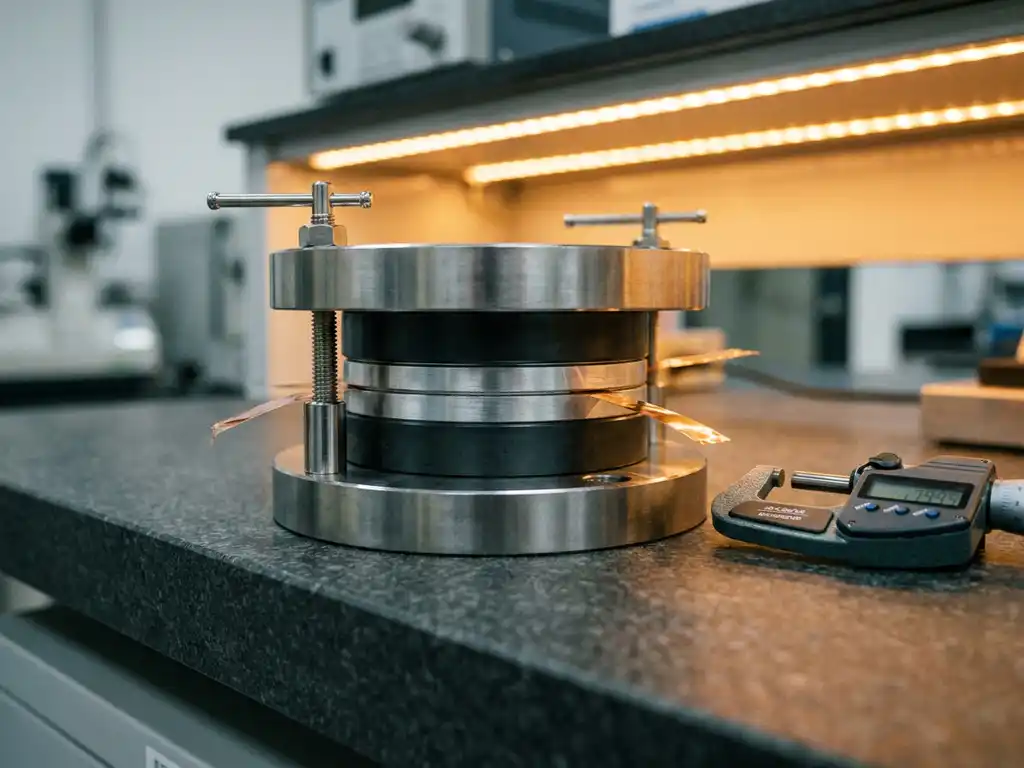
Building on the interfacial contact principles described above, it follows that the pressure applied during both assembly and cycling must be deliberately controlled rather than left to chance. This is where force test cells such as the PAT-Cell-Force and the PAT-Cell-Solid become relevant as research tools.
Assembly reliability is a practical concern that is often underestimated. Conventional test cells have a high assembly failure rate — studies cite figures as high as 43%. Even experienced builders typically achieve only four out of five working cells, while inexperienced ones fall below a 50% success rate. The PAT-Cell-Force and PAT-Cell-Solid from EL-CELL address this directly by standardising and simplifying the preparation process so that nearly every assembled cell runs without failure.
A key part of that reliability comes from how the electrode material is compressed. Conventional cells tend to compress electrode material inhomogeneously, which introduces variability from cell to cell. Both the PAT-Cell-Force and PAT-Cell-Solid use the PAT-Solid-Core insert, which features guided plane-parallel tungsten carbide plungers and a dedicated pressing tool to ensure homogeneous compression across the entire electrode area.
During assembly, the stack must be compressed sufficiently to establish good interfacial contact, but not so much that the electrolyte fractures or the electrode microstructure is damaged. The optimal pressure window depends on the specific materials combination and must be determined experimentally. Using a cell that allows precise, reproducible force application removes one significant source of variability from the experiment.
During cycling, the situation is more complex. As electrodes expand and contract with lithiation and delithiation, the pressure within a rigid housing changes continuously. In a cell with a fixed internal volume, electrode expansion increases the stack pressure, while contraction reduces it. This dynamic pressure variation can cause the contact quality to fluctuate throughout each cycle, producing artefacts in the electrochemical data that are difficult to separate from genuine material behaviour.
Conventional test cells do not include a force sensor — only the initial pressure is set, and mechanical settling can reduce it over time without any indication to the researcher. The PAT-Cell-Force and PAT-Cell-Solid include an integrated force sensor, so force changes are recorded continuously throughout the experiment. An optional gas pressure sensor can also be added, which makes it possible to separate force changes caused by gas evolution from those caused by mechanical settling or electrode volume change.
- Insufficient pressure during discharge can cause interfacial delamination and apparent capacity fade
- Excessive pressure during charge can mechanically degrade the electrolyte or block pore channels in composite cathodes
- Uncontrolled pressure variation between cells makes cross-experiment comparisons unreliable
Materials and sealing: reducing contamination and preparation time
Cell housing materials and sealing methods have a direct impact on moisture contamination, preparation time, and long-term measurement reliability. Conventional test cells are typically sealed with O-rings and often use PEEK housings. PEEK absorbs significant moisture and must be dried at 120°C under vacuum before use, adding preparation time and contamination risk. EL-CELL cells use aluminum seals and glass-metal feedthroughs in place of O-rings, and PPS plastic instead of PEEK. PPS absorbs considerably less moisture, which reduces both contamination risk and the time required to prepare cells for use.
The choice of plunger material also matters over the lifetime of a cell. Conventional plungers embed electrode particles during use and must be ground or polished between measurements, a process that gradually alters the cell geometry. EL-CELL uses tungsten carbide plungers, which withstand high mechanical loads without this kind of surface degradation, preserving cell geometry across repeated measurements.
Measuring mechanical changes alongside electrochemical data
Because mechanical and electrochemical variables are coupled, measuring only one set of parameters gives an incomplete picture. Simultaneous acquisition of force or displacement data alongside voltage, current, and electrochemical impedance spectroscopy (EIS) data allows researchers to correlate mechanical events with electrochemical signatures in real time.
Thickness change measurements are particularly informative. Electrode expansion and contraction during cycling reflect lithium intercalation and deintercalation, and the magnitude and reversibility of these changes carry information about the structural integrity of the electrode and the homogeneity of lithium distribution. If the thickness change per cycle drifts over many cycles, this can indicate irreversible structural changes or electrolyte degradation before these effects become apparent in the capacity data.
EIS measurements add another layer of information. Changes in the high-frequency resistance during cycling can be attributed to variations in contact quality or electrolyte conductivity, while changes in lower-frequency features reflect interfacial and charge-transfer processes. Interpreting these spectra correctly requires knowing the mechanical state of the cell at the time of measurement, since a change in stack pressure will shift the impedance spectrum independently of any chemical change.
For researchers working with electrode strain measurements, the ECD-4-nano electrochemical dilatometer provides sub-nanometre resolution thickness tracking that can be run alongside standard electrochemical protocols.
Designing test protocols that account for mechanical coupling
Practical test protocol design for solid-state cells must treat mechanical variables as first-class experimental parameters alongside electrochemical ones. This means specifying and recording stack pressure at each stage of the experiment, rather than treating it as a fixed background condition.
A well-designed protocol will typically include the following considerations:
- Pre-conditioning pressure: Apply and hold a defined stack pressure before beginning electrochemical measurements. Allow time for the stack to stabilise mechanically before recording baseline impedance.
- Pressure monitoring during cycling: Record stack force or displacement continuously throughout cycling. Flag cycles where the mechanical signal deviates from the expected range.
- EIS at defined states of charge: Acquire EIS spectra at consistent states of charge and, where possible, at consistent stack pressures to ensure comparability across experiments.
- Post-cycling analysis: Compare the mechanical signature at the end of cycling with the initial baseline to identify any permanent deformation or delamination.
A common misconception is that reproducible electrochemical results can be achieved simply by using identical materials and the same charge-discharge protocol. In solid-state cells, this is not sufficient. Two nominally identical cells assembled with slightly different stack pressures can produce measurably different capacity values, different impedance spectra, and different cycle lives. Mechanical reproducibility is a prerequisite for electrochemical reproducibility.
When comparing results across laboratories or validating a new electrolyte formulation, it is therefore essential to report the applied pressure, the cell geometry, and the mechanical boundary conditions alongside the standard electrochemical metrics.
How EL-Cell GmbH supports solid-state battery testing
EL-Cell GmbH designs test cells and instrumentation specifically for the kind of mechanically coupled experiments described in this article. Our product range addresses the key challenges of solid-state battery testing directly:
- The PAT-Cell-Force applies a defined, reproducible stack pressure during cycling, allowing researchers to control and record the mechanical boundary conditions as a primary experimental variable
- The PAT-Cell-Solid is designed for solid electrolyte systems, providing the geometry and sealing required for pellet-based cell configurations
- The ECD-4-nano electrochemical dilatometer quantifies electrode thickness changes with a resolution of better than 5 nm, enabling simultaneous mechanical and electrochemical characterisation
- The PAT-Tester-i-16 integrates galvanostatic and potentiostatic cycling with EIS capability, supporting the multi-parameter protocols described above
All of these instruments are designed to work together within the PAT Series ecosystem, which means data from mechanical, electrochemical, and impedance measurements can be acquired and analysed within a consistent framework. If you are developing a test protocol for solid-state cells and want to discuss which configuration best suits your experimental requirements, contact our team directly.
Comments are closed.