


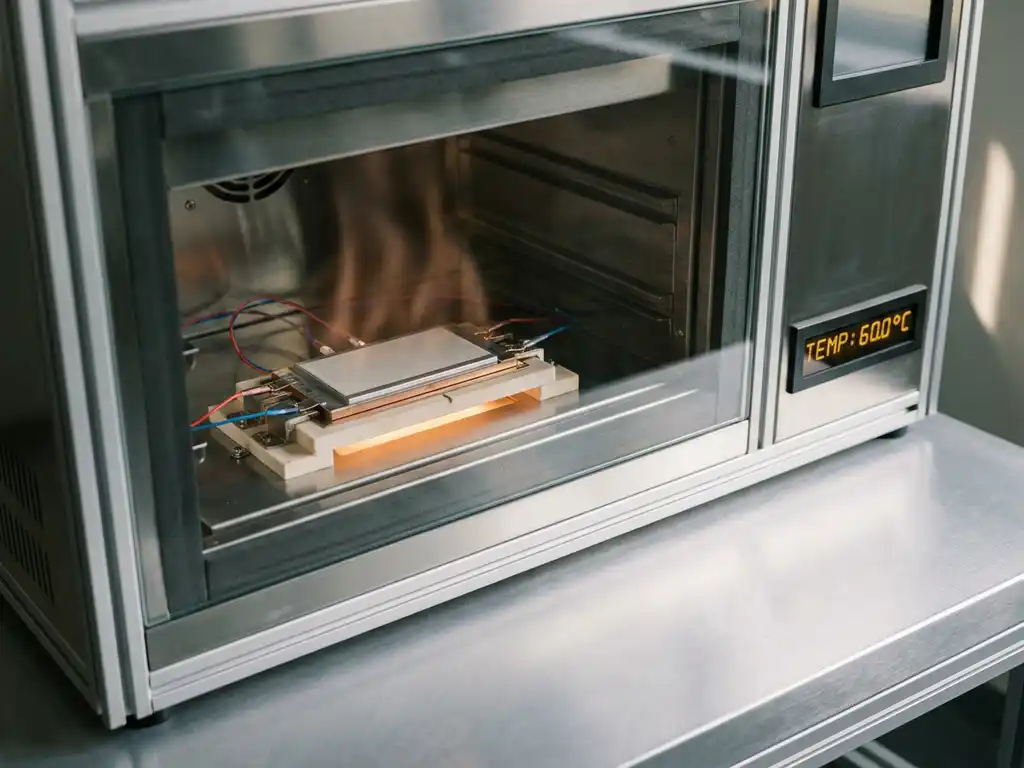
Thermal stability in solid-state batteries is tested using a combination of material-level techniques and full-cell characterisation methods. The most widely used approaches include differential scanning calorimetry (DSC), thermogravimetric analysis (TGA), accelerating rate calorimetry (ARC), and electrochemical cycling under controlled temperature conditions. Because solid-state batteries replace the flammable liquid electrolyte with a solid alternative, their thermal behaviour differs fundamentally from that of conventional lithium-ion cells, and the test protocols must reflect that difference.
The sections below address the most common questions researchers ask when designing a thermal stability test programme for solid-state battery materials and cells.
What makes solid-state batteries more thermally stable than liquid electrolyte cells?
Solid-state batteries are generally more thermally stable than liquid electrolyte cells because they eliminate the flammable organic solvent that drives the most dangerous stages of thermal runaway in conventional lithium-ion systems. Without a volatile electrolyte, the exothermic reactions that propagate cell failure are either absent or significantly reduced in magnitude.
In a conventional lithium-ion cell, thermal runaway typically progresses through a chain of reactions: decomposition of the solid electrolyte interphase (SEI) layer, reaction of the anode with the liquid electrolyte, separator melting, and finally cathode decomposition. Each stage releases heat and, in some cases, flammable gas, which accelerates the next stage.
Solid-state designs interrupt this chain at several points:
- The absence of a liquid solvent removes the primary fuel source for combustion
- Many solid electrolytes are non-flammable and thermally stable up to several hundred degrees Celsius
- There is no separator to melt, which eliminates one of the key internal short-circuit pathways
- Interfacial reactions between the electrode and electrolyte are often slower and less exothermic than their liquid-phase equivalents
That said, thermal stability is not guaranteed simply by removing the liquid electrolyte. The specific solid electrolyte chemistry, electrode materials, and interface quality all influence how a cell responds to elevated temperature or abuse conditions. This is precisely why rigorous solid-state battery testing remains essential.
What are the main thermal stability tests used for solid-state batteries?
The main thermal stability tests for solid-state batteries are DSC, TGA, ARC, and isothermal storage testing. Each method targets a different aspect of thermal behaviour, from material-level decomposition to full-cell abuse response. Researchers typically combine several methods to build a complete picture.
DSC and TGA for material characterisation
DSC measures heat flow as a function of temperature, revealing phase transitions, melting points, and exothermic decomposition events. TGA measures mass loss over temperature, identifying decomposition temperatures and volatile product formation. Both are applied to electrolyte powders, electrode composites, and harvested cell components.
ARC and isothermal testing for cell-level behaviour
Accelerating rate calorimetry (ARC) tracks self-heating in a fully adiabatic environment, making it the standard method for measuring onset temperature and heat generation rate during thermal runaway. Isothermal storage testing holds cells at elevated but sub-abuse temperatures over extended periods to assess capacity fade, impedance growth, and any slow interfacial degradation that occurs without triggering runaway.
How does DSC testing reveal thermal risks in solid-state battery materials?
DSC testing reveals thermal risks in solid-state battery materials by measuring the heat flow associated with chemical and physical transitions as temperature increases. Exothermic peaks in the DSC trace indicate reactions that release energy, which is the defining feature of a thermal hazard in any battery material.
For solid electrolytes, DSC is used to identify:
- Decomposition onset temperature, which sets an upper operating limit for the material
- Phase transitions, such as the transition in lithium argyrodites or LLZO-family oxides that affects ionic conductivity
- Reactions between the solid electrolyte and electrode active materials, particularly at the cathode interface
For electrode materials, DSC is often performed on charged (delithiated) cathode powders mixed with electrolyte to simulate the most thermally stressed state of the cell. The onset temperature and total heat released from these mixtures provide a direct comparison of how different electrolyte chemistries interact with the same cathode material.
One important consideration in DSC battery testing is sample preparation. Solid electrolyte powders must be handled under an inert atmosphere to prevent moisture or oxygen contamination, which would alter the measured decomposition behaviour. This is especially critical for sulphide-based electrolytes, which are highly moisture-sensitive.
How is thermal stability tested at the full-cell level?
At the full-cell level, thermal stability is tested by exposing assembled solid-state cells to controlled temperature ramps, abuse conditions, or adiabatic self-heating protocols. The goal is to identify the onset of exothermic behaviour, measure heat generation rates, and determine whether thermal runaway occurs and under what conditions.
The most informative full-cell methods include:
- ARC testing: The cell is placed in an adiabatic calorimeter and heated in small increments. If the cell begins self-heating above a defined threshold, the calorimeter tracks the temperature rise without adding or removing heat. This gives the onset temperature, self-heating rate, and total energy released.
- Hot box testing: The cell is placed in a temperature-controlled chamber and exposed to a defined temperature ramp. Pass or fail is determined by whether the cell vents, ignites, or undergoes structural failure.
- Overcharge and nail penetration tests: These abuse tests probe the cell’s response to electrical and mechanical triggers for thermal runaway, complementing the purely thermal methods above.
For solid-state cells specifically, full-cell thermal testing must account for the stack pressure applied during cycling. Many solid electrolytes require mechanical compression to maintain good interfacial contact. Changes in this pressure at elevated temperature can alter the cell’s electrochemical and thermal behaviour, so test fixtures should replicate the intended operating stack pressure.
What role does the solid electrolyte type play in thermal test results?
The type of solid electrolyte used has a direct and significant influence on thermal test results. Oxide, sulphide, and polymer electrolytes each have distinct decomposition temperatures, reaction enthalpies with electrode materials, and failure modes, which produce measurably different DSC and ARC profiles.
Oxide electrolytes
Oxide-based electrolytes such as garnet-type LLZO (lithium lanthanum zirconium oxide) and NASICON-type LAGP are among the most thermally stable solid electrolyte materials. They typically show no significant decomposition below 700 °C and are non-reactive with the ambient atmosphere. DSC traces for these materials are largely featureless up to high temperatures, and ARC testing of LLZO-based cells generally shows higher onset temperatures than liquid electrolyte equivalents.
Sulphide electrolytes
Sulphide electrolytes, including argyrodites (Li6PS5X) and LGPS-type materials, offer high ionic conductivity but are less thermally stable than oxides. DSC testing typically reveals exothermic events at lower temperatures, and these materials react with moisture to produce hydrogen sulphide gas. Solid-state electrolyte thermal stability testing for sulphides must therefore be performed under strictly controlled inert conditions. Interfacial reactions between sulphide electrolytes and oxide cathodes can also generate additional heat, which is detectable in DSC experiments on mixed samples.
Polymer and composite electrolytes
Polymer electrolytes introduce organic components that lower the upper thermal stability limit. TGA is particularly informative for these materials, as it quantifies the temperature at which polymer degradation and mass loss begin. Composite electrolytes that combine ceramic fillers with a polymer matrix show intermediate behaviour, and their thermal profiles depend strongly on filler loading and distribution.
What equipment do researchers need to run solid-state battery thermal tests?
Researchers running solid-state battery thermal stability tests require a combination of analytical instruments for material characterisation and electrochemical test cells capable of operating under controlled temperature and pressure conditions. The specific equipment depends on whether the focus is material-level screening or full-cell characterisation.
For material-level thermal analysis:
- A DSC instrument with an inert atmosphere capability (nitrogen or argon purge) for electrolyte and electrode powder characterisation
- A TGA instrument, ideally coupled with evolved gas analysis, for decomposition temperature and mass loss data
- A glove box or inert transfer vessel for sample preparation, essential for moisture-sensitive sulphide electrolytes
For full-cell electrochemical and thermal characterisation:
- A test cell designed for solid-state electrolytes, capable of applying and maintaining defined stack pressure throughout cycling
- A temperature-controlled cell chamber that allows cycling across a defined temperature range
- A multichannel potentiostat/galvanostat with electrochemical impedance spectroscopy (EIS) capability, to track impedance growth as a function of temperature
- An ARC instrument for abuse-level thermal characterisation at the full-cell level
The PAT-Cell-Solid is designed specifically for solid-state battery research and supports the stack pressure requirements that make full-cell thermal characterisation reliable. For researchers who need to monitor both electrochemical performance and dimensional changes during thermal cycling, the ECD-4-nano provides sub-5 nm resolution thickness measurements that can reveal thermally induced mechanical changes in the electrode stack.
How EL-Cell GmbH supports solid-state battery thermal stability research
EL-Cell GmbH designs and manufactures the electrochemical test infrastructure that researchers need to run reproducible, well-controlled solid-state battery thermal stability experiments. Our product ecosystem is built specifically for battery materials research, and every component is designed to work together within a single, interoperable platform. Learn more about the underlying design philosophy on the PAT Core Concept page, or explore the full PAT Series Overview.
A recurring challenge in solid-state battery research is achieving consistent, failure-free cell assembly. Conventional test cells carry a high assembly failure rate — studies cite figures as high as 43%. Even experienced builders typically achieve only 4 out of 5 working cells, while inexperienced researchers fall below 50%. The PAT-Cell-Force and PAT-Cell-Solid from EL-CELL address this directly by standardising and simplifying the preparation process so that nearly every assembled cell runs without failure.
Both cells use the PAT-Solid-Core insert, which features guided plane-parallel tungsten carbide plungers and a dedicated pressing tool. This ensures homogeneous compression of electrode material — something conventional cells routinely fail to achieve, as their plungers compress material inhomogeneously. The tungsten carbide plungers also withstand high mechanical loads without embedding particles into their surfaces, which is a known problem with conventional plungers that must be ground or polished between measurements, gradually altering cell geometry over time.
Sealing and housing materials also differ significantly. Conventional cells are typically sealed with O-rings and often use PEEK housings, which absorb significant moisture and require drying at 120 °C under vacuum before use. EL-CELL cells use aluminium seals and glass-metal feedthroughs in place of O-rings, and PPS plastic instead of PEEK. PPS absorbs considerably less moisture, which reduces contamination risk and shortens preparation time — an important advantage when working with moisture-sensitive sulphide electrolytes.
On the measurement side, conventional test cells do not include a force sensor: only the initial stack pressure is set, and mechanical settling can reduce it over time without any indication to the researcher. EL-CELL cells include an integrated force sensor that tracks pressure continuously throughout cycling. An optional gas pressure sensor can be added to measure force changes caused by gas evolution separately from purely mechanical ones, enabling a clearer interpretation of what is driving any observed pressure shift.
For researchers working on thermal stability in solid-state systems, we offer:
- PAT-Cell-Solid: A test cell engineered for solid electrolyte systems, providing controlled stack pressure and compatibility with inert-atmosphere assembly workflows
- PAT-Cell-Force: Allows continuous in-situ force measurement during cycling, directly relevant to understanding how thermal expansion affects interfacial contact and cell resistance
- ECD-4-nano: A high-resolution electrochemical dilatometer that quantifies electrode thickness changes during thermal and electrochemical cycling with better than 5 nm resolution
- PAT-Tester-i-16: A 16-channel battery tester with an integrated temperature-controlled cell chamber, potentiostat/galvanostat, and EIS capability, enabling systematic thermal characterisation across multiple cells simultaneously
All instruments are available as part of a complete, configurable research ecosystem. If your laboratory is setting up a solid-state battery testing programme or expanding an existing one, contact EL-Cell GmbH to discuss which configuration best fits your experimental requirements.
Comments are closed.