


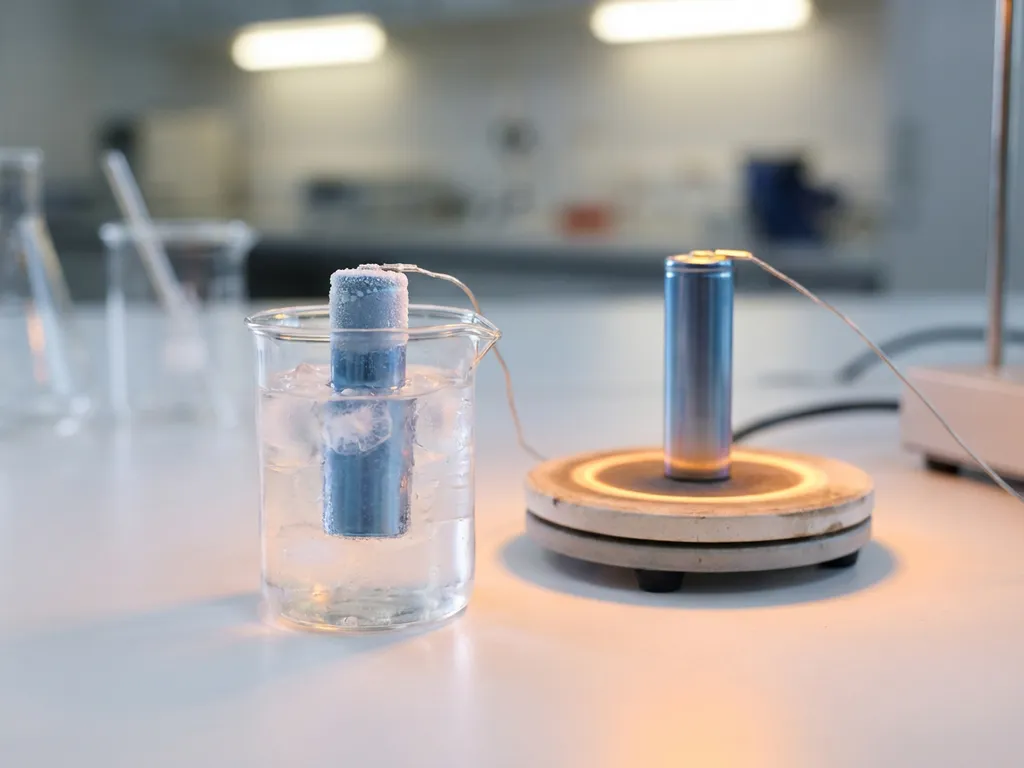
Temperature is one of the most significant variables governing electrochemical reaction rates in batteries. Whether a researcher is cycling a lithium-ion half-cell at room temperature or stress-testing a next-generation solid-state electrode under thermal extremes, temperature directly determines how fast reactions proceed, how ions move, and how quickly degradation accumulates. Understanding these relationships is essential for producing reproducible, meaningful data in battery materials research.
The sections below address the key questions surrounding temperature and battery performance, progressing from the underlying thermodynamic principles to practical guidance on temperature control in the laboratory.
Why does temperature affect electrochemical reaction rates?
Temperature affects electrochemical reaction rates because thermal energy governs the activation energy barriers that ions and charge carriers must overcome during redox reactions. Higher temperatures supply more thermal energy to reactant species, increasing the fraction of particles with sufficient energy to complete a reaction. Lower temperatures reduce this fraction, slowing reaction kinetics at both the anode and the cathode.
In a battery electrode, electrochemical reactions involve charge transfer at the electrode–electrolyte interface, solid-state diffusion of lithium ions within the active material, and ionic transport through the electrolyte. Each of these processes is thermally activated. When temperature drops, all three slow simultaneously, which is why battery performance degrades markedly in cold conditions. Conversely, elevated temperatures accelerate these processes but introduce additional degradation mechanisms that researchers must account for.
The temperature effect on battery performance is not limited to reaction speed. Thermodynamic quantities such as the open-circuit voltage (OCV) are also temperature-dependent, since the Gibbs free energy of the cell reaction varies with temperature. This means that even at equilibrium, a cell measured at different temperatures will show different voltage characteristics, a consideration that is critical when interpreting electrochemical data.
How does the Arrhenius equation describe battery kinetics?
The Arrhenius equation describes battery kinetics by relating the rate constant of an electrochemical reaction to temperature through an exponential function: k = A·exp(–Ea/RT), where Ea is the activation energy, R is the gas constant, and T is the absolute temperature. A higher activation energy means the reaction rate is more sensitive to temperature changes, and a lower temperature causes a disproportionately large reduction in rate.
In practice, battery researchers use the Arrhenius relationship to extract activation energies for specific processes, such as lithium-ion diffusion through the solid electrolyte interphase (SEI) layer or charge transfer at the electrode surface. By measuring electrochemical impedance spectroscopy (EIS) data across a controlled temperature range, it is possible to isolate individual resistive contributions and determine their Ea values. This approach provides mechanistic insight that cannot be obtained from a single-temperature measurement.
The Arrhenius framework also explains why small temperature differences can produce large changes in observed capacity and rate capability. An activation energy of even 0.3 to 0.5 eV, which is typical for interfacial charge transfer in lithium-ion systems, translates to a substantial rate change over a 40 to 60 °C window. This sensitivity underscores why precise temperature control during electrochemical testing is not optional but fundamental to reproducible results.
What happens to ion transport and electrolyte conductivity at low temperatures?
At low temperatures, the ionic conductivity of liquid electrolytes decreases significantly because ion mobility is reduced as the viscosity of the solvent increases. Lithium-ion diffusion coefficients in both the electrolyte and within electrode active materials fall, leading to higher internal resistance, increased overpotential under applied current, and apparent capacity loss that does not reflect the true thermodynamic capacity of the material.
Electrolyte viscosity and ionic mobility
Common carbonate-based electrolytes used in lithium-ion research become noticeably more viscous below approximately 0 °C. As viscosity rises, the drag on solvated lithium ions increases, reducing their mobility and the overall ionic conductivity of the electrolyte. At sufficiently low temperatures, some electrolyte formulations approach their freezing point, which can cause phase separation and irreversible changes to the electrolyte composition.
Solid-state diffusion limitations
Beyond the electrolyte, solid-state diffusion of lithium within active materials such as graphite or layered oxide cathodes is also thermally activated. At low temperatures, the diffusion coefficient within the solid phase decreases, meaning lithium ions cannot redistribute uniformly within electrode particles during cycling. This produces concentration gradients, localised overpotentials, and, in graphite anodes, an elevated risk of lithium plating rather than intercalation. Lithium plating at low temperatures is a significant safety and degradation concern in research involving fast-charge protocols.
How does elevated temperature accelerate battery degradation?
Elevated temperature accelerates battery degradation by increasing the rate of parasitic side reactions at the electrode–electrolyte interface. The most significant of these is accelerated SEI layer growth on the anode, which consumes lithium inventory and increases cell impedance over time. Cathode dissolution, electrolyte oxidation, and structural disordering of active materials also proceed faster at higher temperatures, all of which reduce reversible capacity and coulombic efficiency.
The SEI layer, which forms during the first few charge–discharge cycles, is thermodynamically metastable. At elevated temperatures, the chemical species within the SEI continue to react with the electrolyte, causing the layer to thicken. Each increment of thickness adds to the resistance that lithium ions must overcome during intercalation and deintercalation, progressively increasing overpotential and reducing effective capacity in mAh/g.
On the cathode side, transition-metal dissolution becomes more pronounced at elevated temperatures, particularly in manganese-containing materials. Dissolved metal ions can migrate through the electrolyte and deposit on the anode, where they catalyse further electrolyte decomposition. These cross-talk mechanisms mean that elevated-temperature testing must be approached with the awareness that degradation modes interact and that separating their contributions requires careful experimental design.
How do researchers accurately control temperature in battery testing?
Accurate temperature control in battery testing requires a combination of a thermostatted cell environment, direct thermal contact between the temperature-control element and the test cell, and sufficient equilibration time before measurements begin. Passive ambient-temperature testing in an open laboratory is insufficient for quantitative research, as room temperature fluctuates and does not represent a controlled experimental variable.
The most reliable approach integrates a temperature-controlled chamber directly with the electrochemical test cell and measurement hardware. This eliminates thermal gradients between the cell and the environment and ensures that the temperature the researcher records is the temperature the cell actually experiences. For EIS measurements in particular, even a few degrees of thermal drift during a frequency sweep can introduce artefacts that obscure the true impedance response.
Additional considerations include:
- Allowing sufficient thermal equilibration time after a temperature change before beginning a measurement, as the cell interior may lag behind the chamber setpoint
- Using calibrated temperature sensors positioned as close to the electrochemical interface as possible
- Accounting for self-heating at high C-rates, which can raise the local cell temperature above the setpoint during discharge
- Ensuring that all cell components, including seals and current collectors, are rated for the intended temperature range
What temperature range should battery researchers test at?
Battery researchers should test across a range that reflects both the intended application conditions and the mechanistic questions being investigated. For standard lithium-ion materials characterisation, a range of 20 to 60 °C covers most relevant operating and degradation conditions. Testing at sub-zero temperatures is necessary when investigating cold-start behaviour, lithium plating risk, or electrolyte formulations for low-temperature applications.
For fundamental kinetic studies using the Arrhenius approach, a broader temperature window, typically from around −20 to +60 °C, provides sufficient data points to extract reliable activation energies and to distinguish between different rate-limiting processes. Each temperature step should be held long enough to ensure thermal and electrochemical equilibrium before data collection.
Accelerated ageing studies are often conducted at elevated temperatures, commonly 45 to 60 °C, to compress the timescale of degradation. Researchers must exercise caution when extrapolating results from accelerated ageing to ambient conditions, as the dominant degradation mechanisms can shift with temperature, and an Arrhenius extrapolation assumes a single activated process is rate-limiting throughout the tested range.
How EL-Cell GmbH supports temperature-controlled battery research
Controlling temperature precisely during electrochemical measurements is a fundamental requirement, not an optional refinement. EL-Cell GmbH designs its test equipment with this in mind, providing researchers with the hardware needed to integrate temperature control directly into their experimental workflow.
- The PAT-Tester-i-16 integrates a temperature-controlled cell chamber directly with the battery tester and docking station, ensuring that the temperature at the cell is defined, stable, and logged alongside electrochemical data across all 16 channels
- The PAT-Cell and related test cells are designed for direct thermal coupling within the PAT Series ecosystem, minimising thermal gradients and supporting reproducible measurements across temperature ranges relevant to both fundamental research and application testing
- The ECD-4-nano electrochemical dilatometer enables simultaneous thickness and electrochemical measurements, allowing researchers to observe how thermally driven expansion and contraction of electrodes correlate with reaction kinetics across temperature conditions
If you are designing a test protocol that requires defined temperature conditions or want to understand how our equipment integrates with your existing setup, contact the EL-Cell team directly to discuss your requirements.
Comments are closed.