


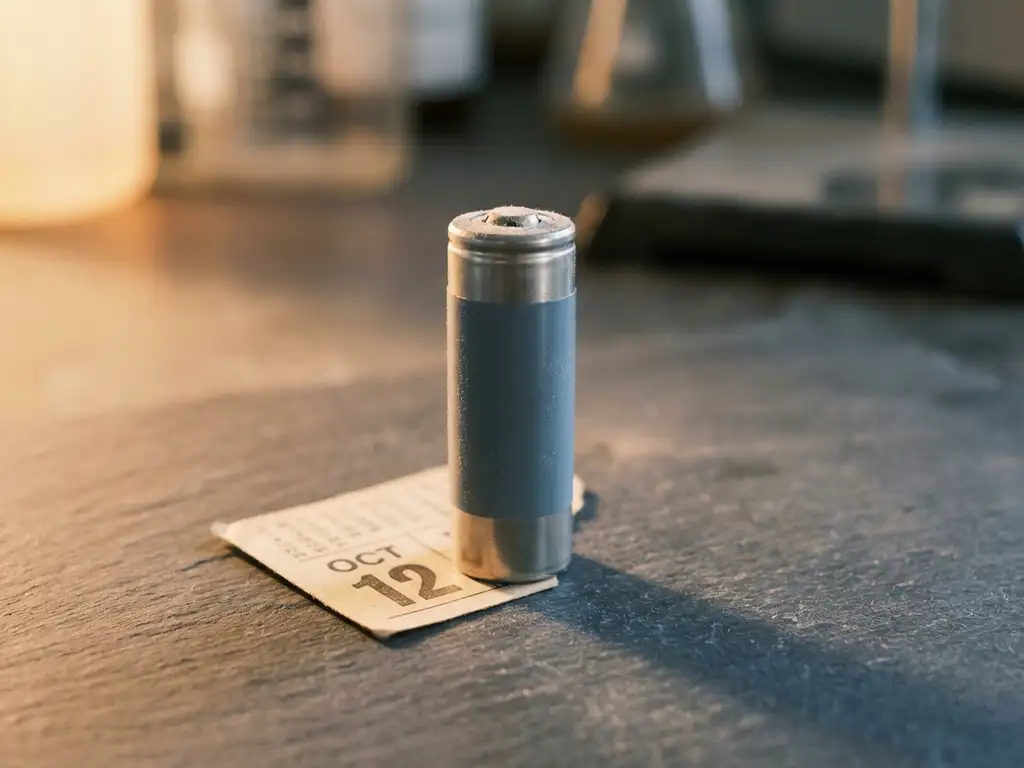
An unused lithium-ion battery does not last indefinitely. Even in storage, electrochemical processes continue at a low level, gradually reducing the battery’s capacity and performance. Understanding the shelf life of a lithium-ion battery is directly relevant to researchers who store electrode materials, fabricate test cells in batches, or need to account for calendar ageing in their experimental designs.
This article addresses the key questions surrounding lithium-ion battery storage life, degradation mechanisms, and measurement approaches—with a focus on what matters most to battery materials researchers working in laboratory settings.
Why do lithium-ion batteries degrade even when not in use?
Lithium-ion batteries degrade during storage because electrochemical and chemical reactions continue even without an applied current. The primary mechanism is parasitic electrolyte decomposition at the electrode–electrolyte interface, particularly at the anode. The solid electrolyte interphase (SEI) layer, which forms on the anode surface during initial cycling, is not fully stable and continues to grow slowly over time, consuming cyclable lithium and increasing internal resistance.
Self-discharge is a closely related phenomenon. Even without an external circuit, lithium ions migrate slowly through the electrolyte, and minor redox reactions occur at both electrodes. These reactions are thermally activated, meaning they proceed faster at elevated temperatures. Over months or years, the cumulative effect of SEI growth, electrolyte oxidation at the cathode, and lithium plating under certain conditions results in measurable capacity loss and impedance rise—even in a cell that has never been cycled.
The role of the electrolyte
The liquid electrolyte in conventional lithium-ion cells is thermodynamically unstable against both the anode and the cathode at the voltages typically used. This instability is managed kinetically by the SEI layer, but the layer itself is a product of electrolyte decomposition. Solvents such as ethylene carbonate and dimethyl carbonate continue to react slowly at the anode surface, and lithium hexafluorophosphate (LiPF6) salt can decompose to produce hydrofluoric acid, which attacks both the SEI and the cathode structure over time.
What factors affect the shelf life of a lithium-ion battery?
The shelf life of a lithium-ion battery is affected primarily by storage temperature, state of charge (SoC) during storage, electrolyte composition, and electrode chemistry. Each of these variables influences the rate of parasitic reactions and, therefore, the rate of capacity fade and impedance growth during calendar ageing.
- State of charge: Storing a cell at high SoC accelerates cathode degradation and electrolyte oxidation. Storing at very low SoC risks lithium plating and deep discharge of the anode. A moderate SoC is generally preferred for long-term storage.
- Electrode chemistry: Cathode materials differ significantly in their stability. Layered oxides such as NMC and NCA are more reactive than olivine-type LFP and therefore show greater calendar-ageing losses under equivalent conditions.
- Electrolyte formulation: Additives such as vinylene carbonate (VC) or fluoroethylene carbonate (FEC) are known to improve SEI stability and reduce ongoing decomposition during storage.
- Cell design and sealing quality: Moisture ingress through a compromised seal accelerates electrolyte degradation and can trigger additional parasitic reactions.
- Storage duration: Calendar-ageing losses are not linear over time; they often follow a square-root dependence, reflecting diffusion-limited SEI growth.
What is the best way to store a lithium-ion battery long-term?
The best way to store a lithium-ion battery long-term is at a moderate state of charge (typically 30 to 50% SoC), in a cool, dry environment, away from direct light and humidity. These conditions minimise the rate of parasitic electrochemical reactions and slow SEI growth at the anode.
For researchers storing fabricated test cells or electrode assemblies, additional considerations apply. Cells should be sealed under an inert atmosphere where possible to prevent moisture and oxygen ingress. If cells are stored in a discharged state for extended periods, periodic recharging to a low SoC can help prevent copper current collector dissolution at the anode, which occurs at very low potentials. Labelling cells with their fabrication date and initial open-circuit voltage provides useful reference data for later comparison.
Practical storage guidelines for laboratory cells
- Store at 30 to 50% SoC to balance anode and cathode stability.
- Use a temperature-controlled environment; avoid fluctuations.
- Maintain dry conditions; use desiccant or sealed containers where appropriate.
- Record the open-circuit voltage at the start of storage to track self-discharge over time.
- Avoid stacking cells under mechanical pressure unless the cell design requires it.
How does storage temperature affect lithium-ion battery shelf life?
Storage temperature has a strong influence on lithium-ion battery shelf life because the rate of parasitic reactions increases exponentially with temperature, following Arrhenius-type kinetics. Cells stored at elevated temperatures degrade significantly faster than those stored at room temperature or below, even when all other conditions are identical.
At temperatures above approximately 40°C, electrolyte decomposition and SEI growth accelerate substantially, leading to faster capacity fade and resistance increase. At very low temperatures, below approximately 0°C, degradation reactions slow considerably, which can extend storage life. However, very low temperatures can also cause electrolyte conductivity to drop and, in some formulations, partial electrolyte solidification. For most laboratory purposes, storage between 15°C and 25°C represents a practical compromise that slows ageing without introducing low-temperature complications.
Researchers conducting calendar ageing studies often use elevated storage temperatures deliberately to accelerate degradation and generate data within a reasonable experimental timeframe. This approach requires careful modelling to extrapolate accelerated ageing results to real-world conditions, as the relative contributions of different degradation mechanisms can shift with temperature.
How can researchers accurately measure battery degradation during storage?
Researchers can accurately measure battery degradation during storage by tracking capacity retention, open-circuit voltage decay, and impedance evolution over time. Periodic characterisation using galvanostatic cycling and electrochemical impedance spectroscopy (EIS) provides quantitative data on both capacity loss and changes in internal resistance, allowing degradation mechanisms to be identified and separated.
A robust calendar ageing protocol typically includes the following measurement steps at defined intervals:
- Record the open-circuit voltage to quantify self-discharge.
- Perform a reference performance test (RPT) at a low C-rate to measure remaining specific capacity (mAh/g or mAh/cm²).
- Acquire EIS spectra to resolve changes in SEI resistance, charge-transfer resistance, and diffusion behaviour.
- Return the cell to the target SoC and continue storage.
Incremental capacity analysis (ICA) and differential voltage analysis (DVA) applied to the RPT data can reveal shifts in electrode stoichiometry and the relative contributions of loss of lithium inventory versus loss of active material. For studies requiring dimensional data, tracking electrode thickness changes during storage using a dilatometer adds a further layer of mechanistic insight, as SEI growth and gas evolution both produce measurable volume changes.
The importance of cell reproducibility in storage studies
Calendar ageing studies require high cell-to-cell reproducibility to produce statistically meaningful results. Variability in electrode coating thickness, electrolyte volume, and cell assembly conditions introduces scatter that can obscure genuine degradation trends. Standardised test cells with well-defined geometry and controlled assembly conditions are therefore essential for this type of research.
How EL-Cell GmbH supports lithium-ion battery storage and degradation research
Accurate calendar ageing and storage degradation studies depend on test cells that deliver consistent, reproducible results across multiple samples and measurement intervals. EL-Cell GmbH designs and manufactures electrochemical test cells and instruments specifically for this type of rigorous battery materials research. Our products address the practical and technical requirements of degradation studies directly:
- The PAT series test cells provide standardised, reproducible cell geometry with controlled electrolyte volume and reliable sealing, reducing assembly variability that would otherwise obscure calendar-ageing data.
- The ECD-4-nano electrochemical dilatometer measures electrode thickness changes with a resolution better than 5 nanometres, enabling direct detection of SEI growth and gas evolution during storage intervals.
- The PAT-Tester-i-16 integrates galvanostatic cycling, potentiostat/galvanostat (PStat/GStat) functionality, and electrochemical impedance spectroscopy (EIS) in a single instrument with temperature-controlled cell housing, supporting complete reference performance test protocols without requiring multiple instruments.
- Our EL-Software enables structured test sequences, including periodic RPT routines, to be defined and executed automatically across all channels.
If you are designing a calendar ageing study or need standardised test cells for long-term storage experiments, contact EL-Cell GmbH to discuss your experimental requirements.
Comments are closed.