


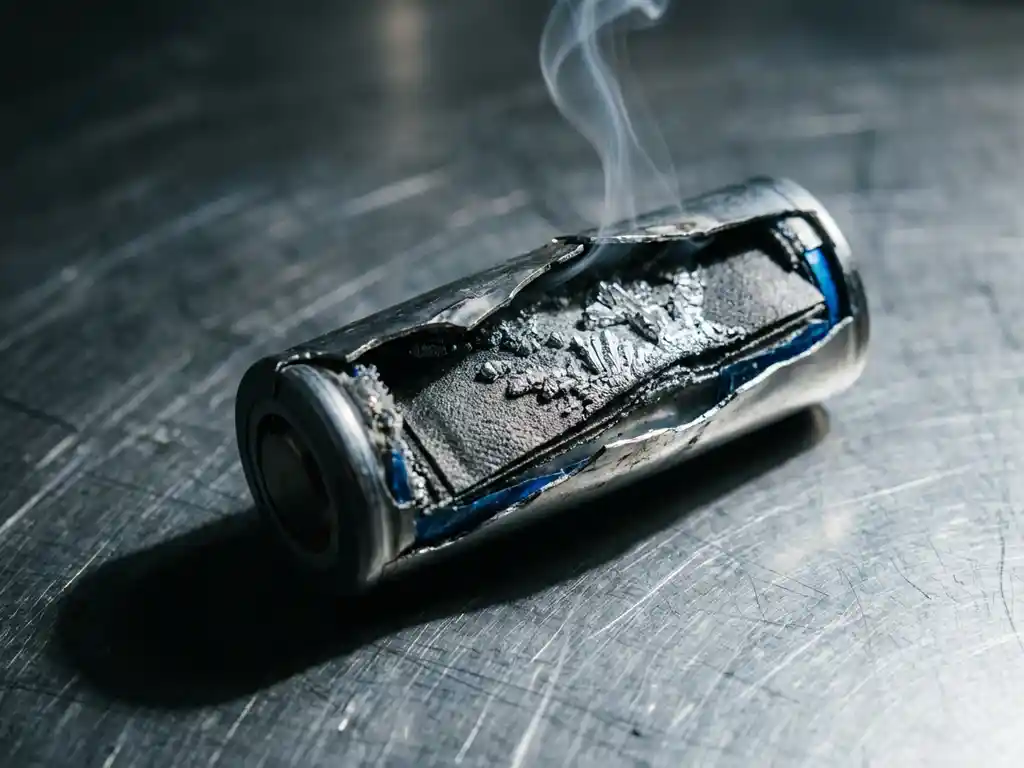
Lithium plating is one of the most studied degradation mechanisms in lithium-ion battery research—and for good reason. It sits at the intersection of battery safety and performance, making it a critical concern for anyone working on anode materials, electrolyte formulations, or fast-charging protocols in the lab.
Understanding what lithium plating is, why it occurs, and how to detect and prevent it is essential for producing reliable, publishable results. This article addresses each of those questions in turn.
What is lithium plating in a battery?
Lithium plating is the deposition of metallic lithium on the surface of the anode, rather than its intended intercalation into the anode host material. During charging of a lithium-ion cell, lithium ions should insert into the graphite lattice. When conditions prevent this, lithium instead is reduced and deposits as a metallic layer on the anode surface.
This metallic lithium deposit is chemically distinct from intercalated lithium. It is highly reactive, partially electrically isolated from the electrode, and can take several morphological forms depending on local conditions. The most concerning of these is the growth of lithium dendrites: needle-like or filamentary metallic structures that extend outward from the anode surface into the electrolyte. Dendrite formation is not merely a performance issue; it carries direct safety implications, making lithium plating one of the most actively studied failure modes in battery research.
Why does lithium plating happen in the first place?
Lithium plating occurs when the electrochemical potential at the anode surface drops below 0 V vs. Li/Li+, making lithium deposition thermodynamically favourable over intercalation. This condition arises when lithium ions arrive at the anode faster than they can be inserted into the host structure.
Several factors drive this imbalance:
- High C-rate charging: At elevated charge rates, the flux of lithium ions to the anode surface exceeds the intercalation kinetics of graphite, increasing the local overpotential and pushing the anode potential below 0 V vs. Li/Li+.
- Low temperature: Lower temperatures slow lithium-ion diffusion both in the electrolyte and within the graphite particles, making plating more likely even at moderate C-rates.
- Electrolyte limitations: Poor ionic conductivity or inadequate wetting of the electrode restricts ion transport and raises the concentration overpotential at the anode.
- Electrode design: Thick electrodes, high areal loading (mAh/cm²), or non-uniform current distribution across the electrode surface create local regions where the anode potential drops below the plating threshold.
- State of charge: A fully or nearly fully charged graphite anode has limited remaining intercalation capacity, reducing the driving force for insertion and increasing plating risk.
In practice, lithium plating is rarely caused by a single factor in isolation. It typically results from the combined effects of several of these conditions, which is why researchers study it across a range of controlled experimental variables.
Why is lithium plating dangerous for battery safety?
Lithium plating poses a direct safety risk because metallic lithium deposits, particularly lithium dendrites, can grow through the separator and create an internal short circuit between the anode and cathode. An internal short circuit releases energy rapidly and can trigger thermal runaway, a self-sustaining exothermic reaction that can lead to fire or explosion.
Beyond the dendrite short-circuit risk, plated lithium that becomes electrically disconnected from the electrode forms what is known as dead lithium. Dead lithium does not contribute to the cell’s capacity but does react with the electrolyte, generating heat and irreversibly consuming electrolyte. The solid electrolyte interphase (SEI) layer, which forms on the anode during the first charge cycles, is disrupted by repeated plating events. Each disruption exposes fresh metallic lithium to the electrolyte, accelerating electrolyte decomposition and gas generation.
These safety concerns are amplified in cells with solid or thin electrolytes, where mechanical penetration by dendrites is a particularly active area of research, and in fast-charging applications, where plating risk is inherently elevated.
How does lithium plating affect battery performance?
Lithium plating degrades battery performance through several interconnected mechanisms, all of which reduce the usable capacity and cycle life of the cell. The primary performance impact is the loss of active lithium: plated lithium that becomes dead lithium is no longer available for cycling, which directly reduces the specific capacity (mAh/g) of the cell.
The performance consequences include:
- Reduced coulombic efficiency: Each cycle in which plating occurs results in lithium that is not recovered on discharge, lowering coulombic efficiency and accelerating capacity fade.
- Increased internal resistance: SEI disruption and electrolyte decomposition increase the impedance of the cell, which can be measured by electrochemical impedance spectroscopy (EIS).
- Accelerated capacity fade: The cumulative loss of active lithium and electrolyte over repeated cycles significantly shortens the functional cycle life of the cell.
- Voltage artefacts: In some cases, the stripping of plated lithium during discharge produces a characteristic voltage plateau, which researchers use as a diagnostic indicator of prior plating events.
These performance effects make lithium plating particularly problematic for research on fast-charging protocols, where the trade-off between charge speed and cycle life must be carefully characterised using well-controlled test conditions.
How can lithium plating be detected and studied in the lab?
Lithium plating can be detected through a combination of electrochemical measurements, physical characterisation techniques, and in situ monitoring methods. No single technique provides a complete picture, so researchers typically combine several approaches.
Electrochemical detection methods
The most accessible detection method is analysis of the discharge voltage profile. A voltage plateau at approximately 0 V vs. Li/Li+ during the early stages of discharge is associated with the stripping of plated lithium. Tracking coulombic efficiency over cycles also reveals plating indirectly: a sustained drop in efficiency suggests irreversible lithium loss consistent with plating and dead-lithium formation.
EIS is widely used to track changes in SEI resistance and charge-transfer resistance that accompany repeated plating events. An increase in these impedance components over cycling is a strong indicator that plating-related degradation is occurring.
Physical and in situ characterisation
Post-mortem analysis by scanning electron microscopy (SEM) or optical microscopy allows direct visualisation of metallic lithium deposits and dendrite morphology on disassembled electrodes. However, this approach is destructive and captures only a snapshot of the electrode state at one point in time.
In situ methods offer a more dynamic view. Electrochemical dilatometry tracks the thickness change of the electrode during cycling; lithium plating produces a characteristic swelling signature that differs from the volume change associated with normal intercalation. Optical in situ cells allow visual observation of dendrite nucleation and growth in real time, which is particularly valuable for studying plating in novel electrolyte systems or with lithium-metal anodes.
How can lithium plating be prevented or minimised?
Lithium plating can be minimised by controlling the conditions that drive the anode potential below 0 V vs. Li/Li+. In practice, this means managing C-rate, temperature, electrode design, and electrolyte properties simultaneously.
Key mitigation strategies include:
- Limiting charge rate: Reducing the C-rate during charging gives lithium ions more time to intercalate, keeping the anode potential above the plating threshold.
- Temperature control: Maintaining the cell within an appropriate temperature range improves electrolyte conductivity and ion-diffusion kinetics, both of which reduce plating risk.
- Electrode optimisation: Reducing electrode thickness or areal loading, improving particle size distribution, and ensuring uniform current density across the electrode surface all lower local overpotentials.
- Electrolyte formulation: Additives that improve SEI stability or enhance ionic conductivity can reduce the overpotential at which plating initiates.
- Anode material selection: Silicon-containing anodes or prelithiation strategies can alter the intercalation kinetics and capacity balance in ways that reduce plating susceptibility.
- Charging protocol design: Pulse charging or multi-step constant-current protocols can reduce the peak current density at the anode surface compared with standard constant-current charging.
For researchers, isolating the contribution of each factor requires well-controlled experimental conditions and reproducible test hardware. Variability introduced by the test cell itself can obscure the effects of the variable under study, making hardware selection a non-trivial consideration in plating research.
How EL-Cell GmbH supports lithium plating research
Studying lithium plating rigorously requires test hardware that introduces minimal experimental artefacts and supports a range of characterisation techniques. EL-Cell GmbH designs and manufactures electrochemical test cells and instruments specifically for this type of research.
Our product range addresses the key requirements of lithium plating studies directly:
- The ECD-4-nano electrochemical dilatometer measures electrode thickness changes with a resolution of better than 5 nm, enabling precise detection of the volume changes associated with lithium plating and stripping events during cycling.
- The ECC-Opto-10 optical in situ cell allows visual observation of the anode surface during electrochemical cycling, supporting real-time imaging of dendrite nucleation and growth.
- The PAT-Tester-i-16 provides up to 16 independent test channels with galvanostatic and potentiostatic control, a temperature-controlled cell chamber, and integrated EIS capability, enabling systematic study of plating across multiple conditions in parallel.
- The PAT-Cell and PAT-Cell-Force provide standardised, reproducible half-cell and full-cell formats compatible with a range of anode materials and electrolyte systems relevant to plating research.
If you are designing experiments around lithium plating detection, prevention, or characterisation, contact EL-Cell GmbH to discuss which combination of test cells and instrumentation best fits your experimental requirements.
Comments are closed.