


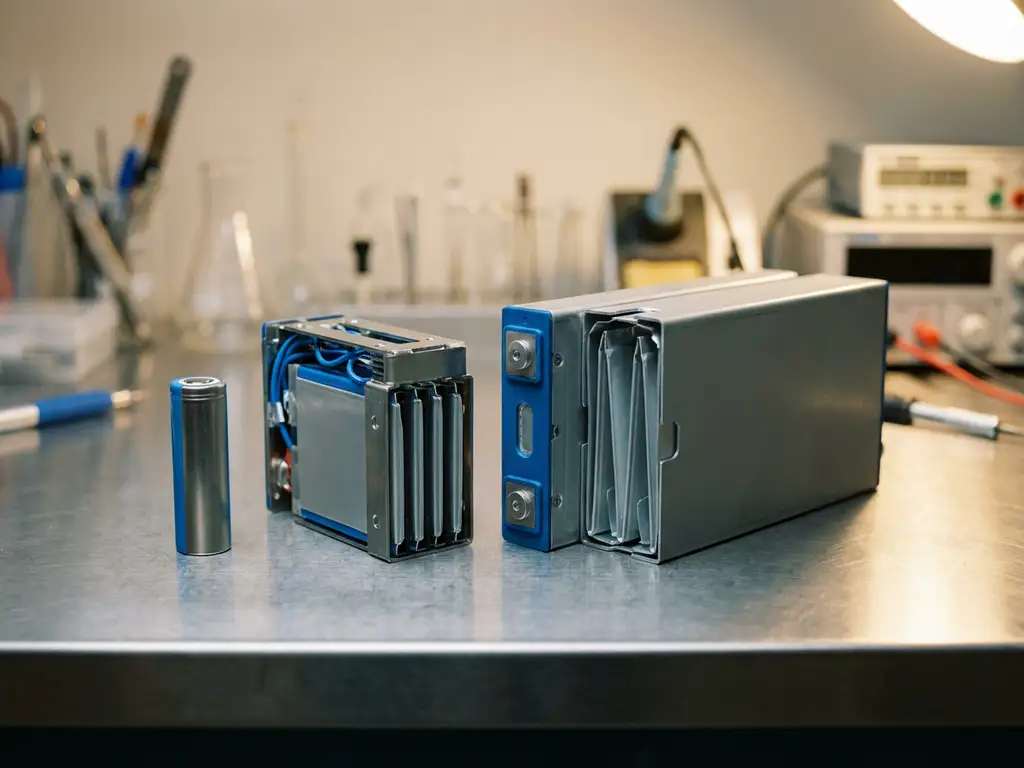
A battery cell, module, and pack are three distinct levels of organisation in a battery system. A battery cell is the fundamental electrochemical unit; a battery module is an assembly of grouped cells; and a battery pack is a complete, integrated system of modules. Understanding how these three levels relate is essential for anyone working in battery materials research, cell design, or electrochemical characterisation.
For researchers focused on electrode materials, electrolytes, or cell architecture, the distinction between these three levels determines where experimental work fits within the broader development pipeline. What happens at the cell level directly constrains what is achievable at the module and pack levels.
What is a battery cell and how does it work?
A battery cell is the smallest self-contained electrochemical unit capable of storing and releasing electrical energy. It consists of a positive electrode (cathode), a negative electrode (anode), a separator, and an electrolyte housed within a single enclosure. During discharge, oxidation occurs at the anode and reduction occurs at the cathode, driving electrons through an external circuit.
The electrochemical reactions within a cell are governed by the thermodynamic properties of the electrode materials. The cell voltage is determined by the difference in electrochemical potential between the two electrodes. Practical cell performance is further shaped by kinetic factors such as overpotential, the ionic conductivity of the electrolyte, and the formation of the solid electrolyte interphase (SEI) layer on the anode during early charge cycles.
Cells are manufactured in several form factors, including cylindrical, prismatic, and pouch configurations. Each format carries different implications for thermal management, mechanical stress, and volumetric energy density. In research settings, laboratory-scale test cells replicate the core electrochemistry of these formats under controlled conditions, enabling systematic study of individual cell components.
What is a battery module and what does it contain?
A battery module is an intermediate assembly comprising multiple individual cells connected in series, in parallel, or in a combination of both. The module integrates cells with mechanical housing, electrical interconnects, and often thermal management components. Its purpose is to aggregate cell-level energy and power into a unit that can be handled, monitored, and replaced as a single entity.
Within a module, cell-to-cell variation becomes a critical engineering concern. Even small differences in capacity, internal resistance, or coulombic efficiency between cells can lead to imbalances during cycling. Battery management electronics are often incorporated at the module level to monitor individual cell voltages and temperatures and to balance charge distribution across the assembly.
The mechanical design of a module must also accommodate dimensional changes in the cells during cycling. Electrode materials expand and contract as lithium ions intercalate and deintercalate, generating mechanical stress that accumulates across the module structure. This is one reason why electrode strain, measured at the cell level, is directly relevant to module engineering.
What is a battery pack and how is it structured?
A battery pack is the highest level of integration in a battery system. It consists of multiple modules arranged within a structural enclosure, combined with a battery management system (BMS), thermal management hardware, safety mechanisms, and external electrical interfaces. The pack is the unit that interfaces with the end application, whether that is an electric vehicle (EV) drivetrain, a grid storage system, or an industrial device.
The architecture of an EV battery pack, for example, is designed to meet specific energy density (Wh/kg), power density, thermal stability, and safety requirements simultaneously. The BMS monitors state of charge, state of health, and cell temperatures in real time, adjusting charge and discharge rates to protect the cells from operating outside safe limits.
Pack-level performance is ultimately constrained by the properties of the individual cells within it. Degradation mechanisms that originate at the electrode–electrolyte interface—such as SEI growth, lithium plating, or particle cracking—propagate upward through the module and pack hierarchy, reducing capacity and increasing internal resistance over time.
What’s the difference between a battery cell, module, and pack?
The key distinction lies in the level of integration and function. A battery cell is the electrochemical unit where energy conversion occurs. A battery module groups cells into a mechanically and electrically managed assembly. A battery pack integrates modules into a complete system with thermal control, safety hardware, and a BMS. Each level builds on the one below it.
- Battery cell: Single electrochemical unit; defined by electrode chemistry, electrolyte, and form factor; characterised by voltage, specific capacity (mAh/g or mAh/cm²), and coulombic efficiency.
- Battery module: Assembly of cells in series or parallel; adds mechanical structure, electrical interconnects, and cell-level monitoring; performance limited by the weakest cell in the assembly.
- Battery pack: System-level integration of modules; includes a BMS, thermal management, and safety systems; defines the energy and power output available to the application.
In practical terms, the distinction matters because problems at one level cannot always be corrected at a higher level. A cell with poor cycling stability or high capacity fade will degrade module and pack performance regardless of how well the higher-level engineering is executed.
Why does the cell-module-pack hierarchy matter in battery research?
The cell-module-pack hierarchy matters in battery research because the fundamental electrochemical properties established at the cell level set hard limits on what is achievable at the module and pack levels. Researchers working on electrode materials, electrolytes, or cell design directly influence the performance ceiling of every system built from those cells.
Understanding this hierarchy also clarifies the scope and relevance of laboratory-scale experiments. A researcher measuring specific capacity or cycling stability in a half-cell is generating data that will eventually inform full-cell design, module architecture, and pack-level energy density targets. The translation from laboratory measurements to application performance depends on how accurately the test cell replicates the conditions of a real cell.
This is why reproducibility and standardisation in cell-level testing are not merely methodological preferences—they are prerequisites for data that can be meaningfully compared, published, and applied. Variability introduced by inconsistent cell assembly, poorly controlled electrode loading, or non-standardised test hardware obscures the true electrochemical behaviour of the materials under study.
How are battery cells tested before assembly into modules?
Battery cells are tested before module assembly through a series of electrochemical protocols designed to characterise their capacity, rate capability, cycling stability, and internal resistance. These tests are conducted at the cell level to identify performance outliers and to verify that cells meet the specifications required for matched assembly into modules.
Standard electrochemical characterisation methods
The most common cell-level tests include:
- Galvanostatic cycling: Charging and discharging at defined C-rates to measure specific capacity and coulombic efficiency over repeated cycles.
- Rate capability testing: Cycling at progressively higher C-rates to assess how capacity and overpotential respond to increasing current demand.
- Electrochemical impedance spectroscopy (EIS): Applying a small AC perturbation across a range of frequencies to resolve contributions from the electrolyte, the SEI layer, charge-transfer resistance, and solid-state diffusion.
- Open-circuit voltage (OCV) measurements: Monitoring voltage relaxation to assess thermodynamic equilibrium and identify self-discharge behaviour.
Mechanical and dimensional characterisation
Beyond electrochemical measurements, dimensional changes in electrodes during cycling are increasingly characterised before module assembly. Electrode expansion and contraction, quantified through dilatometry, provide direct insight into the mechanical stress a cell will impose on its module housing during operation. These data inform the mechanical design of the module and help predict long-term structural integrity.
In research settings, these same characterisation methods are applied to evaluate new electrode materials and electrolyte formulations before they are considered for scale-up. The accuracy and reproducibility of the test hardware used at this stage directly determine the reliability of the conclusions drawn.
How EL-Cell GmbH supports battery cell characterisation research
EL-Cell GmbH designs and manufactures electrochemical test equipment specifically for researchers working at the cell level—the stage at which electrode materials, electrolytes, and cell architectures are characterised before any consideration of module or pack integration. Our instruments are built to provide the reproducibility and measurement precision that publishable, peer-reviewed research requires.
Our product range addresses the full scope of cell-level characterisation described in this article:
- Standardised test cells: The PAT-Cell provides a laboratory-scale format with controlled geometry and consistent stack pressure, enabling reproducible galvanostatic cycling, EIS, and rate-capability measurements across different electrode materials.
- Electrode strain measurement: The ECD-4-nano electrochemical dilatometer quantifies electrode thickness changes during cycling with a resolution better than 5 nm, providing the mechanical characterisation data needed to understand how electrode expansion will affect module design.
- Integrated testing platforms: The PAT-Tester-i-16 combines a 16-channel battery tester, a temperature-controlled cell chamber, and EIS capability in a single instrument, supporting systematic characterisation of multiple cells under identical conditions.
- Specialised cell formats: The PAT-Cell series includes variants for gas analysis (PAT-Cell-Gas), force measurement (PAT-Cell-Force), and solid-state research (PAT-Cell-Solid), allowing researchers to extend standard electrochemical measurements to address specific material and design questions.
If you are developing electrode materials or electrolyte formulations and require test equipment that delivers consistent, comparable results, contact EL-Cell GmbH to discuss which cell format and characterisation platform is appropriate for your experimental requirements.
Comments are closed.