


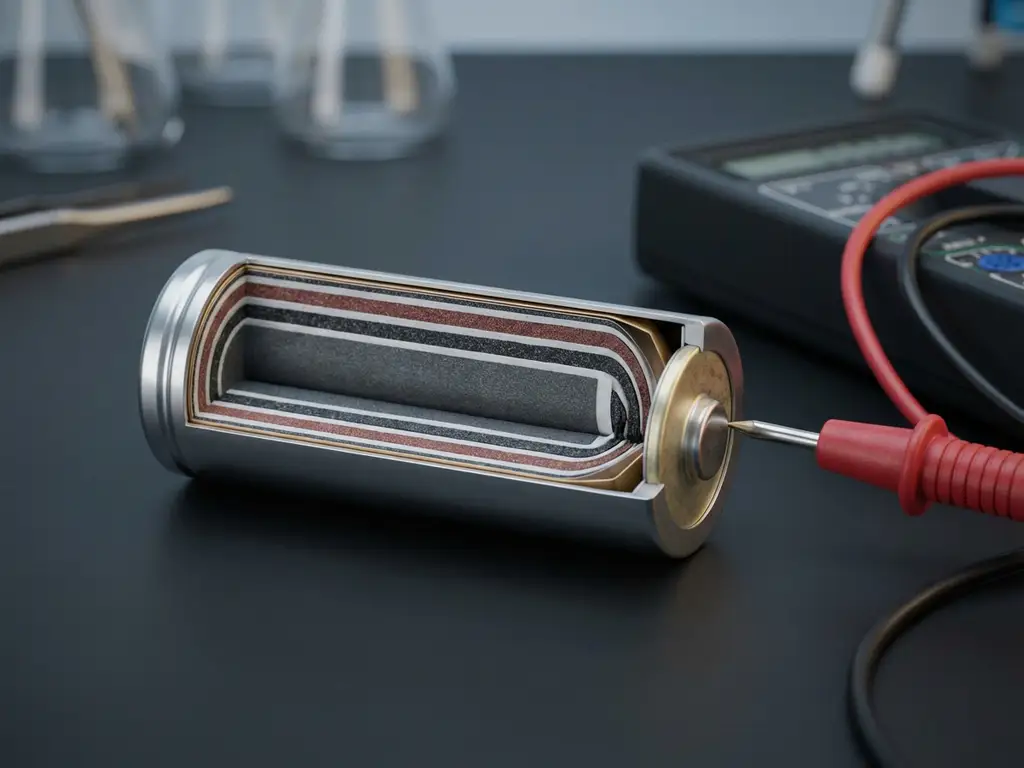
The internal resistance of a lithium-ion battery is a fundamental parameter in battery research, directly influencing how a cell performs under real operating conditions. Understanding its origins, how it is measured, and what it reveals about electrode and electrolyte behaviour is essential for anyone working on battery materials development or cell characterisation.
What is the internal resistance of a lithium-ion battery?
The internal resistance of a lithium-ion battery is the total opposition to current flow within the cell, arising from the combined resistances of the electrodes, electrolyte, separator, and contact interfaces. It is typically expressed in ohms (Ω) or milliohms (mΩ) and represents energy lost as heat during charge and discharge cycles.
Internal resistance is not a single, fixed material property. It is a composite parameter that changes with state of charge, temperature, cycling history, and cell design. In a research context, distinguishing the individual contributions to total internal resistance is often more informative than measuring a single aggregate value.
What causes internal resistance in a lithium-ion battery?
Internal resistance in a lithium-ion battery arises from several distinct physical and chemical sources operating simultaneously within the cell. Each component of the cell contributes a measurable resistance, and these contributions sum to produce the total observed value.
Ohmic contributions
The electrolyte, current collectors, electrode bulk material, and all contact resistances between layers contribute to ohmic resistance. This component responds instantaneously to an applied current or voltage step. In liquid-electrolyte cells, the ionic conductivity of the electrolyte is a primary determinant of this value.
Interfacial and kinetic contributions
The solid electrolyte interphase (SEI) layer that forms on the anode surface during the first charge cycles introduces significant interfacial resistance. Charge-transfer resistance at both electrodes, which reflects the kinetics of the lithium intercalation reaction, also contributes. These components are frequency-dependent and are best resolved using electrochemical impedance spectroscopy (EIS).
Diffusion-related contributions
At longer timescales, solid-state diffusion of lithium ions within the active material particles limits the rate at which charge can be stored or released. This diffusion impedance appears at low frequencies in an EIS spectrum and becomes increasingly significant at high C-rates.
How does internal resistance affect battery performance?
Higher internal resistance directly reduces the energy available from a cell during discharge and increases heat generation under load. The voltage drop across the internal resistance under current is given by Ohm’s law, meaning that a cell with elevated resistance delivers a lower terminal voltage than its open-circuit voltage, reducing usable capacity at a given cut-off voltage.
In research settings, changes in internal resistance over cycling are a sensitive indicator of degradation mechanisms. An increase in charge-transfer resistance may signal SEI growth or particle cracking, while a rise in ohmic resistance often points to current-collector corrosion or contact degradation. Tracking these changes allows researchers to identify failure modes at the materials level rather than inferring them from capacity fade alone.
How is internal resistance measured in a laboratory?
Internal resistance in a laboratory setting is measured using two principal methods: direct-current (DC) pulse techniques and electrochemical impedance spectroscopy (EIS). Each method captures different aspects of the total resistance and is suited to different research questions.
- DC pulse method: A short current pulse is applied, and the instantaneous voltage response is used to calculate resistance via Ohm’s law. This approach captures primarily the ohmic component and is fast and straightforward to implement.
- Electrochemical impedance spectroscopy (EIS): A small sinusoidal perturbation is applied across a range of frequencies, and the complex impedance response is recorded. The resulting Nyquist or Bode plot allows separation of ohmic resistance, charge-transfer resistance, SEI resistance, and diffusion impedance into distinct contributions.
EIS is the preferred technique in battery materials research because it provides mechanistic detail that DC methods cannot resolve. Measurements should be conducted at a well-defined state of charge and temperature, as both variables significantly affect the impedance spectrum.
What’s the difference between ohmic resistance and impedance in a battery?
Ohmic resistance is the purely resistive, frequency-independent component of a battery’s total opposition to current flow, representing instantaneous energy dissipation. Impedance is the broader, frequency-dependent quantity that encompasses ohmic resistance, capacitive elements, inductive elements, and diffusion processes—all of which vary with the frequency of the applied signal.
In practice, ohmic resistance appears as the real-axis intercept of a Nyquist plot at high frequencies. The full impedance spectrum extends across many decades of frequency, revealing semicircles associated with charge-transfer and SEI processes at intermediate frequencies, and Warburg-type diffusion tails at low frequencies. Reducing battery performance to a single ohmic resistance value discards the mechanistic information that impedance analysis provides, which is why EIS has become a standard characterisation technique in battery research.
What factors influence internal resistance measurements in research cells?
Internal resistance measurements in research cells are sensitive to a range of experimental variables, and controlling these is essential for obtaining reproducible, comparable results across experiments and between laboratories.
- Temperature: Ionic conductivity in the electrolyte and charge-transfer kinetics at the electrodes are both strongly temperature-dependent. Measurements should be performed at a controlled, recorded temperature.
- State of charge (SoC): Impedance spectra change significantly across the SoC window. Comparing measurements at different SoC values without accounting for this introduces systematic error.
- Cell geometry and stack pressure: In research cells, contact resistance between layers depends on the applied stack pressure. Inconsistent pressure leads to variability in the ohmic resistance component.
- Electrode preparation: Electrode thickness, porosity, and active material loading all affect both ionic and electronic transport within the electrode, and therefore the measured impedance.
- Electrolyte volume and wetting: Insufficient electrolyte or incomplete wetting of the electrode and separator introduces additional interfacial resistance that is not intrinsic to the materials under study.
- Measurement frequency range and perturbation amplitude: The frequency range selected for EIS must be appropriate to resolve all relevant processes. The perturbation amplitude should be small enough to remain within the linear-response regime of the cell.
Standardising these variables within a research programme is as important as the measurement technique itself. Poorly controlled experimental conditions are a common source of irreproducible impedance data in battery research.
How EL-Cell GmbH supports internal resistance and impedance measurements
Accurate internal resistance and impedance characterisation depends on well-designed test cells that minimise extraneous contributions to the measured signal. EL-Cell GmbH develops and manufactures electrochemical test cells and measurement instruments specifically for battery materials research, addressing the experimental control requirements described above.
- The PAT-Cell provides reproducible stack pressure and defined electrode geometry, reducing contact resistance variability between experiments and enabling consistent EIS measurements across a research programme.
- The PAT-Tester-x-8 integrates a fully featured potentiostat/galvanostat with EIS capability and a temperature-controlled cell chamber, allowing impedance measurements to be performed under defined thermal conditions without additional equipment.
- The ECD-5-nano electrochemical dilatometer can be operated alongside impedance measurements, enabling simultaneous tracking of electrode thickness changes and resistance evolution during cycling.
If your research requires reproducible impedance data from well-controlled research cells, contact EL-Cell GmbH to discuss which test cell configuration and measurement system best suits your experimental needs.
Comments are closed.