


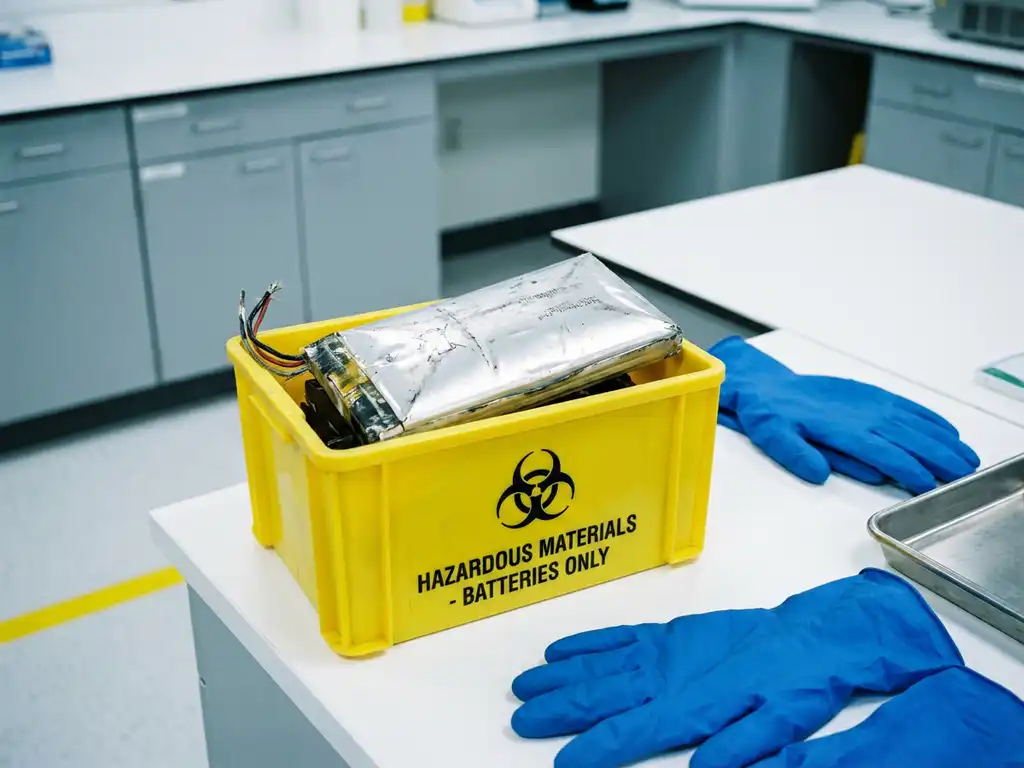
Lithium-ion battery disposal is a regulated process, not a matter of convenience. Whether you work with commercial cells or laboratory-grade test materials, improper disposal of lithium-ion batteries poses genuine chemical, fire, and environmental hazards. This article addresses the key questions researchers and lab professionals ask about safe lithium-ion battery disposal and recycling.
Why can’t you throw lithium-ion batteries in the bin?
Lithium-ion batteries cannot be disposed of in general waste because they contain hazardous materials — including lithium salts, flammable organic electrolytes, and heavy metals such as cobalt, nickel, and manganese — that are incompatible with standard landfill conditions. In most countries, disposing of lithium-ion cells in municipal waste is also illegal under waste electrical and electronic equipment (WEEE) and battery regulations.
The physical construction of a lithium-ion cell presents additional risks in the waste stream. Mechanical crushing or puncturing during compaction can trigger internal short circuits, leading to thermal runaway. Thermal runaway releases toxic gases and can ignite fires that are extremely difficult to extinguish. Beyond the immediate safety risk, the heavy metals and fluorinated compounds present in many cells can leach into soil and groundwater if the cells are landfilled without containment.
Regulatory frameworks in the European Union, the United Kingdom, and the United States classify spent lithium-ion batteries as hazardous waste. This means producers, distributors, and end users all carry legal obligations for proper collection and disposal.
What happens to a lithium-ion battery when it’s not properly disposed of?
When a lithium-ion battery is improperly disposed of, it can cause fires, release toxic compounds, and contaminate the environment. The electrolyte — typically a lithium salt dissolved in an organic solvent such as ethylene carbonate or dimethyl carbonate — is both flammable and reactive with water. If a cell is damaged in a landfill or waste facility, these solvents can ignite or react with moisture to produce hydrofluoric acid from fluorinated binder materials.
Over time, a landfilled cell will corrode. As the casing degrades, the cathode materials — lithium cobalt oxide, lithium iron phosphate, or nickel manganese cobalt oxide, depending on the chemistry — leach into the surrounding environment. Cobalt and nickel are toxic to aquatic organisms and accumulate in food chains. Lithium itself, while less acutely toxic, contributes to long-term changes in soil alkalinity.
At waste processing facilities, lithium-ion cells in general waste bins have caused fires in sorting equipment and collection vehicles. These incidents are well documented across the waste management industry and represent a significant operational and safety risk for workers.
Where can you safely drop off lithium-ion batteries for recycling?
Lithium-ion batteries can be dropped off at designated collection points, including electronics retailers, municipal hazardous waste facilities, and manufacturer take-back schemes. In the European Union, the Battery Regulation and the WEEE Directive require retailers above a certain size to accept spent batteries free of charge. In the UK, the Waste Batteries and Accumulators Regulations impose similar obligations.
For researchers working in institutional settings, the correct route is typically through your institution’s waste management or environmental health and safety (EHS) department. Universities and corporate laboratories are classified as industrial or commercial producers of battery waste and must arrange collection through licensed hazardous waste contractors. Placing spent cells in general lab waste or sharps bins does not comply with these regulations.
- Contact your institution’s EHS or waste management office for approved collection procedures
- Use licensed hazardous waste contractors for bulk or commercial quantities
- For small quantities of consumer-format cells, use retailer take-back points or municipal collection sites
- Check national battery regulation databases for approved schemes in your country
How do you prepare a lithium-ion battery for safe disposal?
To prepare a lithium-ion battery for safe disposal, discharge it to as low a state of charge as possible, protect the terminals to prevent short circuits, and store it in a non-conductive, fireproof container until collection. A fully discharged cell presents a significantly lower risk of thermal runaway during handling and transport.
The following steps apply to most lithium-ion cells prior to disposal:
- Discharge the cell to its lower voltage cut-off using a controlled discharge protocol. Do not over-discharge below the minimum voltage, as this can cause copper dissolution from the anode current collector and create internal hazards.
- Insulate the terminals by covering them with non-conductive tape. This prevents accidental short circuits during storage or transport.
- Inspect for physical damage. Swollen, punctured, or leaking cells must be treated as higher-risk items and handled according to your institution’s specific procedures for damaged lithium cells.
- Store in an appropriate container. Use a fireproof battery storage bag or a metal container lined with non-conductive material. Do not stack loose cells without terminal protection.
- Label clearly. Mark containers with the cell chemistry, approximate state of charge, and any known damage. This information is essential for safe handling by waste contractors.
Never attempt to disassemble a lithium-ion cell for disposal unless you have specific training and equipment to do so. Electrolyte exposure is a serious chemical hazard.
What’s the difference between recycling and repurposing a lithium-ion battery?
Recycling involves breaking down a spent lithium-ion battery to recover its constituent materials — metals, plastics, and electrolyte components — for use in new products. Repurposing, sometimes called second-life use, means redeploying a battery that no longer meets its original performance specification in a less demanding application, without disassembly.
Recycling
Recycling processes such as hydrometallurgy and pyrometallurgy recover valuable metals, including lithium, cobalt, nickel, and manganese, from the cathode material, as well as copper and aluminium from current collectors. The recovered materials re-enter the supply chain for new cell manufacturing. Recycling is the end-of-life route for cells that have degraded beyond further use.
Repurposing
Repurposing extends the useful life of a cell pack before it reaches the end of its life. A battery module removed from an electric vehicle because its capacity has fallen below the threshold for automotive use may still retain sufficient capacity for stationary energy storage applications, where energy density requirements are less stringent. This approach reduces the volume of material entering the recycling stream prematurely and retains the embodied energy of manufacturing.
From a research perspective, both pathways are active areas of investigation. Understanding degradation mechanisms — capacity fade, impedance growth, and lithium plating on the anode — is central to determining whether a given cell chemistry and cycling history is suitable for second-life deployment or requires immediate recycling.
How should researchers dispose of lithium-ion test cells used in the lab?
Researchers should dispose of lithium-ion test cells through their institution’s hazardous waste stream, following the same protocols that apply to other chemical and electrochemical waste. Test cells used in battery research often contain experimental materials — novel electrolytes, modified electrode compositions, or reactive lithium metal anodes — that require additional consideration beyond standard lithium-ion disposal procedures.
Several factors specific to laboratory test cells affect the disposal process:
- Lithium metal anodes are reactive with moisture and air. Cells containing lithium metal must be fully discharged and handled under inert conditions where possible. Consult your EHS department for institution-specific procedures.
- Experimental electrolytes may not be covered by standard disposal classifications. Document the composition of any non-commercial electrolyte and communicate it to your waste contractor.
- Partially cycled cells retain stored energy. Discharge to the lower voltage cut-off before disassembly or disposal.
- Solid electrolyte cells may contain ceramic or sulfide-based materials that have their own disposal requirements, separate from liquid electrolyte systems.
Disassembly of test cells for electrode recovery — for post-mortem analysis or material reclamation — should be conducted in a glovebox under an inert atmosphere when lithium metal or air-sensitive cathode materials are involved. Recovered electrode materials should be treated as chemical waste and disposed of accordingly, not placed in general laboratory waste.
How EL-Cell GmbH supports responsible battery research and end-of-life practices
At EL-Cell GmbH, we design test cells for battery materials research with the full experimental lifecycle in mind. Our products are used by researchers who work with a wide range of electrode materials, electrolytes, and cell chemistries — including systems that require careful handling at end of life. Here is how our product ecosystem supports responsible laboratory practice:
- The PAT Series battery test cells are designed for straightforward disassembly, enabling controlled post-mortem analysis and proper separation of electrode materials, electrolyte, and hardware components before disposal.
- The ECD-4-nano electrochemical dilatometer uses small-format electrodes, minimising the volume of experimental material — including potentially hazardous electrode compositions — generated per experiment.
- The PAT-Tester-i-16 allows precise discharge protocols to be programmed, enabling researchers to bring cells to a defined, low state of charge prior to disassembly or disposal.
- Our application notes and technical documentation include guidance on safe cell-handling procedures relevant to the specific chemistries our test cells are designed to accommodate.
If you have questions about handling or disposing of cells used with our equipment, or if you are setting up a new battery research laboratory and need guidance on integrating safe waste procedures into your workflow, contact the EL-Cell GmbH team directly. We are happy to advise on best practices based on the specific chemistries and cell formats you are working with.
Comments are closed.