


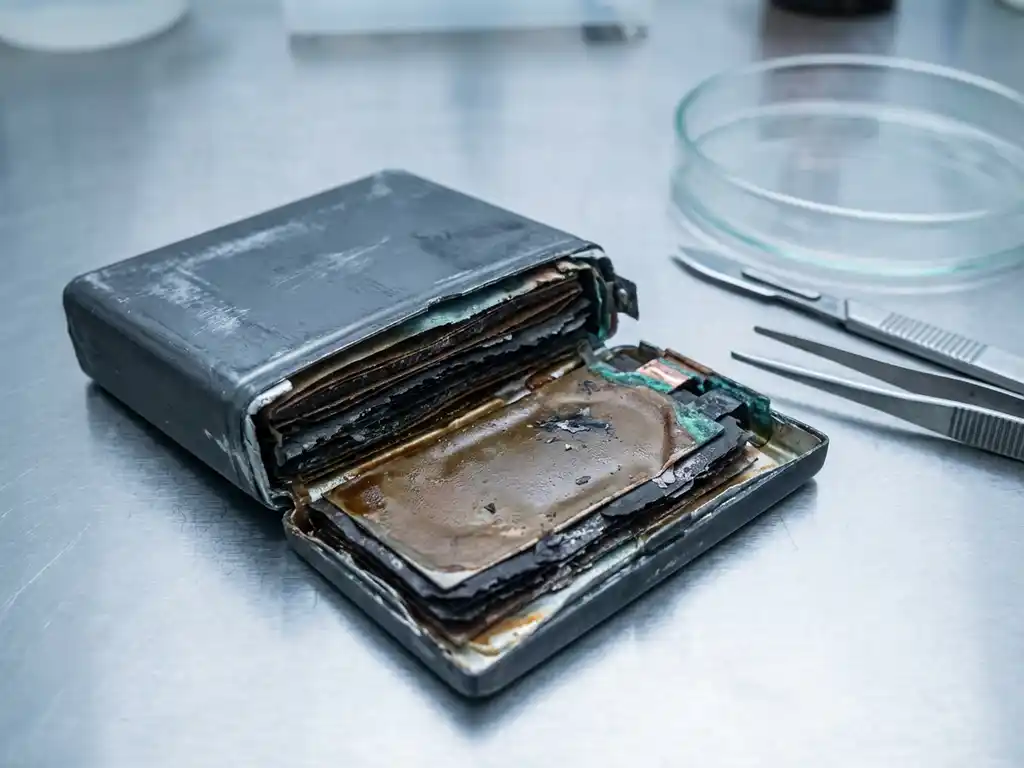
A lithium-ion battery reaches the end of its life when it can no longer deliver sufficient capacity or power to meet the demands of its application. For research purposes, end of life is typically defined by a threshold—commonly 80% of the original capacity—below which the cell is considered degraded. Understanding the mechanisms behind this degradation is central to developing better electrode materials, electrolytes, and cell designs.
For battery materials researchers, end-of-life behaviour is not simply a practical concern but a rich source of scientific information. The processes that drive capacity fade, impedance rise, and eventual failure reflect fundamental electrochemical phenomena that can be studied, quantified, and, in many cases, mitigated through careful materials engineering.
What does ‘end of life’ mean for a lithium-ion battery?
End of life for a lithium-ion battery is the point at which the cell’s performance falls below an application-defined threshold. In research and industry, this is most commonly set at 80% of the initial discharge capacity (measured in mAh/g for electrode-level studies or mAh for full cells). At this point, the cell is considered to have reached the end of its useful cycle life, even if it continues to function at reduced performance.
It is important to distinguish between two modes of end of life: capacity fade and power fade. Capacity fade refers to a reduction in the total charge a cell can store and deliver, while power fade refers to an increase in internal resistance that limits the rate at which energy can be extracted. In practice, both modes often occur simultaneously, and their relative contributions depend on the specific degradation mechanisms active within the cell.
In a research context, end of life is rarely a binary event. Cells are typically cycled under controlled conditions with periodic characterisation to track the progression of degradation. This allows researchers to correlate changes in electrochemical performance with specific physical or chemical changes in the electrode materials or electrolyte.
What causes a lithium-ion battery to degrade over time?
Lithium-ion battery degradation arises from a combination of chemical, mechanical, and structural changes that occur in the electrode materials, electrolyte, and interfaces during cycling. These changes accumulate over time and with use, gradually reducing the cell’s ability to store and deliver charge. No single mechanism operates in isolation; degradation is inherently multifactorial.
Loss of active lithium
One of the primary causes of capacity fade is the irreversible consumption of lithium ions. During the first charge cycle, the electrolyte reacts with the anode surface to form the solid electrolyte interphase (SEI) layer. This consumes lithium that is no longer available for cycling, reducing the total inventory of active lithium in the cell. The SEI layer continues to grow slowly over subsequent cycles, consuming additional lithium and increasing cell impedance.
Loss of active material
Electrode materials can lose electrochemical activity through several routes. On the cathode side, transition-metal dissolution, structural disordering, and phase transformations can reduce the number of sites available for lithium intercalation. On the anode side, particle cracking caused by repeated volume changes during lithiation and delithiation can isolate fragments of active material from the conductive network, rendering them electrochemically inactive.
Electrolyte decomposition
The electrolyte is thermodynamically unstable at the potentials used in lithium-ion cells. Continuous oxidation at the cathode and reduction at the anode consume electrolyte over time, generating gaseous by-products and resistive surface films. This contributes to both impedance rise and capacity fade, particularly at elevated temperatures or high voltages.
What are the signs that a lithium-ion battery is reaching end of life?
The electrochemical signs of end of life in a lithium-ion battery include a measurable reduction in discharge capacity, an increase in internal resistance, changes in the voltage profile during cycling, and a reduction in coulombic efficiency. These indicators can be tracked systematically during long-term cycling experiments.
- Capacity fade: A progressive reduction in the discharge capacity (mAh or mAh/g) relative to the initial value, typically measured at a defined C-rate.
- Impedance rise: An increase in cell resistance, measurable by electrochemical impedance spectroscopy (EIS), reflecting growth of resistive surface films and loss of ionic or electronic conductivity.
- Voltage profile changes: Shifts or flattening of the charge/discharge voltage curves, indicating changes in the thermodynamic behaviour of the electrode materials.
- Reduced coulombic efficiency: A decrease in the ratio of discharge capacity to charge capacity per cycle, reflecting ongoing parasitic reactions that consume lithium or electrolyte.
- Mechanical deformation: Swelling of the cell due to gas generation or irreversible volume changes in the electrode stack, detectable by dilatometric measurements.
In a research setting, these signs are monitored quantitatively using a combination of galvanostatic cycling, EIS, and, where appropriate, in situ techniques such as dilatometry or optical microscopy. Identifying which indicator appears first, and at what rate it progresses, provides valuable mechanistic information about the dominant degradation pathway.
How does temperature affect battery aging and end of life?
Temperature is one of the most significant external factors governing the rate of lithium-ion battery aging. Elevated temperatures accelerate virtually all chemical degradation reactions, including SEI growth, electrolyte decomposition, and transition-metal dissolution, leading to faster capacity fade and shorter cycle life. Low temperatures, conversely, increase electrolyte viscosity and reduce ionic conductivity, promoting lithium plating on the anode during charging.
The relationship between temperature and degradation rate is broadly described by Arrhenius kinetics: reaction rates increase exponentially with temperature. This means that even modest increases in operating or storage temperature can substantially shorten battery lifespan. For researchers studying aging mechanisms, precise temperature control during cycling is therefore essential to obtain reproducible and interpretable results.
Lithium plating at low temperatures deserves particular attention. When the anode cannot accept lithium ions at a sufficient rate due to sluggish kinetics, metallic lithium deposits on the anode surface rather than intercalating into the graphite structure. This deposited lithium can react with the electrolyte, form electrically isolated dead lithium, or, in severe cases, grow as dendrites that risk internal short circuits. Studying the temperature dependence of these failure modes is an active area of battery research.
What happens inside the battery cell as it approaches end of life?
As a lithium-ion cell approaches the end of its life, the cumulative effects of degradation become visible in both the electrochemical response and the physical state of the cell components. The active lithium inventory is reduced, electrode microstructures are altered, and interfacial resistances have grown substantially. These changes interact and can accelerate one another in a process sometimes described as degradation coupling.
At the electrode level, cathode particles may show surface reconstruction, cracking along grain boundaries, or the formation of resistive rock-salt phases at the particle surface. Anode particles, particularly in silicon-containing electrodes, may have undergone significant fragmentation due to the large volume changes associated with lithiation. The SEI layer on the anode is typically thicker and less uniform than in a fresh cell, contributing to higher overpotential during lithium insertion and extraction.
Gas generation within the cell is another consequence of advanced degradation. Electrolyte decomposition and reactions between the electrolyte and electrode materials produce gases such as carbon dioxide and hydrogen, which can cause measurable swelling of the electrode stack. This mechanical deformation further disrupts electrical contact between particles and current collectors, compounding the loss of active material.
In some cells, localised degradation can trigger more abrupt failure modes. Lithium plating, if it has occurred during the cell’s history, can lead to internal short circuits as dendritic structures bridge the separator. This represents a safety-relevant failure mode that is distinct from the gradual capacity fade described above and is an important consideration in the design of accelerated aging protocols.
What can battery researchers do to study end-of-life behavior?
Studying end-of-life behaviour requires a systematic approach that combines long-term cycling under controlled conditions with periodic or continuous diagnostic measurements. The goal is to isolate and quantify the contribution of individual degradation mechanisms to the overall performance loss observed in the cell.
- Controlled cycling protocols: Applying well-defined C-rates, voltage windows, and temperature conditions allows researchers to compare degradation rates across different materials or electrolyte formulations on a consistent basis.
- Electrochemical impedance spectroscopy (EIS): Periodic EIS measurements track changes in interfacial resistances, SEI layer properties, and bulk ionic conductivity as a function of cycle number.
- Incremental capacity analysis (ICA) and differential voltage analysis (DVA): These techniques extract information about phase transitions and active material loss from the shape of the charge/discharge voltage curve without requiring cell disassembly.
- In situ dilatometry: Measuring electrode thickness changes during cycling provides direct information about volume expansion, gas generation, and irreversible mechanical deformation.
- Post-mortem analysis: Disassembling cells after defined cycle intervals and characterising the electrode and electrolyte components using techniques such as scanning electron microscopy or X-ray diffraction reveals the physical state of the materials.
The reproducibility of the test cell itself is a critical factor in all of these approaches. Variability introduced by the hardware rather than the materials under study obscures the signals researchers are trying to measure. Standardised, well-characterised test cells are therefore a prerequisite for generating publishable data on aging and end-of-life mechanisms.
How EL-Cell GmbH supports end-of-life battery research
Studying lithium-ion battery end-of-life behaviour demands test hardware that introduces no additional variability into the measurement. EL-Cell GmbH designs and manufactures electrochemical test cells and instruments specifically for this type of rigorous, long-term research. Our products are used by academic and industrial researchers to characterise degradation mechanisms under precisely controlled conditions.
Our portfolio addresses the key requirements of end-of-life studies:
- PAT-Cell and PAT-Cell-Force: Standardised test cells with controlled stack pressure, enabling reproducible cycling experiments and in situ force measurements that reflect mechanical degradation of the electrode stack over hundreds or thousands of cycles.
- ECD-4-nano: A high-resolution electrochemical dilatometer capable of resolving electrode thickness changes with a resolution better than 5 nm, allowing researchers to track irreversible volume changes and gas generation as cells approach the end of their life.
- PAT-Tester-i-16: A multichannel battery tester integrating galvanostatic cycling, potentiostatic control, and EIS capability in a single instrument with integrated temperature control, enabling systematic aging studies across multiple channels simultaneously.
- ECC-DEMS: Differential electrochemical mass spectrometry capability for identifying and quantifying gas evolution during cycling, directly relevant to studying electrolyte decomposition at advanced stages of degradation.
If you are designing a study to investigate capacity fade, impedance rise, or mechanical degradation in aged cells, contact us to discuss which test cell configuration and instrumentation best suit your experimental requirements.
Comments are closed.