


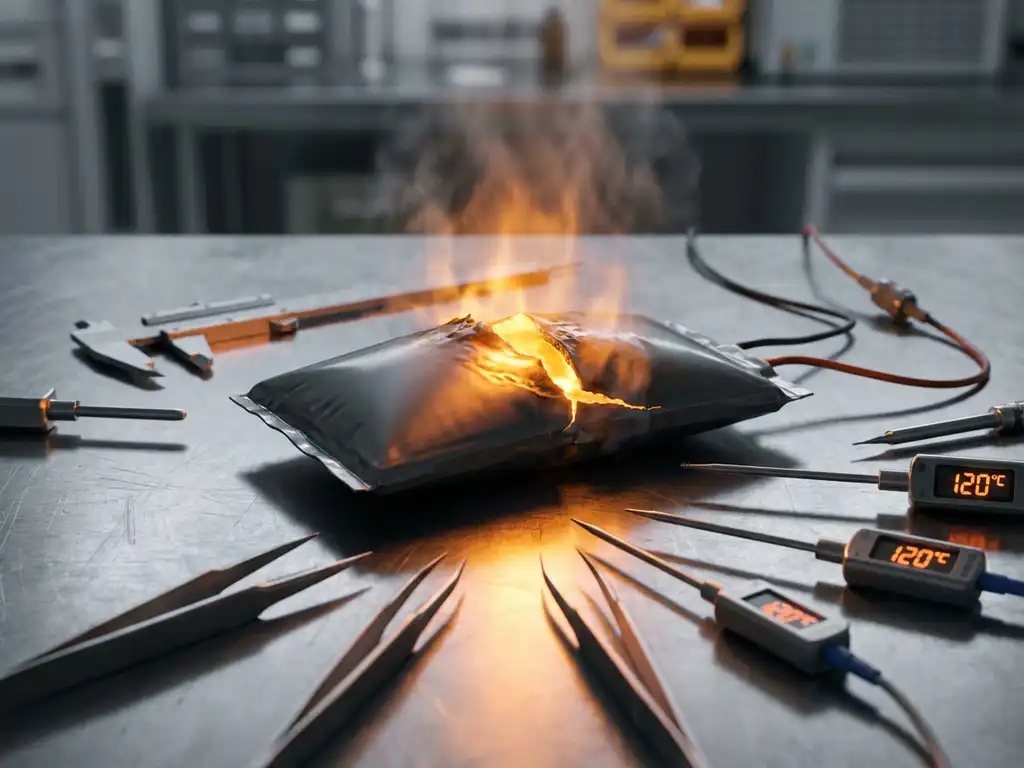
Thermal runaway is one of the most critical failure modes studied in battery materials research. Understanding its mechanisms, triggers, and progression is essential for researchers developing safer electrode materials, electrolytes, and cell architectures. This article addresses the key questions surrounding thermal runaway in lithium-ion batteries, from fundamental definitions to detection and prevention strategies relevant to laboratory-scale investigations.
What causes thermal runaway in lithium-ion batteries?
Thermal runaway in a lithium-ion battery is caused by an uncontrolled, self-sustaining exothermic reaction cycle in which heat generation exceeds the cell’s capacity to dissipate it. The three primary trigger categories are mechanical abuse (crushing, penetration), electrical abuse (overcharge, external short circuit), and thermal abuse (exposure to elevated temperatures). Each trigger initiates a cascade of decomposition reactions that release additional heat.
At the electrochemical level, the initiating event typically involves breakdown of the solid electrolyte interphase (SEI) layer on the anode. The SEI layer, which forms during the first charge cycles, is metastable and begins to decompose at temperatures generally above 90 °C. Once the SEI breaks down, the reactive lithiated anode is exposed directly to the electrolyte, driving further exothermic reactions. Cathode decomposition follows at higher temperatures, releasing oxygen that can react with the organic electrolyte solvent, dramatically accelerating heat production.
Electrical triggers in detail
Overcharge is a particularly well-studied electrical trigger. Driving a cell beyond its upper voltage limit forces excess lithium into the cathode structure and can cause lithium plating on the anode rather than intercalation. Lithium metal deposits are highly reactive and can initiate localised short circuits, generating heat rapidly. Researchers studying fast-charging protocols or novel cathode materials must account for these risks when designing experimental cycling conditions.
How does thermal runaway progress inside a battery cell?
Thermal runaway progresses through a sequence of overlapping exothermic events, each triggered at successively higher temperatures. The progression can be broadly divided into three stages: onset reactions at moderate temperatures, accelerating decomposition at intermediate temperatures, and catastrophic failure involving electrolyte combustion and gas venting at high temperatures.
In the onset stage, SEI decomposition begins and produces heat and gases such as carbon dioxide and hydrocarbons. As the temperature rises, the separator between the anode and cathode can soften and eventually collapse, creating an internal short circuit that dramatically accelerates heating. At higher temperatures, cathode materials such as layered oxides undergo structural decomposition, releasing oxygen into the cell interior. This oxygen reacts with the flammable carbonate-based electrolyte solvents, producing a rapid and intense exothermic reaction. The final stage can involve rupture of the cell casing, electrolyte ejection, and ignition.
The role of the separator
The polymeric separator plays a critical role in the progression of thermal runaway. Most commercial separators are designed to shut down ionic transport at elevated temperatures by melting and closing their pores, which interrupts current flow. However, if the temperature continues to rise, the separator can shrink or rupture entirely, causing a full internal short circuit. This transition from shutdown to rupture is a key area of materials research, and test cells that allow in situ monitoring of internal conditions are valuable tools for studying it.
Why are lithium-ion batteries more prone to thermal runaway than other battery types?
Lithium-ion batteries are more susceptible to thermal runaway than many other electrochemical energy storage systems, primarily because of the combination of a flammable liquid electrolyte, high energy density, and reactive electrode materials. This combination means that the energy stored within the cell can itself fuel the runaway reaction once initiated, making self-sustaining propagation more likely than in lower-energy-density systems.
Aqueous electrolyte systems, such as lead-acid or nickel-metal hydride batteries, carry a significantly lower risk of thermal runaway because water-based electrolytes are non-flammable and the electrode materials are generally less reactive under abuse conditions. Solid-state batteries, which replace the liquid electrolyte with a solid ionic conductor, are an area of active research aimed at reducing this vulnerability, though solid electrolytes introduce their own challenges related to interfacial resistance and mechanical compatibility. The fundamental trade-off between energy density and thermal stability remains a central challenge in battery materials science.
How can thermal runaway be detected early in battery research?
Early detection of thermal runaway in a research context relies on monitoring physical and electrochemical signals that precede catastrophic failure. The most informative early indicators include temperature rise, gas evolution, voltage deviation from expected cycling behaviour, and mechanical swelling of the cell. Tracking these parameters simultaneously provides the most reliable warning of impending thermal runaway.
Electrochemical impedance spectroscopy (EIS) is a particularly useful diagnostic tool at the research scale. Changes in impedance spectra can reveal degradation of the SEI layer, increased internal resistance, or the onset of lithium plating before visible symptoms appear. Researchers also use pressure sensors and dilatometry to detect gas evolution and electrode volume changes, both of which are early physical signatures of abnormal reactions inside the cell. Combining electrochemical and physical monitoring within a single test cell provides the most comprehensive picture of pre-runaway behaviour.
Gas analysis as an early warning method
The gases produced during early-stage thermal decomposition reactions, including carbon dioxide, carbon monoxide, and various hydrocarbons, can serve as chemical markers of internal degradation. Differential electrochemical mass spectrometry (DEMS) allows researchers to identify and quantify these gases in real time during cycling. Detecting elevated gas evolution at temperatures or states of charge where it would not normally occur provides a sensitive early warning signal that can be correlated with electrochemical data to build a detailed picture of failure onset.
How is thermal runaway prevented in lithium-ion battery design?
Thermal runaway prevention in lithium-ion battery design operates at multiple levels: materials selection, cell architecture, and battery management. At the materials level, the most direct approaches involve developing more thermally stable electrolytes, robust SEI-forming additives, and cathode materials with higher decomposition temperatures. Each of these strategies is an active area of fundamental research.
Electrolyte formulation is a primary lever for prevention. Replacing conventional carbonate solvents with ionic liquids, fluorinated solvents, or solid electrolytes reduces or eliminates the flammable component that sustains runaway reactions. SEI-stabilising additives, which form a more thermally robust interphase on the anode during the first cycles, can raise the onset temperature of SEI decomposition and reduce the heat released when it does occur. At the cathode, materials with more stable oxygen sublattices, such as certain lithium iron phosphate (LFP) compositions, release less oxygen upon decomposition than high-nickel layered oxides, making them intrinsically safer, though typically at the cost of energy density.
Cell-level and system-level prevention strategies
Beyond materials, cell design choices such as separator composition, electrode porosity, and current collector geometry influence thermal runaway susceptibility. At the battery management system level, tight voltage and temperature monitoring with protective cut-off circuitry prevents the electrical abuse conditions that most commonly initiate runaway in practice. For researchers, understanding which design variables most strongly influence thermal stability requires systematic experimental work under controlled conditions.
How EL-Cell GmbH supports thermal runaway research
Studying thermal runaway mechanisms requires test equipment that allows precise control of electrochemical conditions alongside simultaneous physical monitoring. EL-Cell GmbH designs and manufactures battery test cells and instruments specifically for this kind of detailed, mechanistic research. Our product range supports the experimental workflows most relevant to thermal stability investigations:
- In situ gas monitoring: The PAT-Cell-Gas II enables real-time gas evolution measurement during cycling, allowing researchers to detect early-stage decomposition products that precede thermal runaway.
- Mechanical swelling measurement: The ECD-4-nano electrochemical dilatometer quantifies electrode thickness changes with a resolution better than 5 nm, capturing the mechanical signatures of gas evolution and structural degradation at the earliest stages.
- Pressure and force monitoring: The PAT-Cell-Force integrates a force sensor directly into the cell stack, enabling continuous measurement of internal pressure build-up during cycling.
- EIS capability: The PAT-Tester-i-16 provides full potentiostat/galvanostat and electrochemical impedance spectroscopy (EIS) functionality across up to 16 independent channels, supporting impedance-based diagnostics alongside standard cycling protocols.
- Gas analysis: The ECC-DEMS cell supports differential electrochemical mass spectrometry, enabling identification and quantification of volatile decomposition products in real time.
If your research involves thermal stability, abuse testing, or failure mechanism analysis of electrode materials or electrolyte formulations, contact EL-Cell GmbH to discuss which combination of test cells and instruments best fits your experimental requirements.
Comments are closed.