


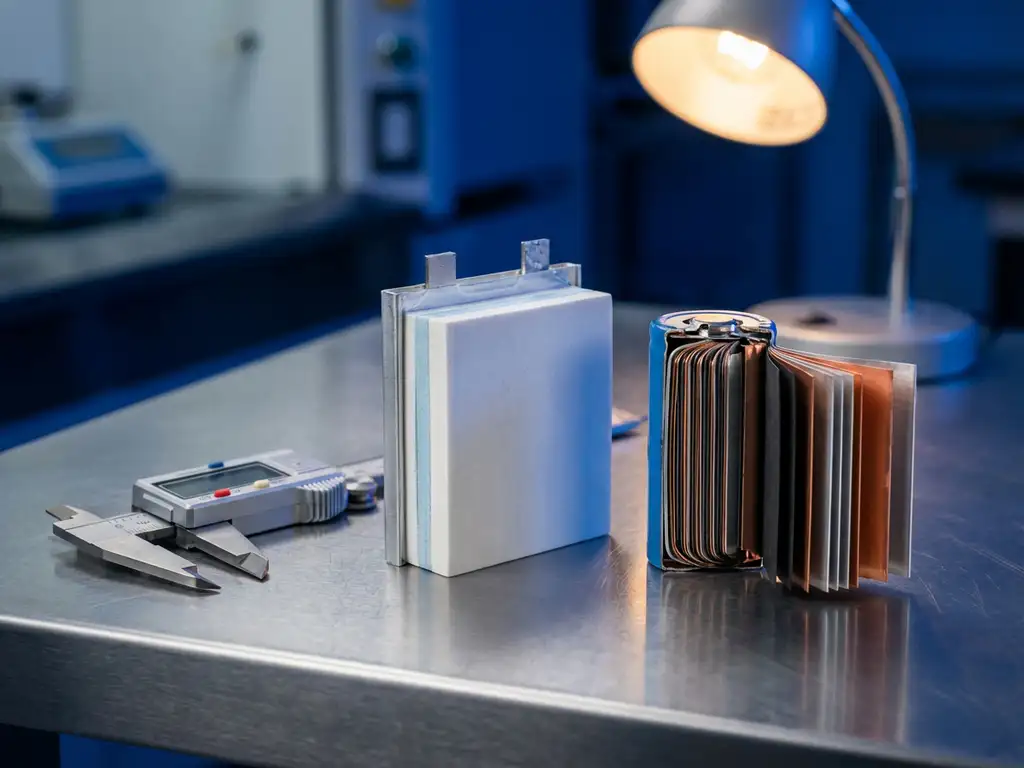
Solid-state batteries represent one of the most actively researched areas in electrochemistry today. For battery materials researchers, understanding the fundamental distinctions between solid-state and conventional lithium-ion architectures is essential for designing experiments, selecting appropriate test hardware, and interpreting electrochemical data correctly.
What is a solid-state battery?
A solid-state battery is an electrochemical energy storage device in which the liquid or gel electrolyte found in conventional lithium-ion cells is replaced entirely with a solid ionic conductor. This single architectural change affects electrode design, interfacial chemistry, manufacturing processes, and the methods required to characterise cell performance in the laboratory.
The solid electrolyte serves the same fundamental role as its liquid counterpart: conducting ions between the anode and cathode while acting as an electronic insulator. Solid electrolyte materials fall broadly into three categories: oxide-based ceramics (such as LLZO, lithium lanthanum zirconium oxide), sulphide-based glasses and glass-ceramics, and polymer-based systems. Each class presents distinct ionic conductivity values, electrochemical stability windows, and processing requirements that directly influence experimental design.
How does a solid-state battery work?
A solid-state battery operates on the same fundamental electrochemical principles as a lithium-ion cell. During charging, lithium ions migrate from the cathode through the solid electrolyte and intercalate into, or plate onto, the anode. During discharge, the process reverses. The critical difference is that ion transport occurs entirely within a rigid solid medium rather than through a liquid solution.
Ion transport in solid electrolytes depends on lattice structure, defect concentration, and temperature. Unlike liquid electrolytes, which achieve high ionic conductivity at room temperature through solvation and diffusion, solid electrolytes often require elevated temperatures or careful materials engineering to reach comparable conductivity values. This has direct implications for testing conditions, particularly when characterising interfacial resistance using electrochemical impedance spectroscopy (EIS).
The electrode–electrolyte interface in solid-state cells presents additional complexity. Without a liquid phase to conformally wet electrode particles, intimate solid–solid contact must be achieved and maintained under mechanical stress. Stack pressure, particle morphology, and sintering conditions all influence the quality of this interface and the resulting electrochemical performance.
What are the key differences between solid-state and lithium-ion batteries?
The primary distinction between solid-state and lithium-ion batteries lies in the electrolyte phase. Lithium-ion cells use a liquid electrolyte, typically a lithium salt dissolved in an organic solvent, while solid-state cells use a solid ionic conductor. This difference propagates through every aspect of cell design, fabrication, and testing.
Key differences relevant to battery materials researchers include:
- Electrolyte state: Liquid versus solid, affecting ionic conductivity, interfacial contact, and processing requirements.
- Separator: Lithium-ion cells require a porous polymer separator to prevent short circuits; solid-state cells use the solid electrolyte layer itself as the separator.
- Interfacial chemistry: Liquid electrolytes form a solid electrolyte interphase (SEI) layer on the anode during early cycles. Solid-state cells develop distinct solid–solid interfaces whose resistance and stability differ significantly from those of liquid-phase SEI layers.
- Mechanical constraints: Solid electrolytes are brittle and require controlled stack pressure during cycling to maintain contact. This makes pressure management a critical experimental variable.
- Operating temperature: Many solid electrolytes, particularly polymer-based systems, require elevated temperatures to achieve sufficient ionic conductivity for meaningful cycling.
What are the main advantages of solid-state batteries over lithium-ion?
Solid-state batteries offer several potential advantages over lithium-ion cells, the most significant being improved safety and compatibility with metallic lithium anodes. The absence of a flammable liquid electrolyte reduces the risk of thermal runaway, while a solid electrolyte can, in principle, suppress lithium dendrite propagation more effectively than a porous separator.
From a materials research perspective, the advantages extend further:
- Wider electrochemical stability window: Some solid electrolytes are stable at higher voltages than conventional liquid electrolytes, enabling pairing with high-voltage cathode materials.
- Lithium metal compatibility: Solid electrolytes can, under the right conditions, enable stable cycling with a lithium metal anode, which offers substantially higher specific capacity (mAh/g) than graphite.
- Reduced electrolyte decomposition: Liquid electrolytes degrade during cycling, contributing to capacity fade. Solid electrolytes, when chemically stable, can reduce this degradation pathway.
- Potential for thinner cell designs: The solid electrolyte layer can be deposited as a thin film, enabling compact cell geometries relevant to certain device applications.
It is important to note that these advantages are conditional. They depend heavily on electrolyte chemistry, electrode pairing, and the quality of solid–solid interfaces achieved during fabrication.
What challenges are still holding solid-state batteries back?
Solid-state batteries face several unresolved technical challenges that prevent straightforward translation from laboratory results to practical applications. The most persistent is interfacial resistance at the electrode–electrolyte boundary, which increases overpotential, reduces rate capability, and degrades coulombic efficiency over cycling.
Additional challenges include:
- Mechanical degradation: Volume changes in electrode materials during lithiation and delithiation generate stress at rigid solid–solid interfaces, leading to contact loss and capacity fade.
- Ionic conductivity at room temperature: Many solid electrolytes do not reach the ionic conductivity of liquid electrolytes at ambient temperature, limiting practical charge and discharge rates (C-rates).
- Chemical and electrochemical instability: Several sulphide-based electrolytes are sensitive to moisture and can react with electrode materials at the interface, forming resistive interphases.
- Scalable manufacturing: Achieving the intimate solid–solid contact required for low interfacial resistance at laboratory scale does not translate easily to large-format cell production.
- Reproducibility: Solid-state cell assembly is sensitive to surface preparation, applied pressure, and sintering conditions, making reproducibility between experiments a genuine challenge.
These challenges make rigorous, controlled experimental conditions particularly important when characterising solid-state materials in the laboratory.
How are solid-state batteries tested in the lab?
Laboratory testing of solid-state batteries requires hardware capable of applying controlled stack pressure, maintaining temperature uniformity, and enabling electrochemical characterisation techniques, including galvanostatic cycling, EIS, and rate capability testing. Standard coin cell hardware designed for liquid electrolyte systems is generally unsuitable for solid-state work.
Key considerations for solid-state cell testing include:
- Stack pressure control: Consistent, quantifiable pressure on the cell stack is essential for maintaining solid–solid contact and achieving reproducible results between assemblies.
- Temperature control: Many solid electrolytes require testing above ambient temperature. Precise, stable temperature control prevents artefacts in impedance and capacity data.
- Inert atmosphere assembly: Sulphide electrolytes, in particular, require glove-box assembly to prevent moisture-induced degradation before the cell is sealed.
- EIS capability: Impedance spectroscopy is a primary tool for resolving bulk electrolyte resistance, interfacial resistance, and charge-transfer contributions in solid-state cells. A potentiostat/galvanostat (PStat/GStat) with EIS capability is a standard requirement.
- Dilatometry: Monitoring electrode thickness changes during cycling provides direct insight into the mechanical behaviour of solid-state electrode–electrolyte assemblies.
The reproducibility of solid-state cell testing is closely linked to hardware design. Poorly controlled pressure or temperature introduces artefacts that make it difficult to distinguish genuine material properties from experimental noise, which directly affects the reliability of published results.
How EL-Cell GmbH supports solid-state battery research
EL-Cell GmbH designs and manufactures electrochemical test hardware specifically for the demands of next-generation battery research, including solid-state systems. Our product range addresses the core experimental requirements outlined above:
- PAT-Cell-Solid: A test cell designed specifically for solid-state electrolyte research, with integrated stack pressure control to ensure reproducible solid–solid contact across experiments.
- PAT-Cell-Force: Enables precise, quantifiable force application during cycling, directly addressing the mechanical requirements of solid-state cell testing.
- ECD-4-nano: A high-resolution electrochemical dilatometer with sub-1 nm thickness resolution, enabling quantitative measurement of electrode volume changes in solid-state assemblies.
- PAT-Tester-i-16: An integrated battery tester with up to 16 channels, PStat/GStat functionality, EIS capability, and a temperature-controlled cell chamber, providing the full electrochemical characterisation toolkit for solid-state research in a single instrument.
If you are establishing or expanding a solid-state battery research programme, we welcome enquiries about test cell selection, hardware configuration, and customised solutions for specific experimental requirements. Contact EL-Cell GmbH directly to discuss your research needs.
Comments are closed.