


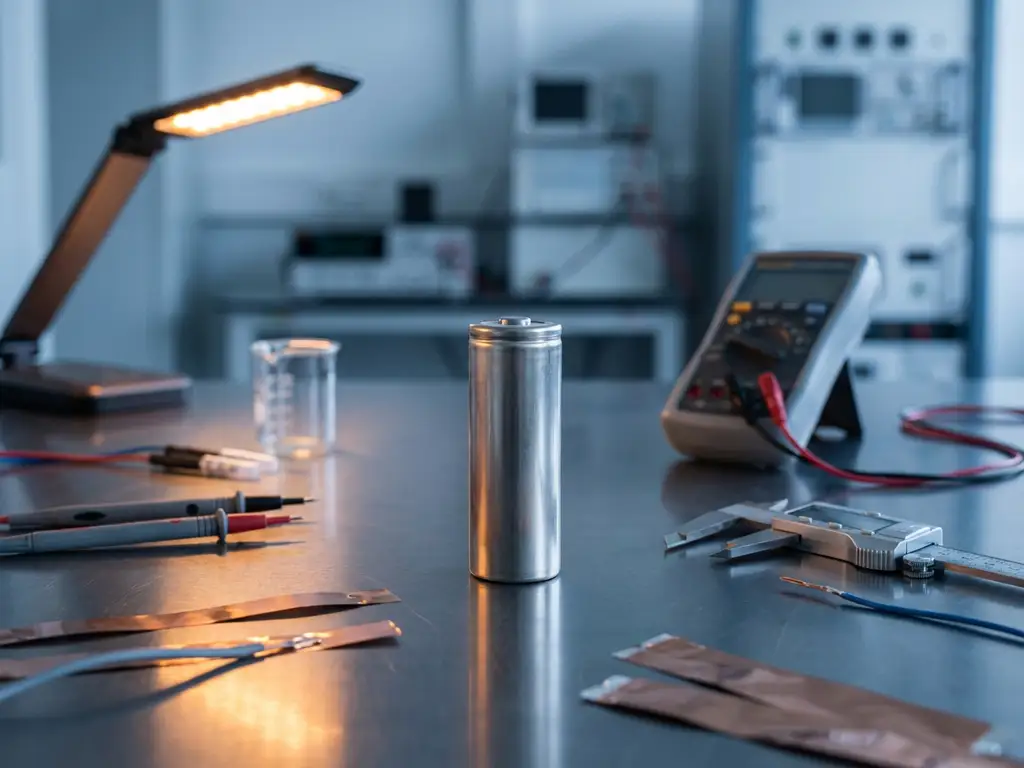
The self-discharge rate of a lithium-ion battery is the rate at which a cell loses stored charge when it is not connected to an external circuit. For most lithium-ion chemistries, this amounts to roughly 1–5% of capacity per month under ambient storage conditions, though the precise figure varies with chemistry, temperature, and cell age. Understanding self-discharge is essential for battery materials researchers, as it reflects the electrochemical stability of electrode and electrolyte systems under open-circuit conditions.
For researchers designing experiments involving long-duration storage, calendar ageing, or coulombic efficiency measurements, self-discharge is not merely a practical inconvenience. It is a diagnostic signal that reveals information about parasitic reactions, electrolyte decomposition, and internal leakage currents. The sections below address the most common questions about lithium-ion self-discharge in a research context.
Why do lithium-ion batteries self-discharge?
Lithium-ion batteries self-discharge because thermodynamic and kinetic factors drive parasitic electrochemical reactions at both electrodes during open-circuit storage. These reactions consume stored charge without performing useful work, gradually reducing the state of charge (SoC) of the cell.
The primary mechanisms include:
- Electrolyte oxidation at the cathode: At high SoC, cathode materials operate at elevated potentials that can oxidise the electrolyte, generating small but continuous parasitic currents.
- Electrolyte reduction at the anode: Graphite and lithium-metal anodes are thermodynamically unstable in contact with standard carbonate electrolytes. Ongoing reduction reactions at the solid electrolyte interphase (SEI) consume lithium ions and electrons.
- SEI instability: The SEI layer that forms on the anode during initial cycling is not perfectly stable. It continues to evolve slowly during storage, consuming lithium and contributing to capacity loss.
- Electronic leakage: Imperfect electronic insulation between electrodes, whether due to separator defects or conductive contamination, allows a small internal current to flow.
- Lithium plating dissolution: In cells where lithium plating has occurred, dissolution of plated lithium during rest contributes to apparent self-discharge.
The relative contribution of each mechanism depends on the specific electrode chemistry, electrolyte formulation, and the SoC at which the cell is stored. High-SoC storage consistently accelerates self-discharge because it places electrodes further from their thermodynamic equilibrium, increasing the driving force for parasitic reactions.
How does temperature affect the self-discharge rate?
Temperature has a strong, direct effect on the self-discharge rate of a lithium-ion battery. Higher temperatures accelerate the kinetics of parasitic electrochemical reactions at both electrodes, increasing the rate of capacity loss during storage. Conversely, storing cells at low temperatures substantially reduces self-discharge.
This relationship follows Arrhenius behaviour: reaction rates increase exponentially with temperature. In practical terms, a cell stored at elevated temperatures will lose charge significantly faster than one stored near 0 °C. This is why low-temperature storage is standard practice for preserving cells intended for long-duration calendar ageing studies.
For researchers, temperature is also a controlled variable used to accelerate ageing in a predictable way. Elevated-temperature storage tests are commonly employed to estimate long-term self-discharge behaviour within a compressed experimental timeframe. However, care must be taken when extrapolating results, as different degradation mechanisms may dominate at different temperature ranges, and the assumption of simple Arrhenius scaling does not always hold across wide temperature windows.
What factors affect the self-discharge rate of a lithium-ion battery?
Several interconnected factors govern the self-discharge rate of a lithium-ion battery. These include state of charge, temperature, electrode chemistry, electrolyte composition, cell age, and manufacturing quality.
State of charge
Cells stored at high SoC exhibit faster self-discharge. At full charge, cathode materials are in a highly oxidised state and anodes are fully lithiated—both conditions that maximise the thermodynamic driving force for parasitic reactions. Storing cells at an intermediate SoC (typically around 50%) is standard practice for minimising self-discharge during extended storage.
Electrode and electrolyte chemistry
The specific active materials and electrolyte formulation have a significant influence. Cathode materials with high operating potentials, such as nickel-rich layered oxides (NMC, NCA), tend to show greater electrolyte oxidation than lower-potential materials such as lithium iron phosphate (LFP). Electrolyte additives designed to stabilise the SEI or passivate the cathode surface can measurably reduce self-discharge.
Cell age and cycling history
Self-discharge typically increases with cell age. As the SEI grows thicker and less stable, and as electrode materials undergo structural changes over cycles, the rate of parasitic reactions increases. Cells that have experienced lithium plating due to charging at high C-rates or low temperatures may show elevated self-discharge due to ongoing dissolution of deposited lithium.
Manufacturing quality
Contamination introduced during cell assembly, including metallic particles, moisture, or impurities in the electrolyte, can create internal short circuits or accelerate parasitic reactions. Rigorous control of assembly conditions is therefore critical for achieving reproducible, low self-discharge in research cells.
How is self-discharge rate measured in the laboratory?
Self-discharge rate is measured in the laboratory by charging a cell to a defined SoC, storing it under controlled conditions for a set period, and then measuring the remaining capacity or open-circuit voltage (OCV) to quantify the charge lost. The result is typically expressed as a percentage of the initial capacity lost per unit time.
Two principal methods are used:
- Capacity-based measurement: The cell is fully charged, rested, stored for a defined period (days to weeks), and then discharged to measure the remaining capacity. The difference between the initial and final capacity, normalised to the storage time, gives the self-discharge rate.
- OCV-based measurement: The open-circuit voltage is monitored continuously or at intervals during storage. Using the cell’s voltage–SoC relationship (the OCV curve), voltage decay can be converted into an estimated capacity loss. This approach is faster but requires accurate OCV characterisation.
A more sensitive and increasingly adopted technique is to measure the parasitic current directly using high-precision coulometry. By holding the cell at a fixed voltage and measuring the small current required to maintain that voltage, researchers can quantify the rate of parasitic reactions with high resolution. This approach, sometimes referred to as potentiostatic intermittent titration or simply precision coulometry, is particularly useful for comparing electrolyte formulations or additive packages.
Regardless of method, temperature control during measurement is critical. Even small fluctuations in ambient temperature introduce artefacts into OCV and capacity measurements, making a temperature-controlled cell environment essential for reliable self-discharge characterisation.
How does self-discharge rate compare across different lithium-ion chemistries?
Self-discharge rate varies meaningfully across lithium-ion chemistries, primarily because different cathode materials operate at different potentials and exhibit different degrees of electrochemical stability in contact with standard electrolytes.
General trends observed across common chemistries include:
- Lithium iron phosphate (LFP): LFP cells typically show among the lowest self-discharge rates of commercial lithium-ion chemistries. The relatively low cathode operating potential reduces the thermodynamic driving force for electrolyte oxidation, and LFP is inherently more stable at high SoC.
- Nickel manganese cobalt oxide (NMC) and nickel cobalt aluminium oxide (NCA): These nickel-rich cathodes operate at higher potentials and are more reactive towards the electrolyte at high SoC, generally resulting in higher self-discharge than LFP.
- Lithium cobalt oxide (LCO): LCO, widely used in consumer electronics cells, shows moderate self-discharge, with stability strongly dependent on the upper cut-off voltage used during charging.
- Lithium manganese oxide (LMO): LMO can show elevated self-discharge, partly due to manganese dissolution into the electrolyte and its subsequent deposition on the anode, which accelerates SEI growth.
It is important to note that anode chemistry also plays a role. Cells using silicon-containing anodes, for example, often show higher self-discharge than graphite-only anodes, partly because silicon–graphite composites present a less stable SEI. Lithium-metal anodes, relevant to next-generation solid-state and lithium-sulphur research, present a distinct self-discharge challenge due to the highly reactive nature of lithium metal in contact with any electrolyte.
Direct comparisons between chemistries should always be made under identical conditions of SoC, temperature, and storage duration, as these variables can easily obscure or exaggerate intrinsic differences between materials.
How EL-Cell GmbH supports self-discharge rate research
Accurate self-discharge measurement demands precise control over temperature, state of charge, and cell assembly quality. EL-Cell GmbH provides the instrumentation and test cell hardware needed to conduct this work under well-defined, reproducible conditions.
Specifically, our product ecosystem supports self-discharge studies in the following ways:
- Temperature-controlled testing: The PAT-Tester-i-16 integrates a temperature-controlled cell chamber directly with up to 16 independent test channels, eliminating the thermal artefacts that compromise OCV and capacity measurements during self-discharge characterisation.
- High-precision electrochemical measurement: The PAT-Tester-i-16 offers potentiostat and galvanostat functionality with electrochemical impedance spectroscopy (EIS) capability, enabling both capacity-based and potentiostatic self-discharge protocols, as well as impedance tracking over storage periods.
- Standardised, reproducible test cells: Our PAT-Cell and related test cell formats provide hermetically sealed, well-defined half-cell and full-cell configurations that minimise assembly-related variability—a critical requirement when comparing self-discharge across different electrode or electrolyte formulations.
- Dilatometric monitoring during storage: The ECD-4-nano electrochemical dilatometer can track electrode thickness changes during open-circuit rest, providing complementary mechanical data alongside electrochemical self-discharge measurements.
If you are designing a self-discharge characterisation protocol or need test cells suited to long-duration storage experiments, contact EL-Cell GmbH to discuss which configuration best fits your experimental requirements. Our Application Laboratory is also available to support measurement campaigns where in-house capacity is limited.
Comments are closed.