


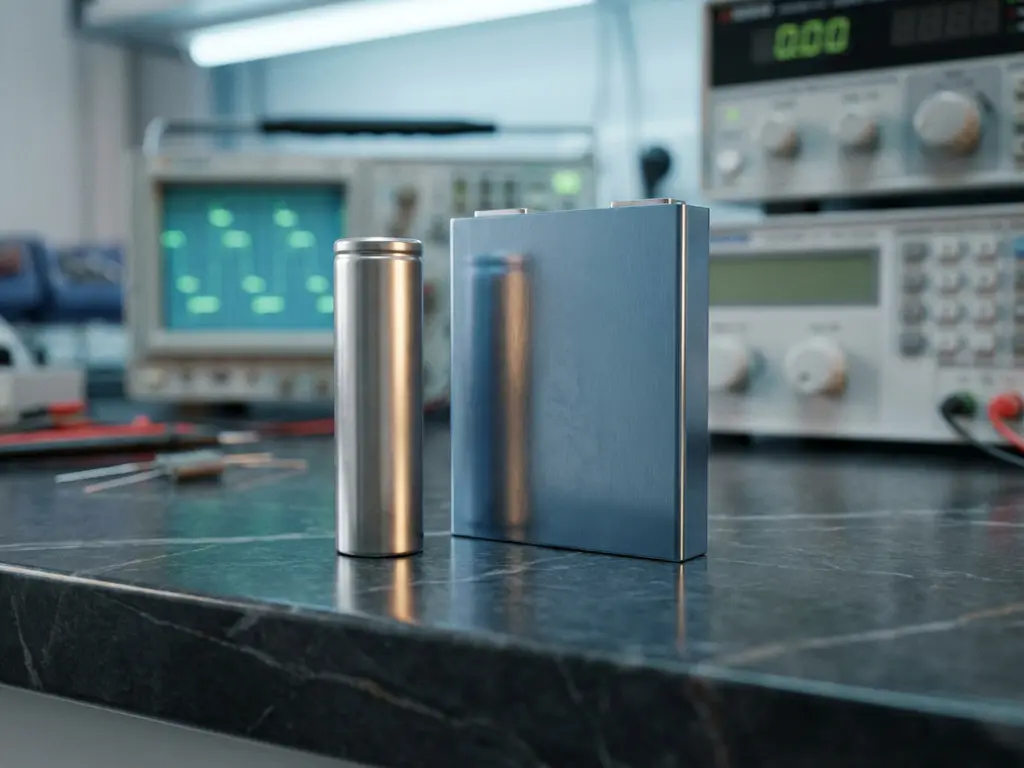
Cylindrical and prismatic lithium-ion cells are the two most prevalent form factors encountered in both commercial battery production and laboratory research. Understanding the structural and electrochemical differences between them is essential for researchers who need to select the appropriate cell format for their experiments, interpret results correctly, and design meaningful comparisons between electrode materials.
This article addresses the key distinctions between cylindrical and prismatic lithium-ion cells from a research perspective, covering internal architecture, electrochemical performance characteristics, and practical considerations for lab-scale testing.
What are cylindrical and prismatic lithium-ion cells?
Cylindrical and prismatic lithium-ion cells are two distinct packaging formats for electrochemical energy storage. A cylindrical cell encloses a jelly-roll electrode assembly within a circular metal casing, while a prismatic cell houses either a wound or stacked electrode assembly within a flat, rectangular enclosure made of metal or hard plastic. The format determines the cell geometry, thermal behaviour, and mechanical constraints during cycling.
Cylindrical cells are identified by standardised diameter and height codes, such as 18650 (18 mm diameter, 65 mm height) or 21700. Prismatic cells do not follow a universal dimensional standard, which means their dimensions vary considerably between manufacturers. Both formats use the same fundamental electrochemistry—lithium intercalation at the anode and cathode—but their packaging imposes different physical constraints on the electrode stack.
How does the internal structure differ between the two formats?
The primary structural difference lies in how the electrode layers are arranged. Cylindrical cells use a continuous jelly-roll configuration, in which anode, separator, and cathode sheets are wound into a tight spiral. Prismatic cells use either a wound configuration adapted to a flat cross-section or a stacked configuration in which discrete electrode sheets are layered on top of one another.
Jelly-roll versus stacked electrode design
The jelly-roll design in cylindrical cells produces a mechanically robust structure with good contact pressure between layers. The winding geometry, however, introduces curvature at the edges of the electrode sheets, which can create localised stress concentrations and non-uniform current distribution, particularly at the inner and outer radii of the roll.
Stacked prismatic cells avoid this curvature by using flat, rectangular electrode sheets. This configuration allows more uniform current distribution across the electrode area and is generally preferred when studying electrode materials that are sensitive to mechanical stress or volume change during cycling. The trade-off is that stacked assemblies can be more susceptible to delamination if swelling is not well controlled.
Casing and pressure management
Cylindrical cells use rigid steel casings that provide inherent mechanical constraint on the electrode stack. This passive compression can help maintain electrode contact during cycling. Prismatic cells with hard casings offer similar constraint, but pouch-format variants require external fixtures to apply controlled stack pressure. For research purposes, controlling and measuring stack pressure is often a critical experimental variable.
What are the key performance differences between cylindrical and prismatic cells?
The key performance differences between cylindrical and prismatic lithium-ion cells relate to thermal management, volumetric energy density, and mechanical behaviour during cycling. Neither format is universally superior; each presents distinct advantages depending on the application and the specific electrochemical system under investigation.
- Thermal management: Cylindrical cells dissipate heat radially from the core outward. The geometry limits the surface area relative to volume, which can result in steeper thermal gradients at high C-rates. Prismatic cells offer larger flat surfaces that facilitate more uniform heat dissipation in module configurations.
- Volumetric energy density: Prismatic cells generally achieve higher volumetric packing efficiency when assembled into modules because their flat geometry eliminates the interstitial space that forms between cylindrical cells.
- Electrode expansion: Prismatic cells, particularly those with stacked designs, accommodate in-plane electrode expansion more predictably. This is relevant when testing high-capacity anode materials such as silicon-based composites, where significant volume changes occur during lithiation and delithiation.
- Coulombic efficiency: Both formats can achieve comparable coulombic efficiency when assembled under controlled conditions, but differences in current distribution and stack pressure can influence first-cycle losses and the formation of the solid electrolyte interphase (SEI) layer.
Which cell format is better for battery research and lab testing?
For battery materials research, neither format is categorically better. The choice depends on what the researcher is trying to measure. Cylindrical cells are well suited to studies that require robust mechanical integrity and standardised dimensions. Prismatic and pouch-format cells are preferred when researchers need direct access to stack pressure data, in situ thickness measurements, or uniform current distribution across flat electrode sheets.
In academic research, coin cells and pouch-type test cells are often used as proxies for both formats because they allow precise control over electrode area, electrolyte volume, and separator compression. When the goal is to characterise an electrode material rather than evaluate a specific commercial cell design, the test cell format should be chosen to minimise experimental artefacts rather than replicate a particular commercial geometry.
Researchers working with next-generation materials, such as solid-state electrolytes or silicon anodes, frequently prefer flat-format test cells because they allow controlled application of uniaxial stack pressure, which is critical for maintaining interfacial contact in solid-state systems.
How do you test cylindrical and prismatic cells in the lab?
Testing cylindrical and prismatic lithium-ion cells in the laboratory requires a potentiostat or galvanostat capable of applying controlled current and voltage profiles, combined with a cell holder or fixture appropriate to the cell geometry. The core electrochemical measurements applied to both formats are the same: galvanostatic cycling, cyclic voltammetry, and electrochemical impedance spectroscopy (EIS).
Setting up galvanostatic cycling
Galvanostatic cycling applies a constant current to charge and discharge the cell between defined voltage limits. The C-rate is calculated relative to the cell’s nominal capacity. For research-grade testing, it is important to record both charge and discharge capacity at each cycle to track coulombic efficiency and capacity fade over time. Temperature should be controlled and recorded throughout, as thermal variation introduces significant scatter into cycling data.
Electrochemical impedance spectroscopy
EIS is used to characterise internal resistance, SEI layer formation, and charge-transfer kinetics. For cylindrical cells, the geometry introduces a distributed impedance response that can complicate equivalent-circuit modelling. Flat-format prismatic or pouch cells generally produce cleaner EIS spectra due to more uniform current distribution, which is one reason many fundamental studies use flat test cells rather than commercial cylindrical formats.
Mechanical measurements during cycling
Monitoring electrode thickness change during cycling is particularly relevant for prismatic and pouch-format cells, where the flat geometry allows direct dilatometric measurement. Thickness changes in the range of nanometres to micrometres can be resolved using high-resolution dilatometers such as the ECD-4-nano, providing insight into electrode expansion, lithium plating, and gas evolution without disassembling the cell.
What are the most common mistakes when comparing these two cell formats?
The most common mistake when comparing cylindrical and prismatic lithium-ion cells is attributing performance differences to the electrode material rather than the cell format itself. Format-dependent variables—including stack pressure, electrolyte volume, current collector geometry, and thermal environment—can all influence measured capacity, rate capability, and cycle life independently of the active material.
- Inconsistent stack pressure: Applying different mechanical constraints to cylindrical and prismatic cells will produce different degrees of electrode contact and different rates of electrolyte redistribution. This makes direct performance comparisons unreliable unless pressure is controlled and matched.
- Mismatched electrolyte volume: Excess electrolyte can mask capacity fade by continuously wetting newly exposed electrode surfaces. Standardising the electrolyte-to-capacity ratio across formats is necessary for meaningful comparisons.
- Ignoring current distribution effects: The wound geometry of cylindrical cells produces non-uniform current density across the electrode area. Researchers who compare results from cylindrical cells with those from flat pouch cells should account for this when interpreting rate capability data.
- Confusing cell-level and material-level metrics: Reporting capacity in mAh rather than mAh/g or mAh/cm² makes cross-format comparisons meaningless. Always normalise capacity to electrode mass or geometric area when comparing results across different cell formats.
- Neglecting formation protocol differences: The SEI layer that forms during the first charge cycles is sensitive to temperature, current density, and electrolyte volume. If formation conditions differ between the two cell formats being compared, observed differences in coulombic efficiency may reflect formation artefacts rather than material properties.
How EL-Cell GmbH supports cylindrical and prismatic cell research
EL-Cell GmbH designs electrochemical test cells and instruments specifically for researchers who need to characterise electrode materials under well-controlled, reproducible conditions. Our product range addresses the practical challenges that arise when studying different cell formats in the laboratory.
- The PAT-Cell provides a flat-format test cell with a defined electrode area, controlled electrolyte volume, and the option to apply and measure uniaxial stack pressure, making it well suited to studies that require format-independent material characterisation.
- The PAT-Cell-Force allows continuous in situ measurement of stack pressure during cycling, which is directly relevant to understanding mechanical behaviour in both wound and stacked electrode assemblies.
- The ECD-4-nano electrochemical dilatometer resolves electrode thickness changes with a resolution better than 5 nm, enabling quantitative measurement of volume expansion in electrode materials regardless of the reference cell format used.
- The PAT-Tester-i-16 integrates galvanostatic cycling, potentiostatic control, and EIS measurement into a single instrument with up to 16 independent channels, supporting systematic comparison studies across multiple cell configurations simultaneously.
If you are designing experiments that require controlled, reproducible comparisons between electrode materials tested in different cell geometries, contact EL-Cell GmbH to discuss which test cell configuration and instrumentation are most appropriate for your research objectives.
Comments are closed.