


Solid-state batteries present a distinct set of mechanical challenges that do not arise in conventional liquid-electrolyte cells. Because the electrolyte is a rigid solid rather than a liquid that can redistribute freely, every volumetric change in the electrode materials translates directly into mechanical stress at the electrode–electrolyte interface. Monitoring that stress in real time, while the cell is actively cycling, is what in-operando pressure measurement is designed to do. This article builds from the foundational concept of operando pressure monitoring through to how researchers use the resulting data to make meaningful decisions about solid-state battery materials and stack design.
What is in-operando pressure monitoring in solid-state batteries?
In-operando pressure monitoring is the continuous measurement of mechanical force or pressure within a battery cell during active electrochemical cycling. The term “operando” distinguishes this approach from post-mortem or ex-situ analysis: the cell remains sealed, functional, and under electrical load throughout the measurement.
In a solid-state cell, the electrodes and solid electrolyte are assembled as a compressed stack. As lithium ions intercalate into or de-intercalate from the electrode materials, those materials expand and contract. Because the solid electrolyte cannot flow to accommodate these dimensional changes, the internal pressure of the stack rises and falls in direct response to the electrochemical state of the cell.
For example, a lithium metal anode grows thicker during charging as lithium deposits onto its surface, increasing the compressive load on the electrolyte layer. During discharge, that deposited lithium is stripped away and the pressure drops. Capturing this pressure profile continuously provides a mechanical fingerprint of the electrochemical processes occurring inside the cell.
Why pressure dynamics are critical to solid-state battery performance
Pressure is not merely a side effect of cycling in solid-state cells — it is a primary variable that governs interfacial contact quality, ionic transport, and long-term mechanical integrity.
Insufficient stack pressure causes the electrode and electrolyte layers to lose intimate contact, increasing interfacial resistance and reducing effective ionic conductivity across the solid–solid interface. Excessive pressure, on the other hand, can fracture brittle ceramic electrolytes such as oxide-based garnets or NASICON-type materials, creating short-circuit pathways or irreversible capacity loss.
The consequences of poorly managed pressure include:
- Rising cell impedance over successive cycles due to contact delamination
- Mechanical cracking of the solid electrolyte layer
- Lithium dendrite formation at low-pressure voids in the electrolyte
- Accelerated capacity fade that is mechanical rather than chemical in origin
Understanding pressure dynamics therefore allows researchers to distinguish mechanical degradation mechanisms from electrochemical ones — a distinction that is difficult or impossible to make from voltage and capacity data alone.
How in-operando pressure measurements are performed
Performing reliable operando pressure measurements requires a test cell that integrates a calibrated force or pressure sensor within a mechanically defined, constrained stack geometry. The cell must apply a known initial load to the electrode stack and then measure deviations from that baseline as the cell cycles.
Key components of a force-sensing test cell
A purpose-built force test cell for solid-state battery research typically incorporates the following elements:
- A rigid cell housing that prevents uncontrolled expansion and defines a fixed external boundary
- A calibrated load cell or piezoelectric sensor positioned along the compression axis of the stack
- Electrical feedthroughs that allow simultaneous electrochemical measurement without compromising the mechanical seal
- A means of applying and adjusting the initial stack pressure prior to cycling
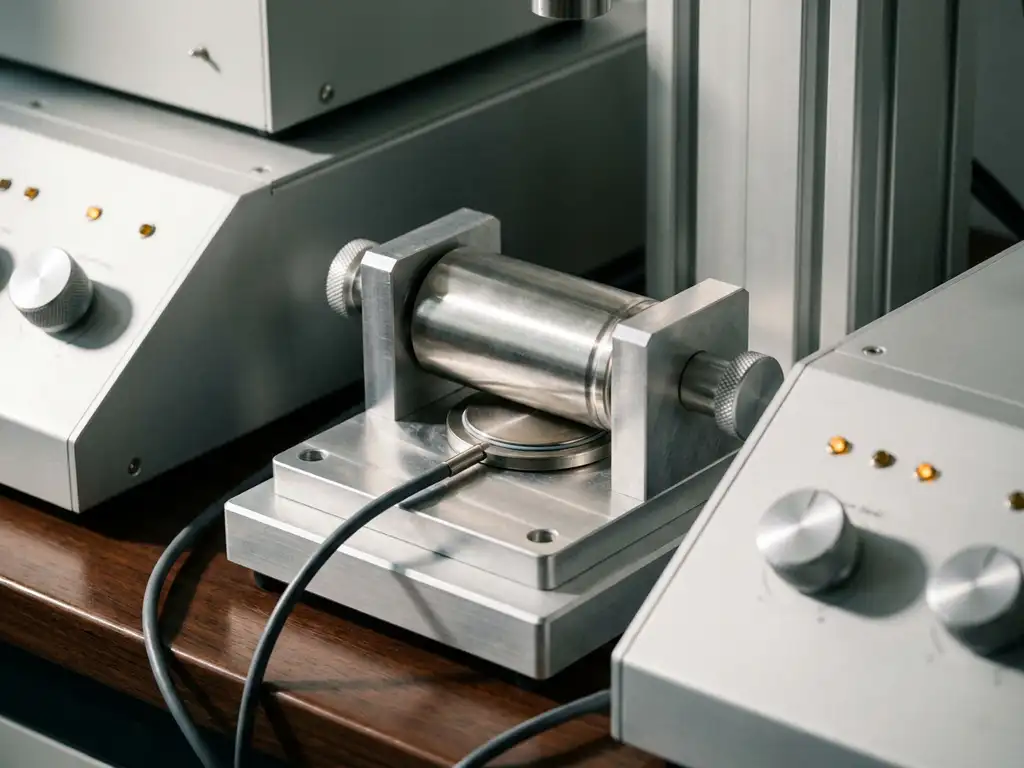
The PAT-Cell-Force is one example of a test cell designed specifically for this purpose, combining electrochemical access with integrated force measurement in a format compatible with standard potentiostat and galvanostat hardware. Unlike conventional test cells, which do not include a force sensor and only allow the initial pressure to be set — leaving any subsequent mechanical settling undetected — the PAT-Cell-Force includes an integrated force sensor that tracks pressure continuously throughout cycling. An optional gas pressure sensor can also be added, making it possible to separate force changes caused by gas evolution from those caused by mechanical settling.
Measurement is typically performed alongside standard galvanostatic cycling, so that force data and electrochemical data share a common time axis. This synchronisation is essential for correlating pressure events with specific electrochemical features such as phase transitions or plateau regions in the voltage profile.
Controlling the initial stack pressure
Before cycling begins, the researcher sets an initial compressive load on the stack. This baseline pressure must be sufficient to ensure good electrode–electrolyte contact but low enough to avoid damaging fragile electrolyte pellets. For sulphide-based electrolytes, typical initial pressures reported in the literature are in the range of tens to a few hundred megapascals, though the appropriate value depends strongly on the specific electrolyte material and electrode geometry.
Interpreting pressure signals across the charge–discharge cycle
Building on the understanding of how pressure is generated and measured, the next step is learning to read the pressure signal and connect its features to specific electrochemical events.
During a standard charge–discharge cycle, the pressure profile is not a simple linear function. It reflects the superposition of multiple physical processes occurring at different rates and at different points in the electrochemical window.
Characteristic features in the pressure trace
Several recognisable features appear consistently in operando pressure data from solid-state cells:
- Monotonic pressure rise during charging: As lithium plates onto or intercalates into the anode, the electrode expands and the stack pressure increases. The rate of pressure rise can indicate the uniformity of lithium deposition.
- Pressure plateaus: A period of roughly constant pressure during charging or discharging often corresponds to a two-phase electrochemical reaction, where the material transforms between two structural phases at a fixed composition.
- Irreversible pressure offset after the first cycle: A permanent shift in the baseline pressure after the initial charge–discharge cycle reflects irreversible structural changes, such as the formation of the Solid Electrolyte Interphase (SEI) layer on the anode or irreversible phase transformations in the cathode material.
- Cycle-to-cycle drift: A gradual upward or downward trend in peak pressure over many cycles is a sensitive indicator of progressive mechanical degradation or electrolyte creep.
A common misconception is that a stable voltage profile implies a stable mechanical state. In practice, cells can show consistent capacity and voltage behaviour while accumulating significant mechanical stress internally. Pressure monitoring reveals this hidden degradation before it manifests in the electrochemical data.
Translating operando pressure data into research outcomes
The practical value of in-operando pressure data lies in its ability to inform decisions about material selection, stack engineering, and operating conditions — areas that are central to advancing solid-state battery science.
Researchers use pressure data to address several concrete questions:
- Material comparison: Two cathode materials with similar specific capacity (mAh/g) may behave very differently under mechanical constraints. Comparing their pressure profiles under identical cycling conditions reveals which material imposes lower mechanical demands on the electrolyte.
- Electrolyte tolerance: By cycling cells at different initial stack pressures and monitoring how the pressure evolves, researchers can identify the operating window within which a given electrolyte remains mechanically stable.
- Failure mode identification: A sudden, sharp pressure drop during cycling often indicates electrolyte fracture or delamination. Identifying the cycle number and state of charge at which this occurs helps isolate the conditions that trigger mechanical failure.
- Stack design optimisation: Varying electrode thickness, active material loading, or binder composition while monitoring the resulting pressure profiles allows systematic optimisation of the physical stack without relying solely on post-mortem cross-sectional analysis.
When pressure data is collected alongside electrochemical impedance spectroscopy (EIS), the combination is particularly powerful. Changes in interfacial resistance measured by EIS can be directly correlated with pressure events, allowing researchers to determine whether an impedance increase originates from contact loss, electrolyte degradation, or SEI growth.
The field of solid-state battery testing is increasingly moving towards multi-modal operando measurements, where pressure, impedance, and sometimes optical or diffraction data are collected simultaneously on a single cell. In-operando pressure monitoring is a foundational element of this approach, providing the mechanical context that makes other operando signals interpretable.
How EL-Cell GmbH supports in-operando pressure and solid-state battery testing
EL-Cell GmbH designs test cells and instrumentation specifically for the kind of mechanically demanding, multi-modal experiments described in this article. A key advantage of the EL-CELL approach is the reliability it brings to cell assembly. Conventional test cell designs have a high assembly failure rate — studies cite a figure of 43%, and even experienced builders typically achieve only four working cells out of every five attempted, while inexperienced assemblers fall below 50%. The PAT-Cell-Force and PAT-Cell-Solid standardize and simplify preparation to the point where nearly every cell runs without failure.
Both cells use the PAT-Solid-Core insert, which features guided plane-parallel tungsten carbide plungers and a dedicated pressing tool. This design ensures homogeneous compression of the electrode material — something conventional cells cannot reliably achieve, as their plunger geometry tends to compress material inhomogeneously. The tungsten carbide plungers are also highly resistant to mechanical degradation: conventional plungers embed particles during use and must be ground or polished between measurements, gradually altering the cell geometry, whereas the tungsten carbide plungers used here withstand high mechanical loads without this degradation.
EL-CELL cells also differ from conventional designs in their sealing and housing materials. Conventional cells are typically sealed with O-rings and use PEEK housings, which absorb significant moisture and require drying at 120°C under vacuum. EL-CELL cells use aluminum seals and glass-metal feedthroughs instead of O-rings, and PPS plastic instead of PEEK. Because PPS absorbs far less moisture than PEEK, contamination risk and preparation time are both reduced.
Our product range addresses the core requirements of operando pressure measurement in solid-state battery research:
- The PAT-Cell-Force provides integrated force measurement within a standard PAT-Series cell format, enabling simultaneous electrochemical cycling and continuous pressure monitoring under defined stack conditions.
- The PAT-Cell-Solid is designed for solid-state electrolyte testing, with a cell geometry suited to compressed pellet assemblies and compatibility with the full PAT-Series ecosystem.
- The PAT-Tester-i-16 multichannel battery tester supports EIS, galvanostatic cycling, and potentiostatic measurements across up to 16 channels, allowing parallel experiments at different stack pressures or with different electrolyte materials.
- All hardware is compatible with EL-Software for synchronised data acquisition, so pressure and electrochemical signals share a common time base for straightforward correlation analysis.
If you are setting up an operando pressure measurement workflow for solid-state battery research, contact us to discuss which cell format and instrumentation configuration best suits your experimental requirements.
Comments are closed.