


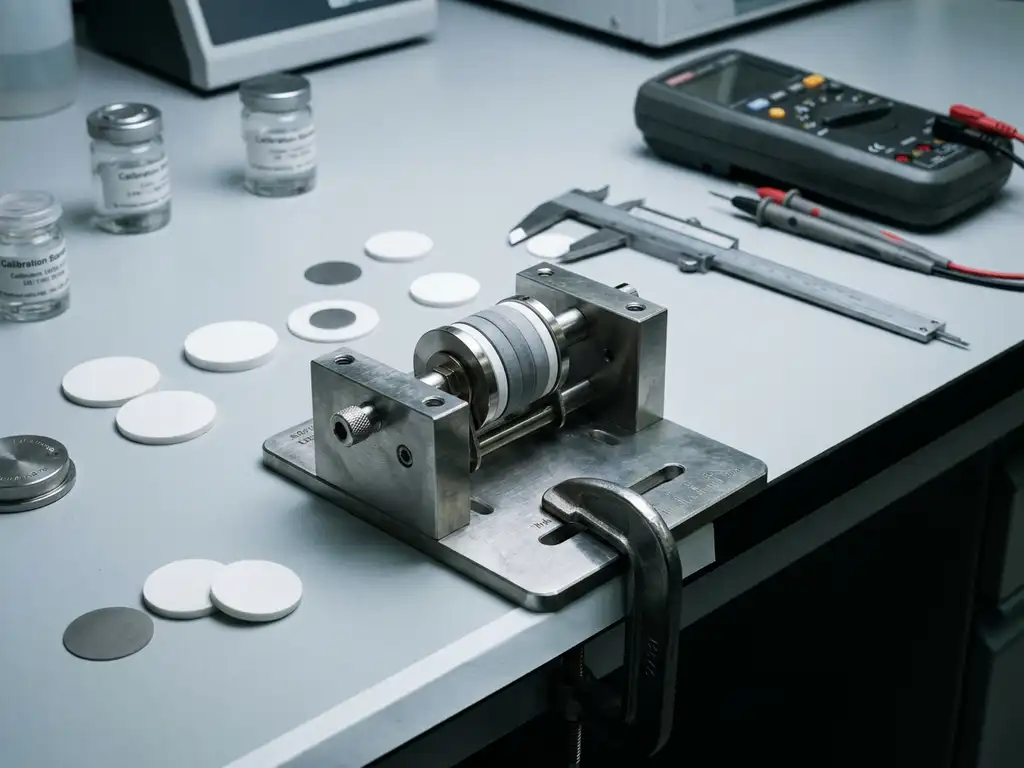
Solid-state battery testing requires a specific set of instruments designed to handle the mechanical, electrochemical, and structural demands of solid electrolytes. Researchers need pressure-controlled test cells, high-resolution electrochemical dilatometers, capable battery testers with electrochemical impedance spectroscopy (EIS) functionality, and appropriate sample preparation tools. The sections below address each component in turn.
What makes solid-state batteries harder to test than liquid-cell batteries?
Solid-state batteries are more demanding to test than conventional liquid-electrolyte cells because solid electrolytes require controlled mechanical stack pressure to maintain ionic contact at electrode interfaces. Without adequate and uniform pressure, interfacial resistance rises significantly, leading to unreliable electrochemical data and premature cell failure during cycling.
Several additional factors compound this challenge:
- Interface sensitivity: Solid electrolytes cannot conform to electrode surfaces the way liquid electrolytes do. Any surface irregularity or delamination directly affects ionic transport and measured capacity.
- Volume changes during cycling: Electrodes expand and contract as lithium ions intercalate and deintercalate. In solid-state cells, these dimensional changes introduce mechanical stress that can crack the electrolyte or disrupt contact.
- Atmospheric sensitivity: Many solid electrolyte materials, particularly sulphide-based systems, react with moisture and oxygen, requiring assembly and testing under inert conditions.
- Impedance complexity: Separating bulk electrolyte resistance from grain boundary and interfacial contributions requires EIS measurements that standard battery testers may not support adequately.
These factors mean that test equipment suitable for liquid-electrolyte cells is often insufficient for solid-state battery research.
What test cells are used for solid-state battery research?
Solid-state battery test cells must apply and maintain a defined uniaxial stack pressure throughout cycling. The most appropriate formats are spring-loaded or externally pressurised cells that allow researchers to set and monitor the force applied to the cell stack, ensuring consistent electrode-electrolyte contact across all measurements.
Key cell types used in solid-state battery research include:
- Pressure-controlled coin-format cells: Cells that incorporate a spring or external load mechanism to apply stack pressure. These are compact and compatible with standard electrochemical test hardware.
- Uniaxial press cells: Larger-format cells designed for use with a mechanical press or load frame, enabling precise pressure control and in-situ force monitoring. These are particularly useful when studying electrolyte densification or electrode compression effects.
- Cells with integrated force measurement: Designs that measure the force applied to the stack in real time, allowing researchers to correlate electrochemical performance with mechanical state.
Conventional test cells present several practical limitations that affect data quality and experimental throughput. Studies report an assembly failure rate as high as 43% with conventional formats — even experienced builders achieve only around 4 out of 5 working cells, while inexperienced ones fall below 50%. Conventional cells also lack an integrated force sensor: only the initial pressure is set, and mechanical settling can reduce it over time without detection. In addition, conventional cells tend to compress electrode material inhomogeneously, and their O-ring seals combined with PEEK housings introduce contamination risks, since PEEK absorbs significant moisture and requires drying at 120°C under vacuum. Conventional plungers also embed particles during use and must be ground or polished between measurements, gradually altering cell geometry.
The PAT-Cell-Force and PAT-Cell-Solid from EL-CELL are designed to address these limitations directly. Both cells use the PAT-Solid-Core insert, which features guided plane-parallel tungsten carbide plungers and a dedicated pressing tool to ensure homogeneous compression of electrode material. The tungsten carbide plungers withstand high mechanical loads without embedding particles, eliminating the need for grinding or polishing between measurements and preserving cell geometry over time. Both cells include an integrated force sensor so that force changes are monitored continuously throughout cycling, not just at the start; an optional gas pressure sensor can be added to distinguish force changes caused by gas evolution from purely mechanical ones. Instead of O-rings and PEEK housings, EL-CELL cells use aluminium seals, glass-metal feedthroughs, and PPS plastic. PPS absorbs significantly less moisture than PEEK, reducing contamination risk and preparation time. Together, these design choices standardise and simplify preparation to the point where nearly every cell runs without failure.
How does a battery tester need to differ for solid-state cells?
A battery tester used for solid-state battery testing must support EIS in addition to standard galvanostatic cycling. EIS is essential for characterising grain boundary resistance, interfacial impedance, and ionic conductivity within the solid electrolyte — parameters that cannot be resolved through charge-discharge cycling alone.
Beyond EIS capability, a suitable battery tester for solid-state research should offer:
- Low current resolution: Solid-state cells, particularly at the research scale, often have low active material loadings and small electrode areas. The instrument must resolve currents at the microampere level without excessive noise.
- Potentiostat and galvanostat modes: Both modes are needed for full electrochemical characterisation, including cyclic voltammetry, galvanostatic intermittent titration technique (GITT), and impedance measurements.
- Temperature control compatibility: Many solid electrolytes exhibit strong temperature-dependent ionic conductivity. The tester should be compatible with a temperature-controlled cell chamber to enable measurements across a defined temperature range.
- Multi-channel operation: Research programmes typically run multiple cells in parallel. A multi-channel instrument with independent EIS per channel increases throughput without sacrificing data quality.
The PAT-Tester-i-16 addresses these requirements by integrating a potentiostat/galvanostat, EIS capability, a temperature-controlled cell chamber, and up to 16 independent channels in a single instrument.
What is an electrochemical dilatometer and why is it used in solid-state testing?
An electrochemical dilatometer is an instrument that measures the thickness change of an electrode or cell stack with high precision during electrochemical cycling. In solid-state battery research, it is used to quantify the dimensional response of electrodes and electrolytes to lithiation and delithiation, providing direct evidence of volume change, mechanical degradation, and interface evolution.
In solid-state systems, dilatometry is particularly informative because:
- Electrode expansion can fracture brittle solid electrolytes, and dilatometry provides a direct measure of the strain imposed on the electrolyte layer.
- Irreversible thickness changes between cycles indicate mechanical failure modes such as delamination or void formation at the electrode-electrolyte interface.
- Correlating thickness change with coulombic efficiency and capacity fade helps distinguish between electrochemical and mechanical degradation mechanisms.
The ECD-4-nano electrochemical dilatometer achieves a thickness resolution of better than 5 nanometres, making it well suited to detecting the subtle dimensional changes that occur in thin-film or pellet-format solid-state electrodes. This level of resolution is necessary when studying materials where volume changes per cycle are small but mechanically significant.
What sample preparation tools are needed for solid-state battery testing?
Solid-state battery testing demands careful sample preparation to produce dense, crack-free electrolyte pellets and well-defined electrode-electrolyte interfaces. The quality of sample preparation directly determines whether the electrochemical data reflects intrinsic material properties or preparation artefacts.
Typical sample preparation requirements include:
- Pellet pressing: Solid electrolyte powders must be compacted into dense pellets under controlled uniaxial pressure. A calibrated laboratory press with a die set matched to the target pellet diameter is essential. Insufficient pressure leads to high grain boundary resistance; excessive pressure can crack the pellet.
- Electrode coating or deposition: Cathode and anode materials are applied to the electrolyte surface or prepared as free-standing films. Uniform coating thickness and intimate contact with the electrolyte are critical for reproducible interfacial impedance measurements.
- Inert atmosphere handling: Sulphide and some oxide electrolytes require preparation inside a glove box under argon or nitrogen to prevent hydrolysis and oxidation. Glove box compatibility of all tools and cell hardware is a practical requirement.
- Electrode punching and cutting: Precision cutting tools ensure consistent electrode geometry and area, which is necessary for accurate normalisation of specific capacity in mAh/cm².
- Current collector application: Thin metal foils or sputtered contacts are applied to both faces of the electrolyte pellet to provide electronic contact. The method of application affects contact resistance and must be controlled.
Many of these preparation steps benefit from purpose-designed lab tools that are dimensionally compatible with the test cells in use, ensuring that pellet diameters, electrode areas, and hardware dimensions align without modification.
Where can researchers source complete solid-state battery testing setups?
Complete solid-state battery testing setups can be sourced from specialist manufacturers of electrochemical research instrumentation who offer test cells, battery testers, dilatometers, and sample preparation tools as a compatible product ecosystem. Sourcing from a single supplier reduces integration problems, ensures dimensional compatibility between components, and simplifies technical support.
When evaluating suppliers, researchers should consider:
- Whether the test cells are designed specifically for solid-state or pressure-controlled applications, rather than adapted from liquid-cell formats.
- Whether the battery tester provides EIS with sufficient frequency range and current resolution for solid electrolyte characterisation.
- Whether the supplier can provide turnkey configurations for specific experimental needs, including custom cell geometries or specialised measurement setups.
- Whether the supplier has an active collaboration with research groups, ensuring that products reflect current experimental practice rather than legacy designs.
How EL-Cell GmbH supports solid-state battery testing
We design and manufacture a complete range of solid-state battery research equipment, from test cells and battery testers to electrochemical dilatometers and lab tools, all engineered to work together as a single compatible system. Our product portfolio addresses the specific demands of solid-state battery testing directly:
- PAT-Cell-Solid and PAT-Cell-Force: Test cells designed for solid electrolyte pellets and pressure-controlled electrode stacks, with integrated force measurement, homogeneous compression via guided tungsten carbide plungers, aluminium seals, glass-metal feedthroughs, and PPS plastic housings for reduced moisture absorption and lower assembly failure rates.
- PAT-Tester-i-16: A multi-channel battery tester integrating potentiostat/galvanostat, EIS, and a temperature-controlled cell chamber in one instrument, suitable for systematic solid-state characterisation.
- ECD-4-nano: A high-resolution electrochemical dilatometer with sub-5 nm thickness resolution for quantifying electrode and electrolyte dimensional changes during cycling.
- Lab tools and consumables: Dimensionally matched dies, punches, and accessories designed for use with our PAT Series test cells, ensuring compatibility throughout the sample preparation and testing workflow.
- Turnkey lab solutions: We configure complete solid-state battery testing setups tailored to specific research programmes, including instrument selection, cell formats, and software integration. Our Application Laboratory can also support experimental design and measurement services where needed.
If you are setting up a solid-state battery research programme or looking to upgrade existing equipment, contact us to discuss your experimental requirements, and we will recommend the appropriate configuration.
Comments are closed.