


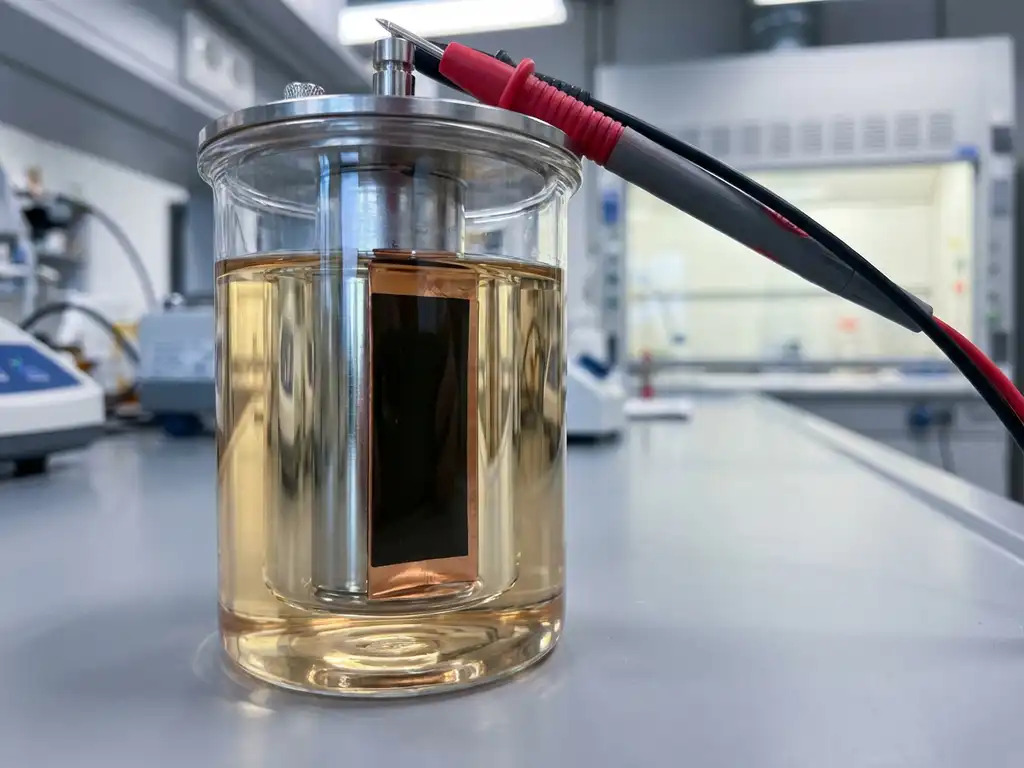
Coulombic efficiency is measured by dividing the charge extracted from a battery electrode during discharge by the charge inserted during the preceding charge step and expressing the result as a percentage. For battery materials researchers, this metric is one of the most sensitive indicators of how efficiently charge is stored and released—and how much active lithium is consumed in irreversible side reactions with each cycle.
Accurate coulombic efficiency measurement requires careful experimental design, a well-controlled electrochemical test cell, and a clear understanding of what the numbers actually represent. This article addresses the key questions researchers encounter when setting up and interpreting coulombic efficiency measurements.
What is coulombic efficiency in a battery electrode?
Coulombic efficiency (CE) is the ratio of discharge capacity to charge capacity in a given cycle, expressed as a percentage. A value of 100% indicates that all charge inserted into an electrode is fully recovered on discharge, with no charge consumed by side reactions. In practice, values below 100% reflect irreversible processes occurring at the electrode–electrolyte interface.
The primary source of coulombic inefficiency in lithium-ion anodes is the formation and ongoing growth of the solid electrolyte interphase (SEI) layer. During the first charge cycle, lithium ions and solvent molecules react at the anode surface to form this passivating film. Although the SEI layer is essential for long-term stability, its formation consumes lithium that is no longer available for charge–discharge cycling. Cathode materials can also exhibit irreversible capacity loss through structural changes or electrolyte oxidation, though the mechanisms differ.
Why does coulombic efficiency matter for battery research?
Coulombic efficiency is a direct measure of lithium inventory loss per cycle. Even small deviations from 100% accumulate over hundreds of cycles, leading to significant capacity fade. For researchers developing new electrode materials, CE values reveal the extent of parasitic reactions and help distinguish between materials that are genuinely promising and those that only appear capable in short-term testing.
In full-cell development, the practical implications are especially significant. A cathode and anode may each perform well in isolation, but if the anode exhibits a low average CE, the limited lithium reservoir in a full cell will be depleted rapidly. Researchers use CE data to assess SEI stability, electrolyte compatibility, and the suitability of new materials for practical application. It is also a standard metric required in peer-reviewed publications, making accurate measurement essential for credible results.
How do you measure coulombic efficiency in a half-cell?
Coulombic efficiency in a half-cell is measured by cycling the working electrode against a lithium metal counter/reference electrode, recording the charge passed during lithiation and delithiation, and calculating the ratio. The measurement is performed galvanostatically at a defined C-rate, with clearly specified voltage cut-off limits that determine the integration window for capacity.
Setting up the measurement correctly
Accurate CE measurement begins with cell assembly. Consistent electrode preparation—including controlled coating thickness, uniform calendering, and precise disc punching—minimises variability between cells. Electrolyte volume, separator type, and stack pressure all influence the result and must be standardised across experiments.
The C-rate selected for cycling affects both the measured capacity and the apparent CE. Slower rates allow more complete lithiation and delithiation, reducing kinetic artefacts. Most researchers report CE at rates between C/10 and C/5 for the formation cycles, before increasing the rate for long-term cycling studies.
Three-electrode configurations for cleaner data
A two-electrode half-cell conflates the potential contributions of both electrodes, making it difficult to isolate the working electrode’s behaviour. A three-electrode configuration, with a separate reference electrode, allows the working electrode potential to be monitored independently. This is particularly valuable when investigating whether capacity loss originates from the working electrode or from degradation of the lithium counter electrode. EL-Cell’s PAT series test cells are specifically designed to support three-electrode measurements, which is one reason they are widely used in rigorous academic research.
What factors affect the accuracy of coulombic efficiency measurements?
Several experimental variables can introduce systematic errors into coulombic efficiency measurements. The most common sources of inaccuracy include moisture contamination, current collector corrosion, parasitic electronic conductivity in the separator, and instrument current resolution at low charge rates.
- Moisture and oxygen contamination: Even trace amounts of water react with lithium and common electrolyte salts such as LiPF6, generating HF and consuming lithium irreversibly. Cell assembly must be performed in a controlled atmosphere, typically a dry room or glove box with low H2O and O2 levels.
- Voltage cut-off precision: Inconsistent cut-off voltages between cycles alter the capacity window and introduce apparent CE variation that does not reflect true electrode behaviour.
- Current leakage: Any parasitic current path—through a poorly sealed cell or a conductive separator—will register as discharged capacity and inflate the apparent CE.
- Instrument resolution: When measuring small electrodes at low C-rates, the current can fall below the reliable measurement range of the potentiostat/galvanostat. Instruments with high current resolution are essential for accurate capacity integration.
- Temperature control: CE is temperature-dependent. Uncontrolled ambient temperature variation between charge and discharge steps introduces noise into the measurement.
What’s the difference between first-cycle and average coulombic efficiency?
First-cycle coulombic efficiency refers specifically to the CE measured during the initial charge–discharge cycle, which is typically the lowest value observed due to SEI layer formation. Average coulombic efficiency refers to the mean CE across a defined number of subsequent cycles, once the SEI has stabilised and irreversible losses have decreased.
The first-cycle efficiency is a material-level property that reflects the intrinsic reactivity of the electrode surface with the electrolyte. Silicon-based anodes, for example, commonly exhibit first-cycle CE values well below those of graphite, due to their high surface area and volume expansion. Researchers report this value separately because it has direct implications for pre-lithiation strategies and full-cell design.
Average CE over cycles 2 to 50, or over a longer formation protocol, is a more practical indicator of long-term performance. A material with a low first-cycle CE but high average CE thereafter may still be viable if pre-lithiation compensates for the initial loss. Conversely, a material with a moderate first-cycle CE but declining average CE signals ongoing parasitic reactions that will limit cycle life.
How can you improve coulombic efficiency in electrode testing?
Improving measured coulombic efficiency in electrode testing requires addressing both material-level factors and experimental conditions. On the experimental side, the most impactful steps are ensuring rigorous cell assembly protocols, using high-purity electrolytes, and maintaining a consistent temperature during cycling.
Experimental controls
- Assemble cells in a controlled atmosphere with verified low moisture levels.
- Use electrolyte from sealed, freshly opened vials and avoid repeated exposure to ambient air.
- Standardise electrode mass loading and geometric area to ensure capacity values in mAh/cm² or mAh/g are directly comparable between cells.
- Apply a defined formation protocol—typically several slow cycles—before reporting steady-state CE values.
- Use temperature-controlled cell holders to eliminate thermal variation as a source of noise.
Material and electrolyte strategies
On the materials side, surface coatings, electrolyte additives, and pre-lithiation are established approaches for improving first-cycle CE and stabilising the SEI. Additives such as vinylene carbonate (VC) or fluoroethylene carbonate (FEC) promote the formation of a more compact and stable SEI layer, reducing ongoing lithium consumption in subsequent cycles. Researchers evaluating these strategies require reproducible test conditions to distinguish material effects from experimental artefacts.
How EL-Cell GmbH supports coulombic efficiency research
Accurate coulombic efficiency measurement depends on hardware that minimises variability and artefacts. EL-Cell GmbH designs and manufactures electrochemical test cells and instruments specifically for this type of rigorous battery materials research. Our products address the key experimental requirements discussed in this article:
- The PAT-Cell supports three-electrode configurations, enabling clean separation of working and counter electrode contributions to measured capacity.
- The PAT-Tester-i-16 integrates a temperature-controlled cell chamber, a multi-channel galvanostat/potentiostat, and electrochemical impedance spectroscopy (EIS) capability—providing the controlled environment and instrument resolution required for accurate CE measurements across up to 16 channels simultaneously.
- Our standardised cell hardware and consumables reduce assembly variability, which is one of the most common sources of inconsistency in half-cell testing.
If you are setting up a coulombic efficiency measurement protocol or evaluating new electrode materials and want to discuss which configuration best fits your research needs, contact the EL-Cell team directly.
Comments are closed.